JWST uncovers sunrise‑sunset split in ultra‑hot exoplanet WASP‑121b’s atmosphere
James Webb Telescope reveals a far‑off exoplanet with surprising atmospheric dynamics that defy current scientific predictions.

Observations with the James Webb Space Telescope (JWST) have revealed that the twilight zone of the ultra‑hot world WASP‑121 b behaves differently at sunrise compared with sunset. The planet’s atmospheric edge does not merely switch from day to night; the narrow terminator itself shows distinct characteristics depending on whether it is being illuminated for the first time or entering darkness.
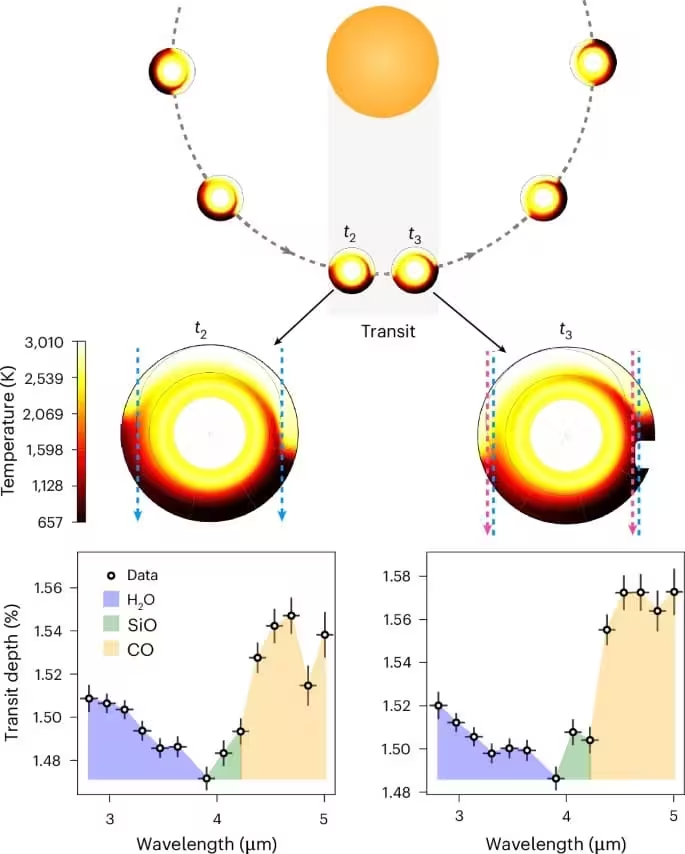
The discovery stems from a series of transit measurements, in which astronomers examined the starlight filtered through the planet’s gaseous envelope as it passed in front of its star. According to a paper in Nature Astronomy, this technique now enables scientists to dissect the limb of an exoplanet into separate sectors rather than treating it as a single, blended region.
WASP‑121 b is a giant planet that orbits extremely close to its host star, resulting in one side being perpetually scorched while the opposite side remains shrouded in darkness. This configuration generates fierce temperature gradients and powerful winds that dictate how heat and chemical species are redistributed around the planet.
Morning‑Evening Asymmetry Detected in the Terminator
By employing JWST’s NIRSpec instrument, the team monitored variations in infrared flux throughout the transit. The study, also published in Nature Astronomy, shows that the dusk side of the limb absorbs more stellar photons than the dawn side, implying that the two halves are not physically identical.
During the roughly 30‑degree rotation that occurs over the transit, the leading edge (the morning side) and the trailing edge (the evening side) can be distinguished. The latter consistently displays deeper absorption, which the researchers interpret as evidence for higher temperatures or a more extended atmospheric column. Lead author Cyril Gapp of the Max Planck Institute for Astronomy explained:
“With its unprecedented observational quality, JWST gives us the most detailed glimpses into distant planets to date. By measuring how star light absorption changes as WASP‑121 b rotates, we probe its atmosphere longitude by longitude.”

The authors attribute the observed asymmetry to the planet’s supersonic wind system, which ferries heat from the blistering dayside toward the night side. This flow can shift the hottest region eastward, aligning it with the evening terminator and accounting for the stronger absorption seen there.
Molecular Signatures Vary Across the Limb
The data also reveal that individual gases behave differently. Emission from carbon monoxide (CO) intensifies toward the later phases of the transit. The team cautions that this does not necessarily imply a higher CO abundance; rather, temperature‑dependent changes in the molecule’s infrared opacity likely modulate the observed signal.
In contrast, water vapor displays a distinct trend. The measurements suggest a genuine depletion of H₂O in portions of the upper atmosphere. At the extreme temperatures of WASP‑121 b, water can thermally dissociate into hydrogen and oxygen, reshaping the chemical makeup of the envelope.
Temperature extremes on the planet are stark: the dayside reaches roughly 2770 K (about 2500 °C), while the night side cools to near 1000 K (about 725 °C). Co‑author Tom Evans‑Soma of the University of Newcastle noted:
“WASP‑121 b is particularly extreme, with average temperatures on the dayside hemisphere being around 2770 Kelvin, while those on the nightside are closer to about 1000 Kelvin.” This difference drives strong global winds that redistribute heat across the planet.
Challenges in Modelling Clouds and Atmospheric Dynamics
When the JWST observations are compared with existing atmospheric simulations, the overall trend is reproduced, yet the models fall short of matching the full magnitude of the morning‑evening contrast. The actual limb appears more disparate than the current theoretical frameworks predict.
One plausible factor is the presence of high‑temperature mineral clouds, likely composed of silicate particles. Such clouds could form preferentially on the cooler dawn side, obscuring deeper, hotter layers and making that region appear less luminous in the infrared.
Incorporating simplified cloud physics into the models brings the simulated spectra closer to the JWST measurements, but uncertainties about cloud nucleation, growth, and dispersal under these extreme conditions mean that a complete explanation remains elusive.
This article has been fact checked for accuracy, with information verified against reputable sources. Learn more about us and our editorial process.
Last reviewed on .
Article history
- Latest version
Reference(s)
- “JWST Near Infrared Spectrograph - JWST User Documentation.”, June 11, 2026 <https://jwst-docs.stsci.edu/jwst-near-infrared-spectrograph>.
- Gapp, Cyril. “Atmospheric asymmetries in WASP-121 b revealed by rotational transits detected with JWST - Nature Astronomy.”, June 10, 2026, pp. 1-11. Nature, doi: 10.1038/s41550-026-02887-6. <https://www.nature.com/articles/s41550-026-02887-6>.
- “Cyril Gapp | Max Planck Institute for Astronomy.” <https://www.mpia.de/person/124742/5092118>.
- <https://www.newcastle.edu.au/profile/tom-evans-soma>.
Cite this page:
- Posted by Aisha Ahmed