Dual‑Layered Black Hole Wind Blasts Out at 30% Light Speed, Shaping Galaxies at Cosmic Noon
Astronomers spot ultra‑fast, layered winds from a supermassive black hole 2 billion years after the Big Bang, one of the most powerful outflows yet.
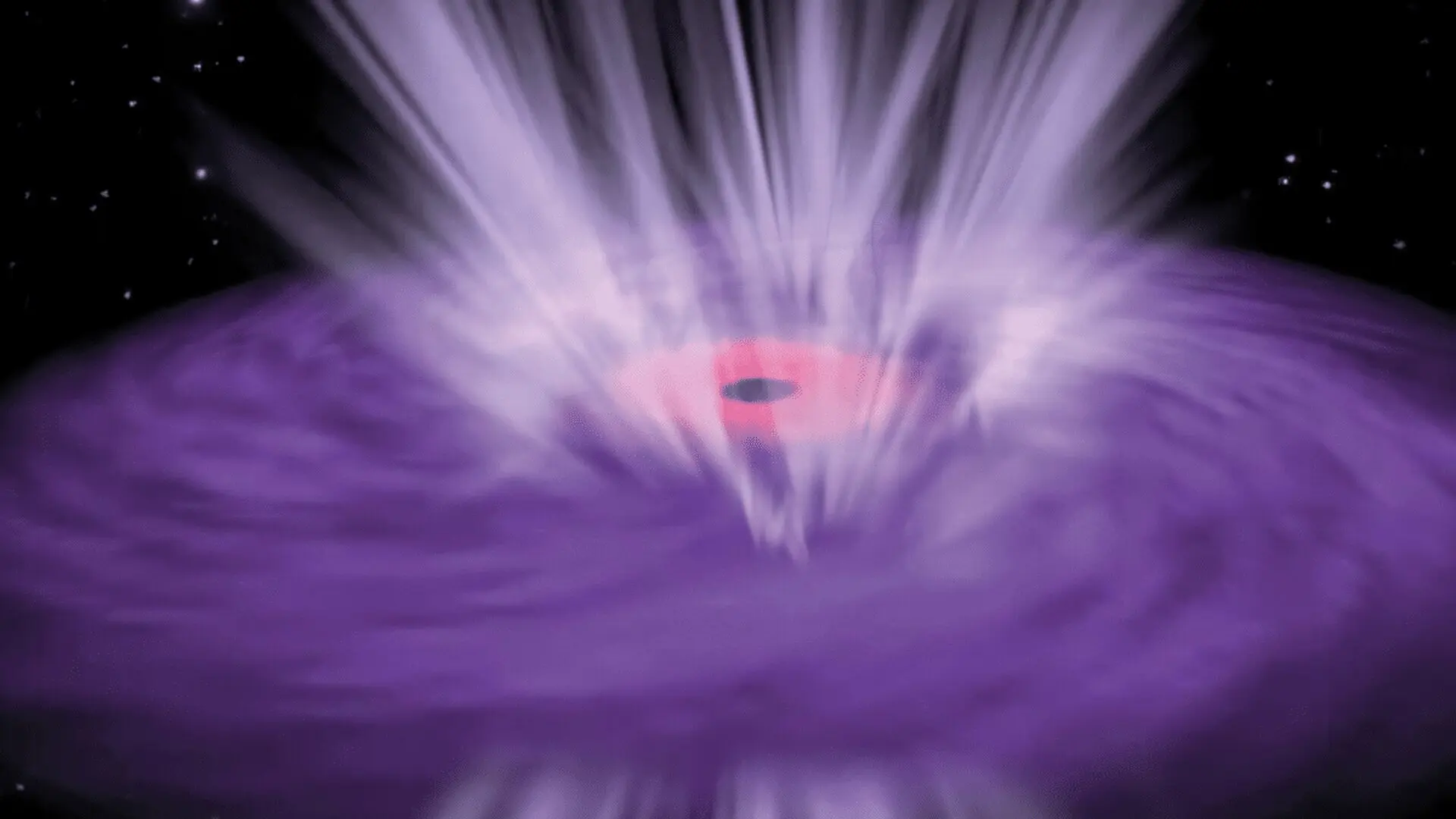
A team of astronomers has identified one of the most energetic ultra‑fast outflows ever recorded from a supermassive black hole, uncovering a two‑tiered wind that races through space at a sizable fraction of light speed. The finding, based on deep X‑ray observations of a hyper‑luminous quasar during the universe’s peak growth era, was recently posted to the arXiv preprint server. Such winds offer a rare window into the mechanisms by which black holes modulate the evolution of their host galaxies at their most active phases.
Rapid Black Hole Winds and Their Galactic Impact
Black holes that accrete large quantities of material do more than simply ingest their surroundings; they actively reshape them. Known as ultra‑fast outflows (UFOs), these streams of ionised gas are propelled at speeds exceeding 10 % of the speed of light, injecting vast amounts of energy into the interstellar medium. The resulting heating can suppress star formation and, in extreme cases, halt the growth of entire galaxies. This phenomenon is especially relevant during “cosmic noon,” roughly 1.6 to 3.5 billion years after the Big Bang, when both galaxies and their central black holes were expanding at their fastest rates.
UFOs reveal themselves in X‑ray spectra through blueshifted absorption signatures of highly ionised iron. Historically, many high‑redshift detections relied on gravitational lensing, where foreground galaxies amplify the quasar’s light. While lensing can aid discovery, it also introduces uncertainties that complicate precise measurements of wind properties.
Breakthrough Detection of a Two‑Layered Quasar Outflow
The WISSHFUL survey, directed by Giorgio Lanzuisi of INAF Bologna, set out to examine 15 hyper‑luminous quasars without the aid of lensing. Its inaugural target, WISSH13, lies at a redshift of 3.294 and hosts a black hole of roughly two billion solar masses, radiating at three times the luminosity expected for its mass. By merging fresh XMM‑Newton and NuSTAR data from October 2024 with archival observations from 2017, the researchers assembled a high‑resolution X‑ray spectrum that displayed two separate absorption troughs.
Spectral modelling linked these features to distinct components of the same outflow, travelling at about 10 % and 30 % of light speed, respectively.
“The detection of two distinct velocity components (∼0.1c and ∼0.3c) with different variability patterns suggests a complex, stratified outflow,” the team writes.
The structure matches theoretical expectations of a fast “spine” emerging from the innermost accretion disk, encased by a slower “sheath” originating farther out. Together, the winds expel roughly 21 and 24 solar masses each year, placing them among the most massive and energetic UFOs documented to date.
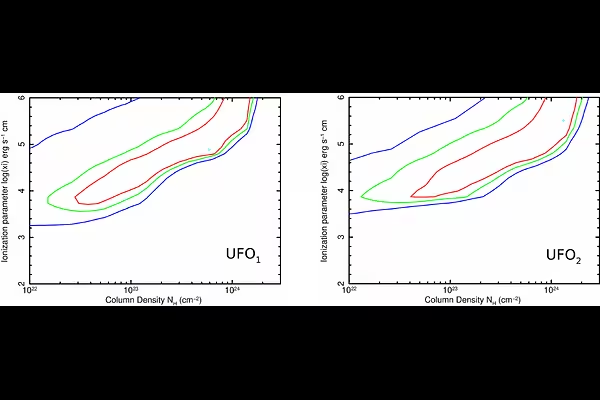
Credit: arXiv
Consequences for Galaxy Evolution
The sheer kinetic power of these winds is more than a spectacular curiosity; it directly influences the evolutionary trajectory of their host galaxies. By depositing energy into surrounding gas, the outflows can regulate both black‑hole accretion and star‑forming activity. Remarkably, despite WISSH13’s considerable distance, the observed wind adheres to the same scaling relations seen in nearer active galaxies, echoing findings reported in a recent arXiv study. This consistency implies that comparable physical processes have been at work throughout cosmic time, offering a valuable glimpse into the life cycles of galaxies across the universe.
This article has been fact checked for accuracy, with information verified against reputable sources. Learn more about us and our editorial process.
Last reviewed on .
Article history
- Latest version
Reference(s)
- Lanzuisi, G.. “The WISSHFUL program: the highest redshift UFO discovered in a non-lensed QSO.” arXiv.org <https://arxiv.org/abs/2606.05312v1>.
Cite this page:
- Posted by Aisha Ahmed