Hubble’s Stunning Image of MACS0329‑0211 Shows Cosmic Lens Magnifying the Distant Universe
Hubble’s new image of galaxy cluster MACS0329-0211 showcases a gravitational lens magnifying ancient, distant galaxies.
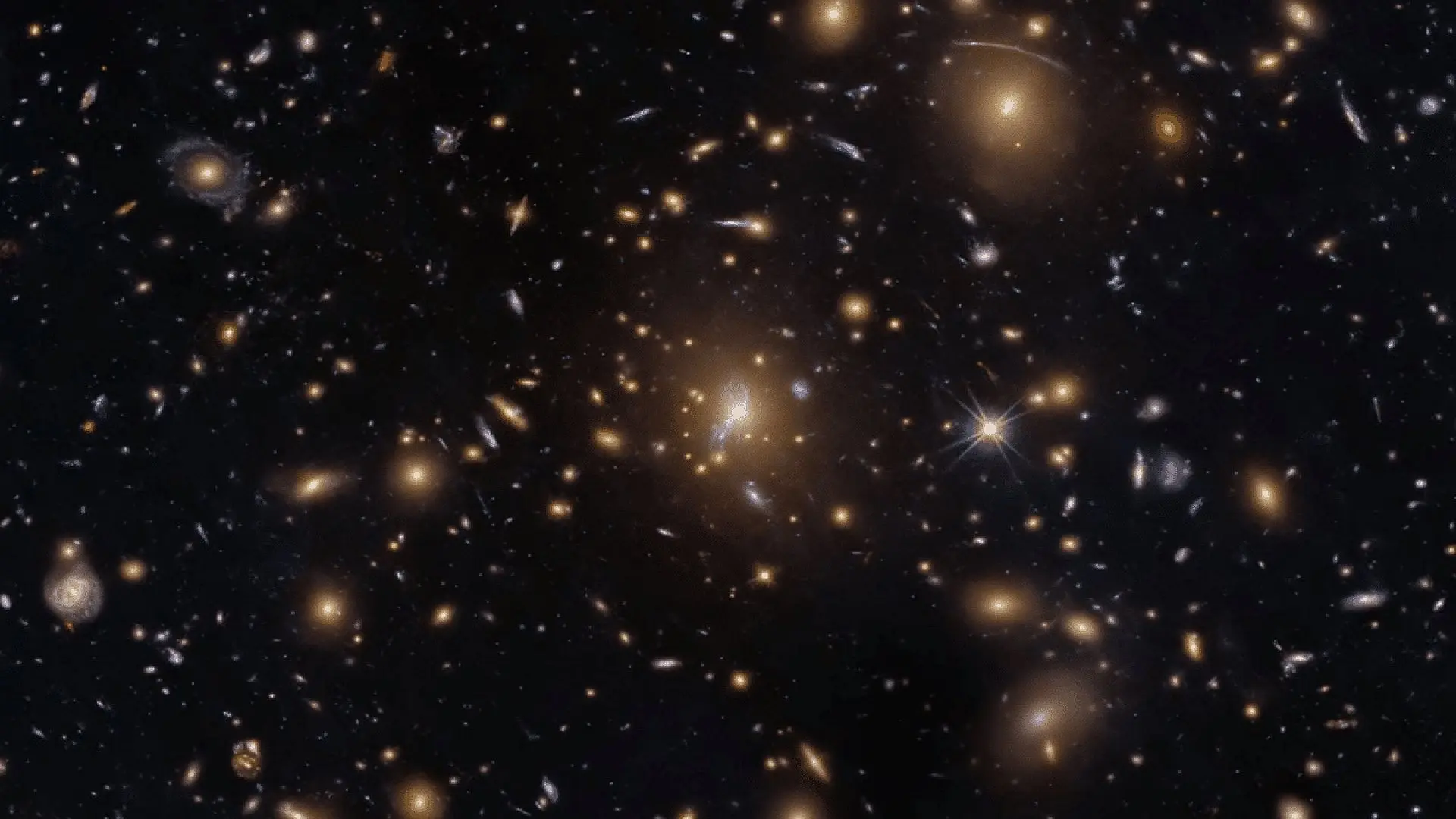
A fresh picture taken by NASA’s Hubble Space Telescope showcases the colossal galaxy cluster MACS0329-0211, whose powerful gravity enables researchers to look farther into the cosmos than would be feasible without its aid. Beyond its visual grandeur, the cluster acts as a natural lens, warping and amplifying light from galaxies billions of light‑years behind it.
An Intricate Tapestry of Galaxies Within the Cluster
Cosmic Magnification: The Lens Effect in Action
The most scientifically intriguing elements are faint, curved streaks that trace the perimeter of the cluster. These arcs result from gravitational lensing, a process where a massive foreground object deflects the trajectory of background light. In the upper‑right quadrant, several background galaxies are stretched into elongated arcs, offering astronomers a window onto objects that would otherwise be too dim to detect. Near the core, a bright set of intersecting curves resembles a twisted figure‑eight, likely representing another distant galaxy whose image has been dramatically distorted by the cluster’s gravity. Such features convert a striking photograph into a valuable research tool.
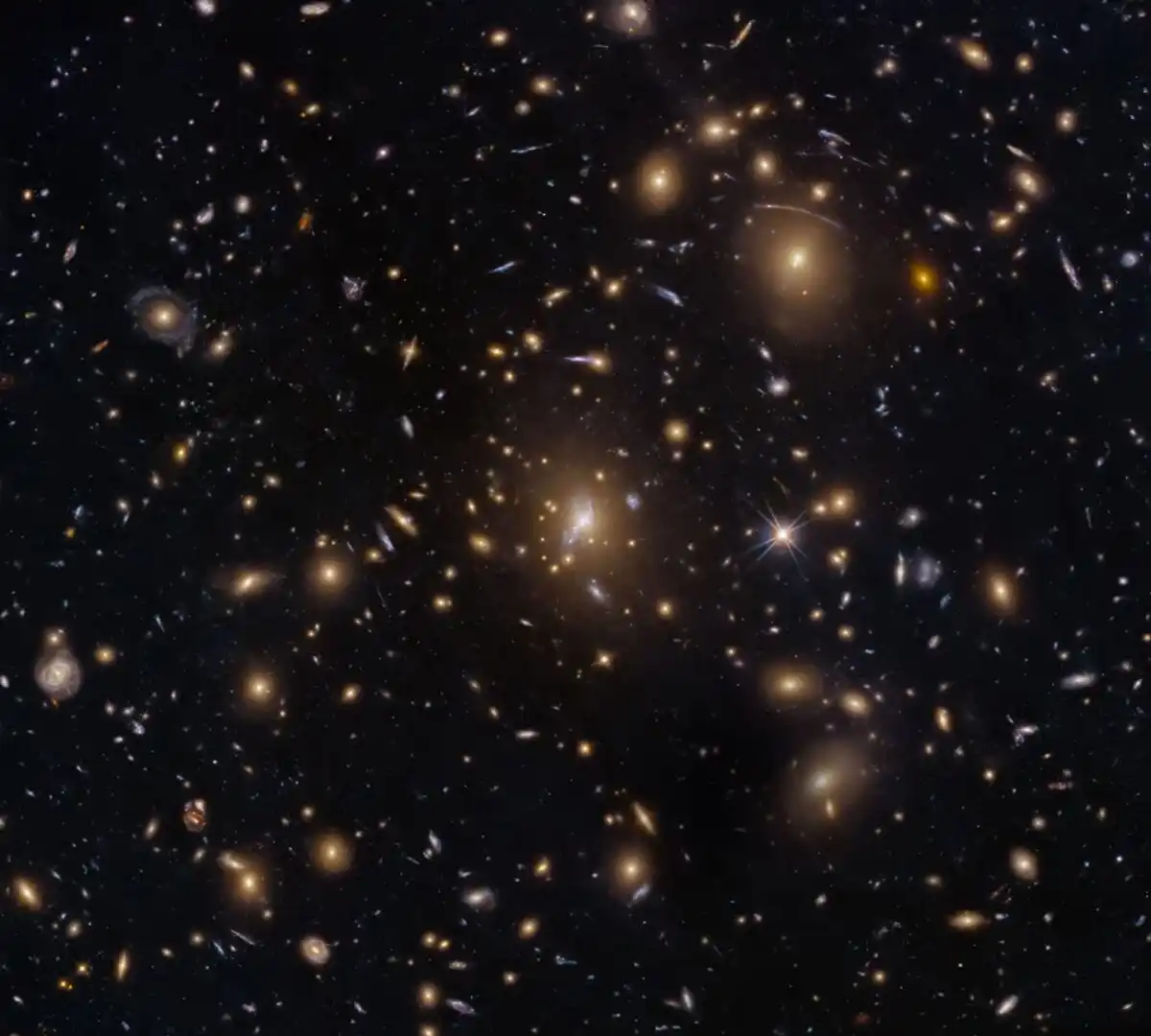
Credit: NASA, ESA, M. Postman (STScI); Image Processing: G. Kober (NASA/Catholic University of America)
Capturing the Cluster with Hubble’s Dual Cameras
NASA notes that the observation formed part of a program targeting X‑ray‑bright galaxy clusters. The data were gathered using Hubble’s Advanced Camera for Surveys together with the Wide Field Camera 3, covering both visible and infrared wavelengths. Visible light captures the morphology of the galaxies, while infrared penetrates dust and picks up more distant sources whose spectra have been redshifted by cosmic expansion. By merging these datasets, scientists can map the cluster’s mass distribution, probe dark‑matter concentrations, and refine models of cosmic evolution.
The resulting image provides both a visual feast and a laboratory for testing theories about the universe’s large‑scale structure.
This article has been fact checked for accuracy, with information verified against reputable sources. Learn more about us and our editorial process.
Last reviewed on .
Article history
- Latest version
Cite this page:
- Posted by Aisha Ahmed