Big Ring Of Galaxies Spans 1.3 Billion Light Years And Defies Standard Cosmology
A mysterious cosmic ring, visible in large‑scale maps of the deep universe, puzzles astronomers as its origin remains unknown.
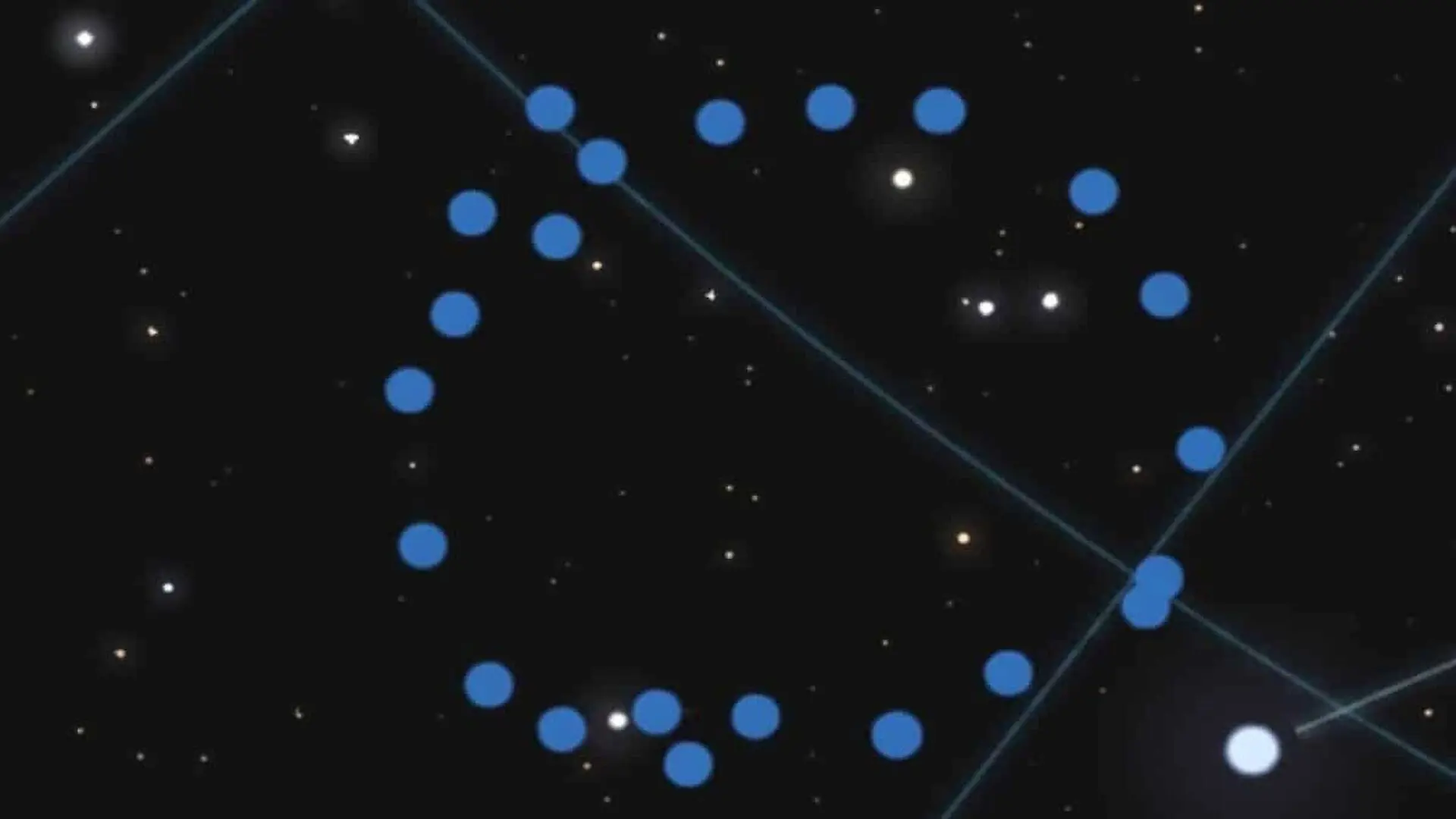
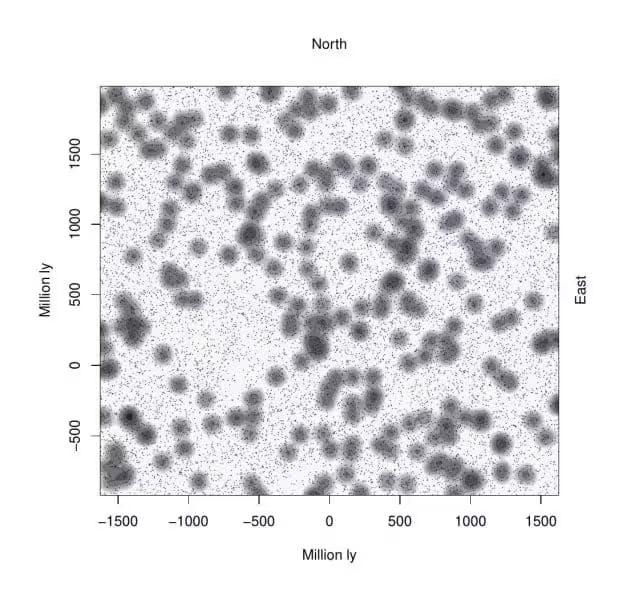
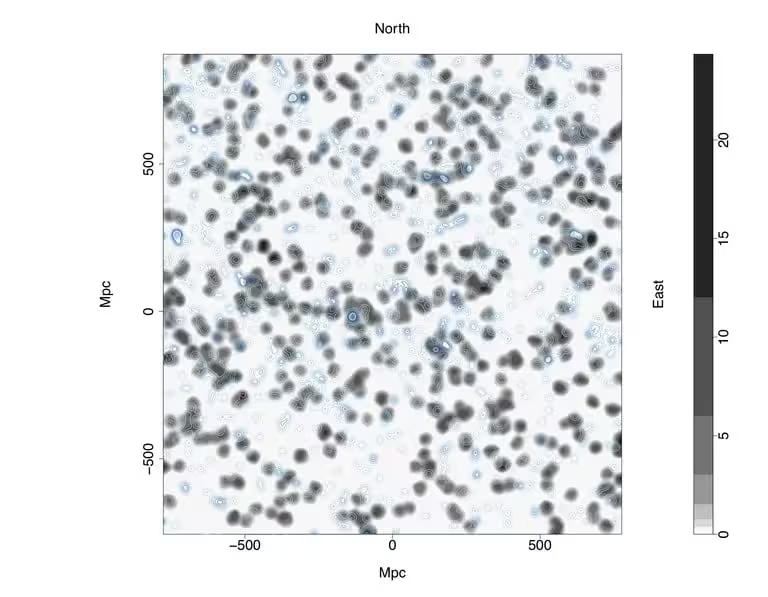
Astronomers have uncovered a colossal arrangement of galaxies dubbed the Big Ring, extending roughly 1.3 billion light‑years across a distant sector of the universe. The feature, mapped by a team led by Alexia Lopez of the University of Central Lancashire, occupies the same celestial region as the previously reported Giant Arc, and both structures appear at comparable distances, deepening the puzzle of large‑scale matter distribution.
The light that reveals this arrangement began its journey about 6.9 billion years ago, placing the observation firmly in an ancient epoch of cosmic history. At such vast scales, the universe is expected to look statistically uniform, without sharply defined patterns that extend over extreme distances.
This expectation stems from the cosmological principle, which asserts that the universe should appear alike in every direction when examined on sufficiently large scales. When structures emerge that surpass the predicted homogeneity threshold, researchers must revisit both the observational data and the theoretical frameworks that describe the cosmos.
A Massive Ring Defies Conventional Categorization
The discovery of the Big Ring emerged from an extensive galaxy‑mapping campaign coordinated by Alexia Lopez. Findings were first shared at the 243rd meeting of the American Astronomical Society and later appeared in the Journal of Cosmology and Astroparticle Physics.
In three‑dimensional reconstructions of the surveyed sky, the formation manifests as a near‑circular alignment of galaxies spanning about 1.3 billion light‑years. Lopez characterized the observation as difficult to reconcile with existing models, noting in a university statement that:
“Neither of these two ultra‑large structures is easy to explain in our current understanding of the universe.”
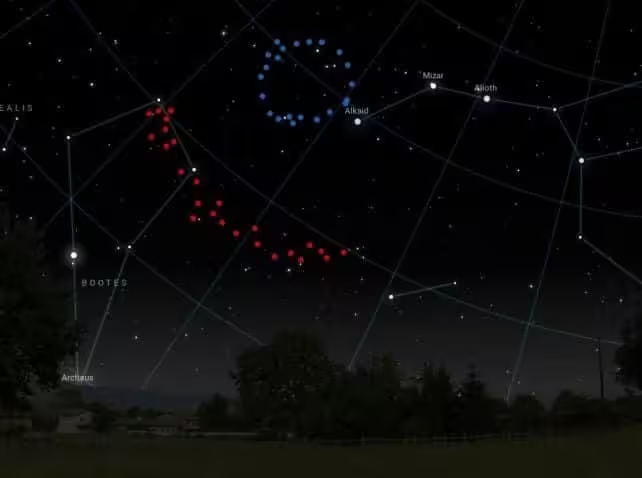
The Big Ring does not stand alone; it shares its sky sector with the Giant Arc, a structure first reported in 2021 by the same research group. Their proximity in both direction and distance has drawn intensified scrutiny from cosmologists probing the limits of known cosmic architecture.
Observational Findings Stretch Theoretical Boundaries
Standard cosmological models predict that matter should become increasingly homogeneous beyond a certain scale, with theoretical calculations placing the maximum coherent size at roughly 1.2 billion light‑years. The Big Ring, at about 1.3 billion light‑years, surpasses this limit, while the Giant Arc extends even farther, challenging the expectation that large‑scale irregularities fade away.
A useful benchmark is the baryon acoustic oscillation (BAO) pattern, which creates spherical shells of galaxies originating from pressure waves in the early universe. Unlike BAOs, which follow a well‑defined scale, the Big Ring appears to be a more intricate configuration, possibly resulting from projection effects that give it a ring‑like appearance in three‑dimensional space.
Competing Explanations Remain Unsettled
One straightforward hypothesis views the formation as a rare statistical fluctuation—an unusual alignment that becomes visible only when observing at extreme scales. Alternative, more speculative ideas invoke exotic physics such as cosmic strings, theoretical defects in spacetime that could imprint large‑scale patterns on the distribution of matter.
Another avenue of discussion involves conformal cyclic cosmology, a model proposed by Roger Penrose that envisions the universe undergoing successive cycles of expansion. Within such a framework, vast ring‑like structures could arise under specific conditions, though the theory remains contentious and far from universally accepted. Lopez and her collaborators stress that, under prevailing cosmological theories, structures of the observed magnitude were not anticipated.
“From current cosmological theories we didn’t think structures on this scale were possible. We could expect maybe one exceedingly large structure in all our observable universe. Yet, the Big Ring and the Giant Arc are two huge structures and are even cosmological neighbours, which is extraordinarily fascinating,” she said.
Also ReadCaltech’s 1,650‑Dish Array Will Scan the Sky in Real Time, Unveiling a Billion New Radio Sources
The coexistence of the Big Ring and the Giant Arc within the same region adds a layer of complexity that challenges the explanatory power of standard cosmological models, prompting ongoing debate and further investigation.
This article has been fact checked for accuracy, with information verified against reputable sources. Learn more about us and our editorial process.
Last reviewed on .
Article history
- Latest version
Reference(s)
- Lancashire, University. “Nobel Prize winner and world-renowned scientist backs University of Central Lancashire astrophysicist.”, April 29, 2025 University of Lancashire <https://www.lancashire.ac.uk/news/alexia-lopez-penrose>.
- Lopez, A.M.., et al. “A Big Ring on the sky.” Journal of Cosmology and Astroparticle Physics, vol. 2024, no. 07, July 24, 2024, pp. 055 IOP Publishing, doi: 10.1088/1475-7516/2024/07/055. <https://doi.org/10.1088/1475-7516/2024/07/055>.
- Lancashire, University. “A Big Cosmological Mystery.”, January 11, 2024 University of Lancashire <https://www.lancashire.ac.uk/news/big-ring-in-the-sky>.
- “What are baryonic acoustic oscillations? - Euclid - Science Portal.” Euclid <https://sci.esa.int/web/euclid/-/what-are-baryonic-acoustic-oscillations->.
Cite this page:
- Posted by Aisha Ahmed