Reanalysis of 2017 Neutron Star Merger Yields Most Precise Hubble Constant Yet
Scientists uncover an unexpected finding in the data from a famous neutron star collision, reigniting interest in this cosmic event.
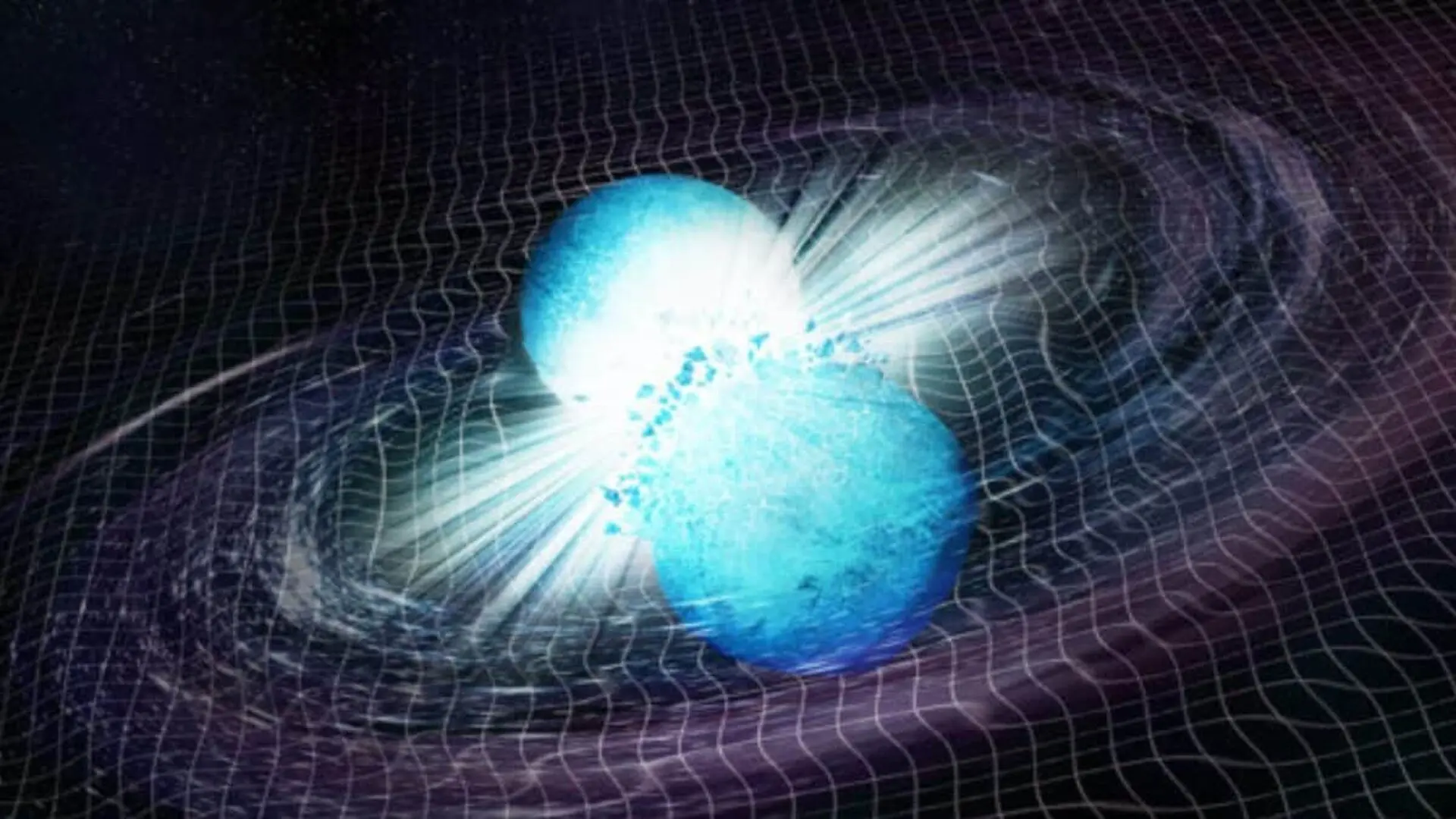
A fresh analysis of the neutron‑star merger dubbed GW170817 delivers the most accurate estimate yet of the Hubble constant derived from gravitational‑wave data. The results appear in The Astrophysical Journal and provide a new, independent data point for a long‑standing controversy in cosmology.
The Hubble constant quantifies the rate at which the cosmos expands, underpinning distance calculations across the observable universe. Despite decades of effort, astronomers have yet to converge on a single value.
The discrepancy, often referred to as the Hubble tension, has intensified as measurement techniques have sharpened. One approach extracts the expansion rate from the relic radiation of the Big Bang, while another relies on nearby distance markers such as pulsating stars and supernova explosions. The two methods continue to yield divergent numbers.
Neutron‑Star Collision Provides a New Angle
Gravitational waves offer an entirely different route to gauge cosmic expansion. These spacetime ripples emerge when ultra‑dense objects—like neutron stars or black holes—merge.
The 2017 detection of GW170817 was historic because scientists captured both the gravitational‑wave signature and the accompanying light from the coalescence of two neutron stars. This dual observation pinpointed the host galaxy, making the event especially valuable for cosmological calculations.
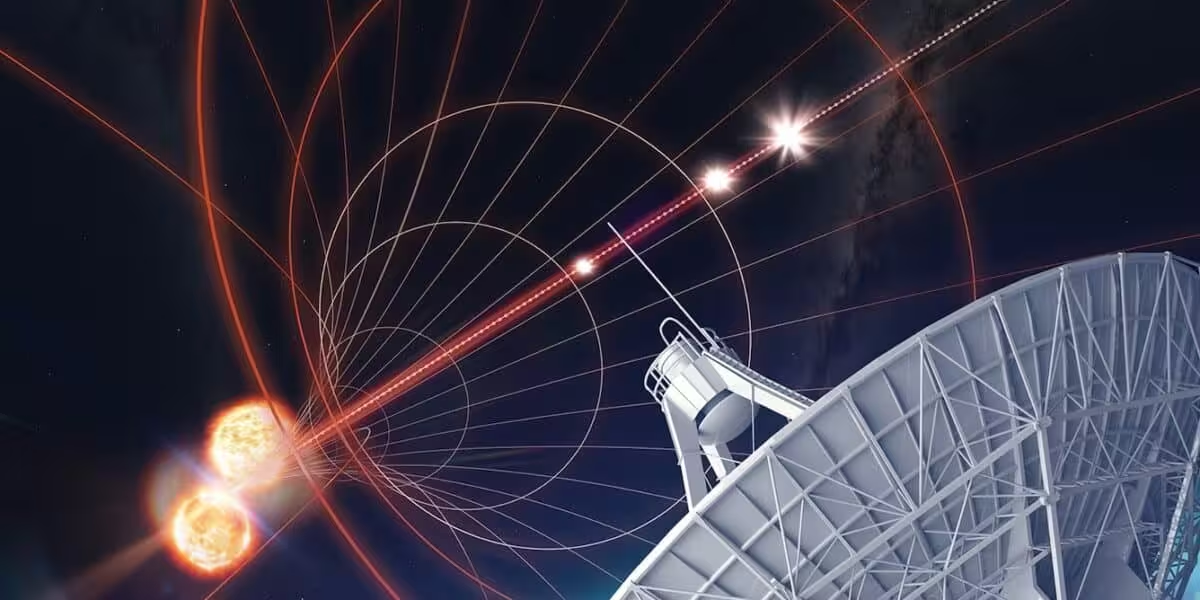
According to the paper, merging the gravitational‑wave signal with the host‑galaxy information enabled a direct application of Einstein’s theory of gravity to compute the expansion rate. The initial result fell midway between the competing estimates, leaving the tension unresolved.
Refined Jet Tracking Narrows the Uncertainty
Since the event’s discovery, researchers have continued to monitor GW170817. A worldwide array of radio dishes followed the rapidly moving jet of charged particles generated after the merger, mapping its trajectory and structure with unprecedented clarity.
The latest study revisits those data using advanced modeling techniques, updated statistical tools, and a more rigorous treatment of uncertainties. It also identifies shortcomings in several earlier modeling approaches that struggled to replicate the observations.
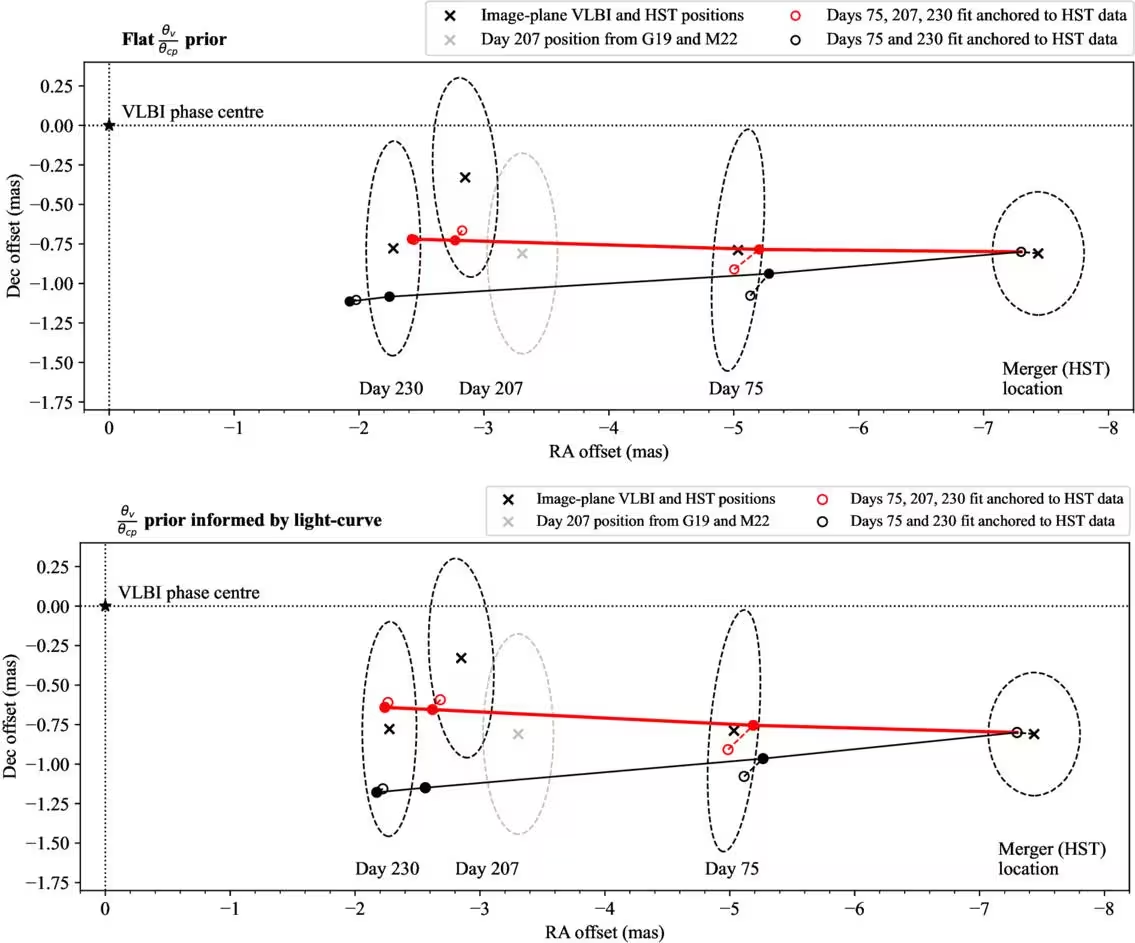
The reanalysis yields a Hubble constant ranging from 61 to 70 kilometers per second per megaparsec, representing the tightest gravitational‑wave‑based constraint for this event to date.
What This Means for the Hubble Debate
While the new figure does not close the debate, it adds a valuable independent measurement. Early‑universe estimates derived from the cosmic microwave background cluster around 67–68 km s⁻¹ Mpc⁻¹, whereas local techniques based on Cepheids and supernovae typically produce values near 72–74 km s⁻¹ Mpc⁻¹.
The authors highlight that their gravitational‑wave result aligns more closely with the distant‑universe value, even though the analysis depends on a relatively nearby merger. They suggest that subtle calibration issues may influence other local methods.
Nevertheless, the precision of the GW170817 measurement remains about four times lower than that of the leading local determinations. Detecting additional neutron‑star collisions will be essential before gravitational‑wave observations alone can achieve the accuracy needed to resolve the Hubble tension.
This article has been fact checked for accuracy, with information verified against reputable sources. Learn more about us and our editorial process.
Last reviewed on .
Article history
- Latest version
Reference(s)
- Gourdji, Kelly., et al. “Revisiting GW170817 at Milliarcsecond Scale: High-precision Constraints on Jet Geometry and H 0.” The Astrophysical Journal, vol. 1005, no. 1, June 29, 2026, pp. 93 American Astronomical Society, doi: 10.3847/1538-4357/ae706c. <https://iopscience.iop.org/article/10.3847/1538-4357/ae706c>.
- “Einstein's Theory of Gravitation | Center for Astrophysics | Harvard & Smithsonian.”, September 5, 2024 <https://www.cfa.harvard.edu/index.php/research/science-field/einsteins-theory-gravitation>.
Cite this page:
- Posted by Aisha Ahmed