How Hopping Might Have Sparked the First Flights of Archaeopteryx
New research explores how feathered theropods transitioned from ground to sky, revealing the step‑by‑step evolution of bird flight.
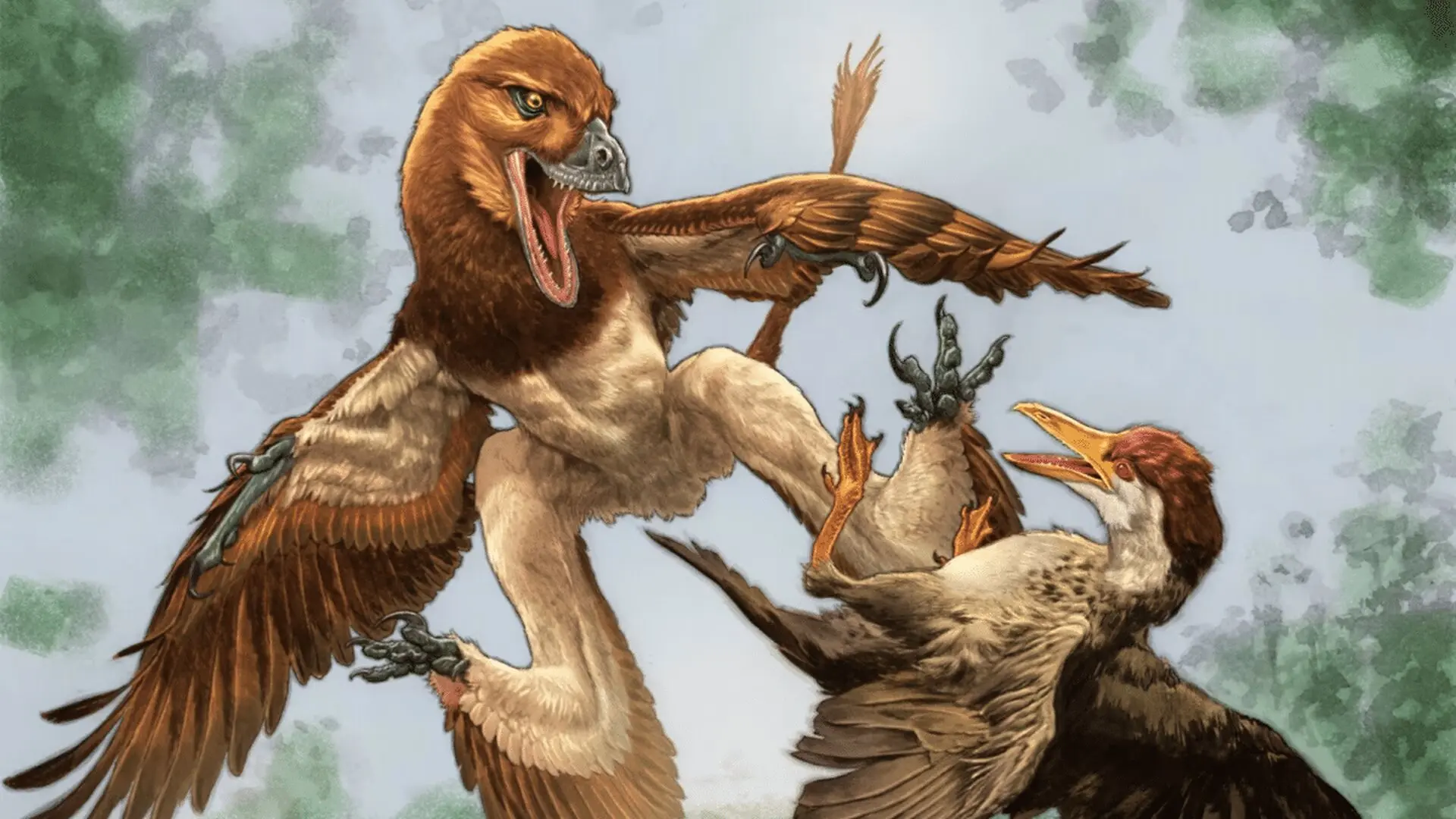
Recent biomechanical modeling indicates that the earliest feathered dinosaurs may have taken to the air by executing a series of rapid hops rather than relying on a single, powerful launch. The investigation, which blends data from modern birds with fossil evidence from Archaeopteryx, proposes a novel route to flight that sits alongside the classic “trees‑down” and “ground‑up” theories.
Beyond Gliding and Running: Could Repeated Hops Have Sparked Flight?
Traditional narratives about avian flight origin fall into two camps. One suggests that proto‑birds ascended trees and began by sliding down, while the other posits that small, feathered predators achieved lift by sprinting along the ground. The new study does not dismiss either scenario; instead, it highlights a behavior observed in many contemporary birds—a brief hop or a quick succession of jumps preceding wingbeat.
The idea originated when the late ornithologist Colin Palmer noted that birds often gain momentum by leaping before flapping. He reached out to researchers at the University of Southampton—Dr Neil Gostling and Prof Markus Heller—to explore whether a similar tactic could have been advantageous for early theropods.
Gostling explained that diminutive dinosaurs possessed muscular hind limbs yet were vulnerable to larger predators. A rapid escape by jumping could have offered a vital survival edge, potentially laying the groundwork for aerial capabilities later on.
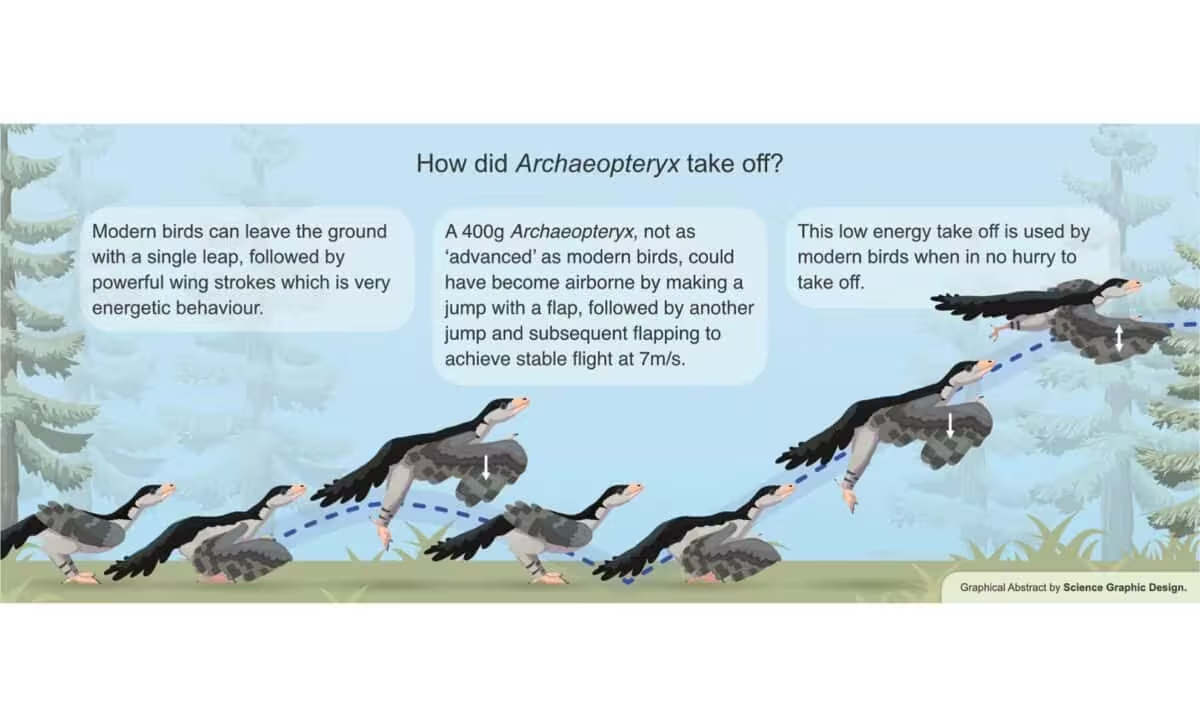
“The hypothesis that we had was that if you are a small theropod dinosaur, you’ve got big powerful legs, but you would also make a tasty snack for a larger dinosaur,” Gostling told IFLScience. “And so if you can jump out of the way, you don’t get eaten.”
To test the feasibility of this “hop‑first” scenario, the team first examined the mechanics of living birds. They leveraged a comprehensive dataset compiled by Dr Pauline Provini at the Paris Natural History Museum, constructing models that captured the forces generated during a pre‑takeoff leap.
After validating their approach on extant species, the researchers applied the same framework to the skeletal remains of Archaeopteryx, a creature that inhabited Earth roughly 150 million years ago. This iconic animal bridges dinosaurian and avian morphologies, featuring teeth, clawed digits, feathered wings, and a plumaged tail.
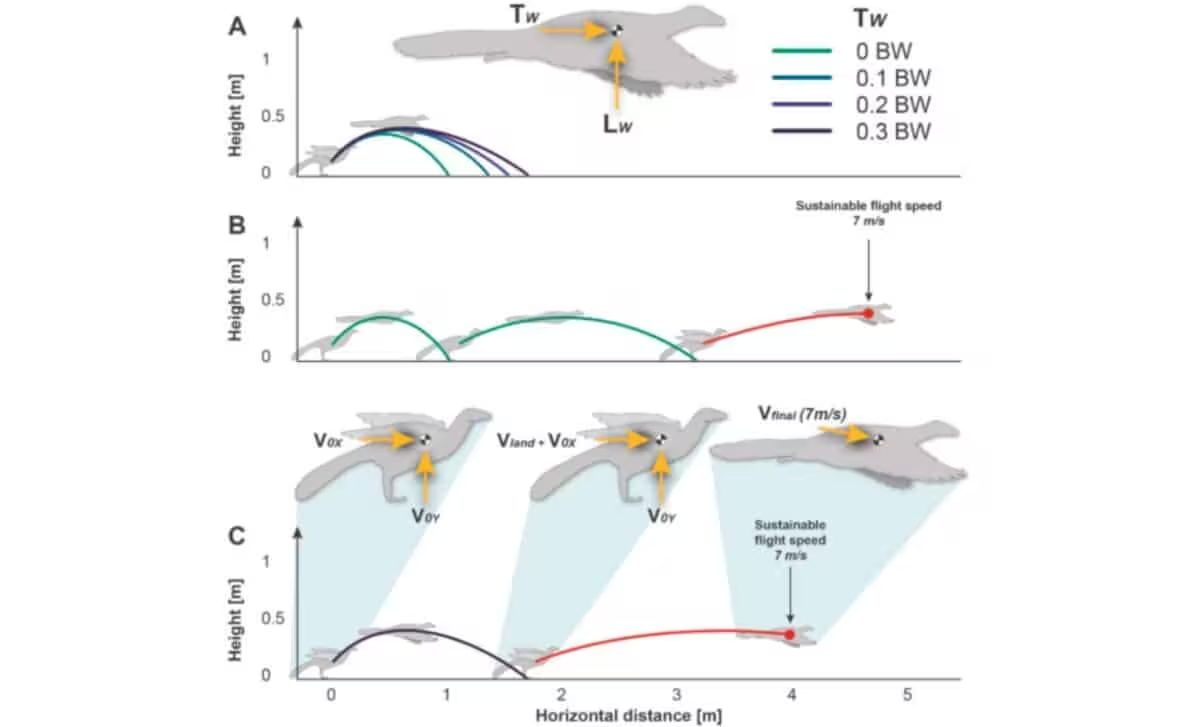
Biomechanical calculations revealed that while Archaeopteryx lacked the robust sternum necessary for sustained, high‑intensity wing strokes, its leg musculature could generate enough thrust to achieve lift after several consecutive jumps. Heller noted that “would not have been able to do this in one go,” but that “with a series of hops, they would eventually be able to reach the velocity that they needed in order to fly away.”
These results suggest a stepwise evolutionary pathway: an initial locomotor behavior—rapid hopping to evade predators—could have been co‑opted later as a prelude to powered flight. Gostling emphasized that such adaptations need not arise with a predetermined purpose; advantageous actions can persist and later acquire new functions.
The findings, detailed in a paper published in Developmental Biology, add hopping to the repertoire of mechanisms scientists evaluate when reconstructing the origins of avian flight, without discarding the roles of gliding, running, or other previously proposed strategies.
This article has been fact checked for accuracy, with information verified against reputable sources. Learn more about us and our editorial process.
Last reviewed on .
Article history
- Latest version
Reference(s)
- “Neil John Gostling | University of Southampton.” University of Southampton <https://www.southampton.ac.uk/people/5x92nj/doctor-neil-j-gostling>.
- “Markus Otto Wilhelm Heller | University of Southampton.” University of Southampton <https://www.southampton.ac.uk/people/5x9ctv/professor-markus-heller>.
- “Pauline Provini.” <https://sites.google.com/site/paulineprovini/home>.
- Meilak, Erik A.., et al. “Hop, hop and away: On the take-off of Archaeopteryx using a multiple leaping mechanism.” Developmental Biology, vol. 539, November 1, 2026, pp. 57-64. Elsevier BV, doi: 10.1016/j.ydbio.2026.07.018. <https://www.sciencedirect.com/science/article/pii/S0012160626001648?via%3Dihub>.
Cite this page:
- Posted by Hassan Raza