Astronomers Capture First Live Spin Of Nearby Planet-Forming Disk
Newly discovered medieval helmets off Spain rewrite history after mistaken identity as Roman artifacts
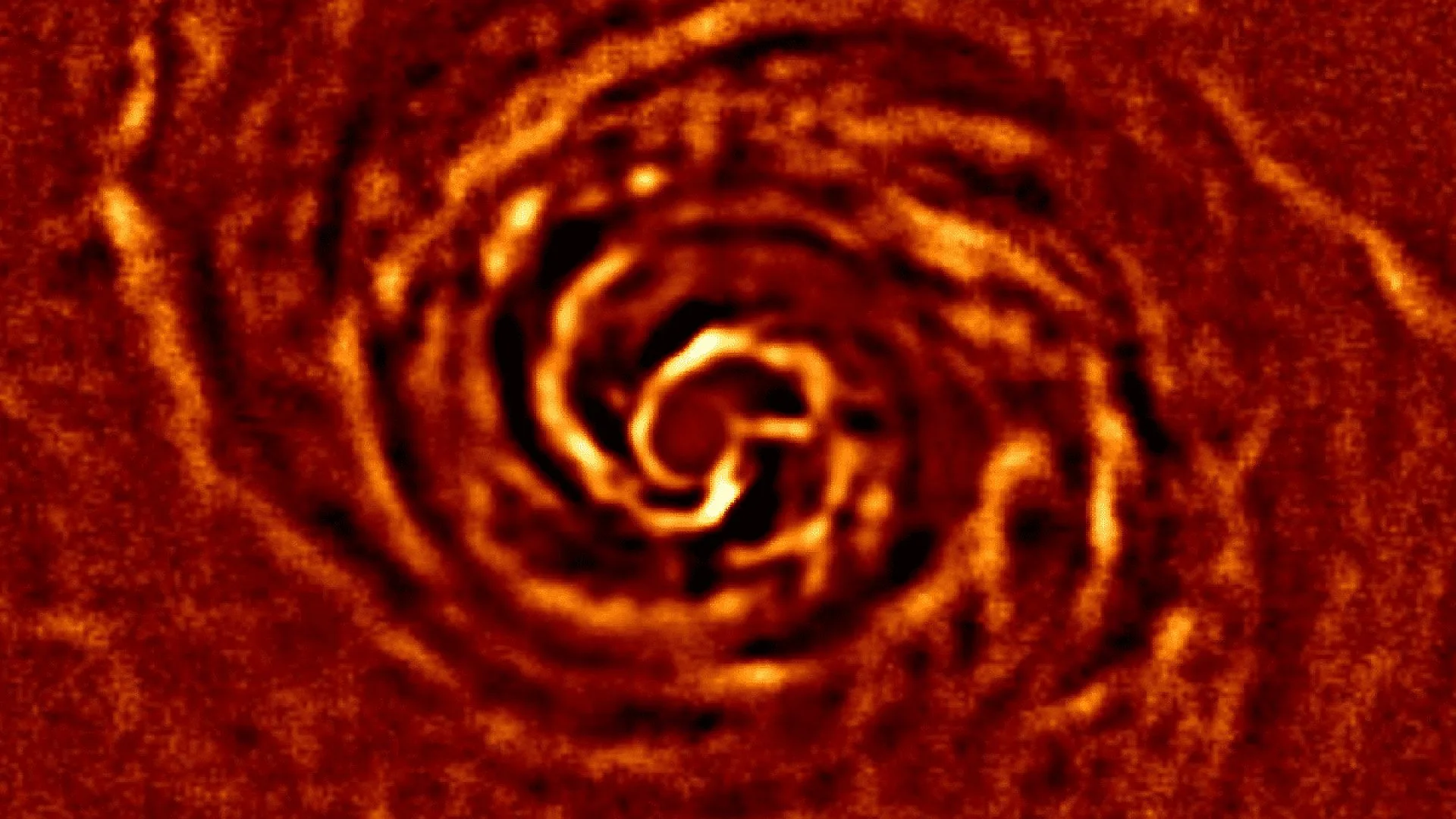
Astronomers have now directly measured the spin of a protoplanetary disk surrounding the young star AB Aurigae, delivering an unprecedented view of a planetary nursery in action and exposing dynamic behavior that challenges existing formation models. The results appear in Astronomy & Astrophysics.
Seeing a Planet‑Forming Disk Turn
Around newly born stars, vast disks of gas and dust serve as the raw material for future planets. Since the first detection of such a disk around Beta Pictoris in 1984, researchers have used these structures to probe how planetary systems emerge beyond our own. The AB Aurigae system, estimated to be four to five million years old, has attracted attention because its disk displays a complex architecture that hints at the presence of massive planets still coalescing.
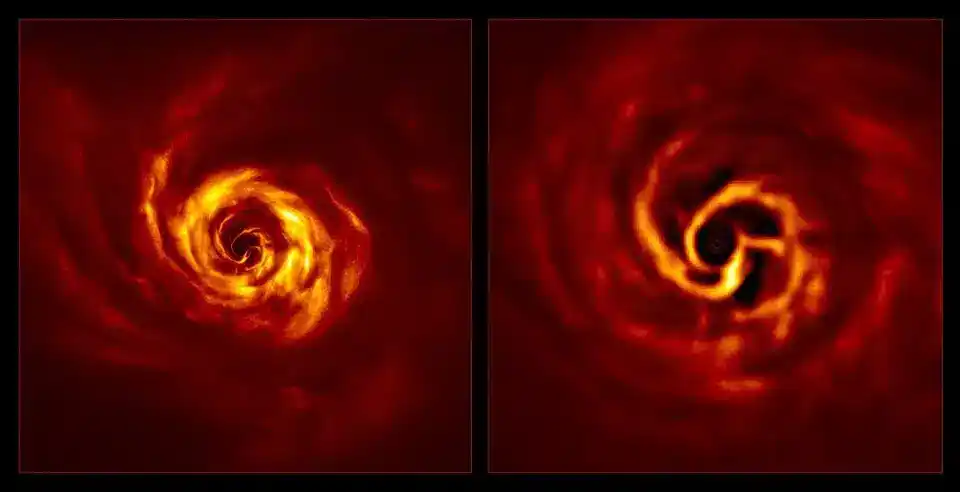
Employing the SPHERE instrument on the European Southern Observatory’s Very Large Telescope in Chile, the team captured infrared light emitted by dust grains embedded in the disk. This technique enabled them to monitor the disk’s rotation with a level of detail never before achieved, revealing localized disturbances that likely stem from the gravity of forming giant planets.
Credit: ESO.
Complex Patterns in AB Aurigae’s Disk
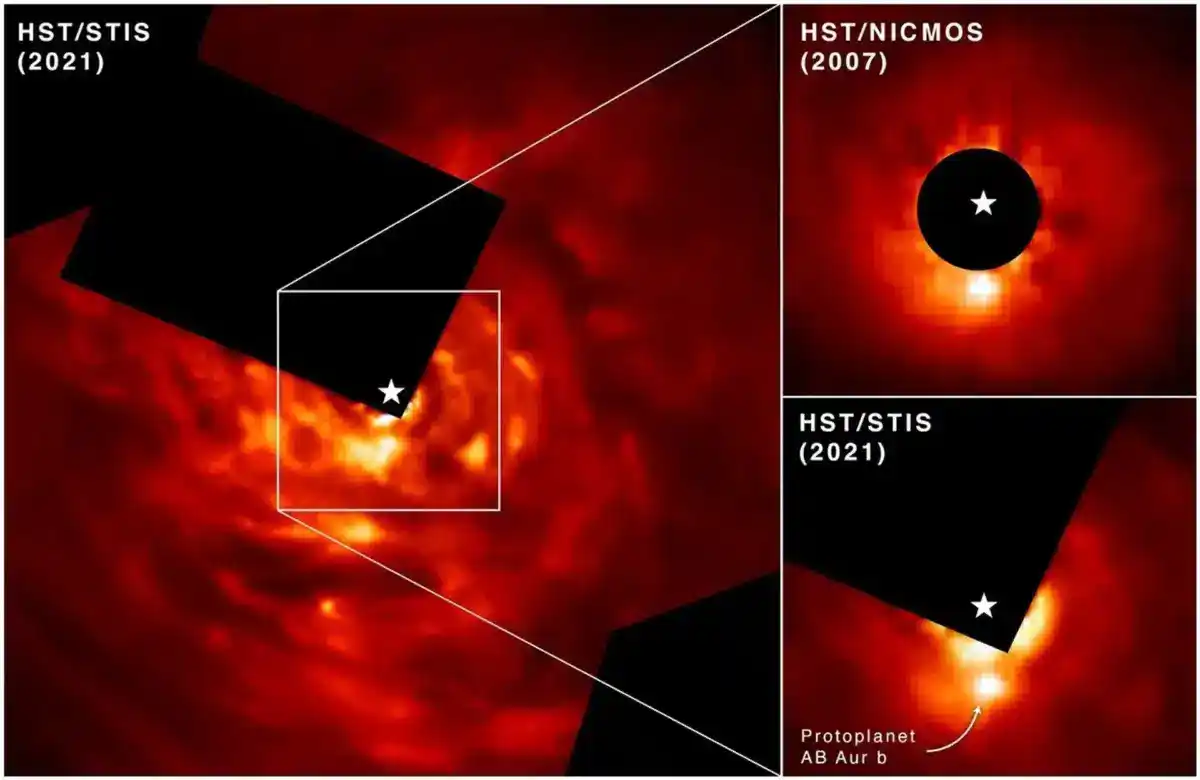
The disk is riddled with spiral features, twisted segments and shifting shadows, all of which point to vigorous interactions between nascent planets and their surroundings. One confirmed gas giant, designated AB Aurigae b, orbits roughly 93 AU from the star and carries an estimated mass near nine times that of Jupiter. Its ongoing growth appears to be reshaping the inner portions of the disk, potentially steering the formation pathways of additional companions.
Other candidate sites are located closer in, at about 30 AU, and farther out between 400 and 600 AU. These condensations may represent early planetary embryos or dense pockets of material that could evolve into full‑blown planets over the next few million years. Their detection offers concrete evidence of the mechanisms that drive accretion and disk evolution.
Credit: NASA/ESA/STScI
Why SPHERE Was Critical
The Spectro‑Polarimetric High‑contrast Exoplanet REsearch (SPHERE) system is engineered to isolate faint infrared signatures from young planets and the surrounding dust. By focusing on the glow of minute grains, the observers pinpointed luminous accretion hotspots—regions where material is gathering before plunging onto a growing giant.
The dataset also captured swiftly shifting shadows that sweep across the disk, likely produced by hidden structures or tightly orbiting companions. These observations provide a rare “real‑time” glimpse of a planetary cradle, prompting a reassessment of current theoretical frameworks and suggesting new pathways for investigating planet formation as it unfolds.
Broader Impact on Planet‑Formation Theory
By tracing the motion of AB Aurigae’s disk directly, astronomers gain a powerful diagnostic for the earliest phases of planetary development. Unlike static snapshots, dynamic monitoring reveals irregularities and transient phenomena that were previously only hypothesized. The study, published in Astronomy & Astrophysics, underscores how cutting‑edge instruments such as SPHERE are reshaping our perception of planetary birthplaces and supplying essential inputs for models of planet formation throughout the Milky Way.
These high‑resolution measurements not only refine our picture of a single system but also help construct a universal framework for comparing nascent planetary environments. Future campaigns will aim to map comparable disks and extend observation baselines, ultimately capturing the full evolutionary trajectory of emerging worlds.
This article has been fact checked for accuracy, with information verified against reputable sources. Learn more about us and our editorial process.
Last reviewed on .
Article history
- Latest version
Reference(s)
- Boccaletti, Anthony. “Destructuring the disk of AB Aurigae: Dynamics and accretion.”, doi: 10.1051/0004-6361/202659736. <https://www.aanda.org/component/article?access=doi&doi=10.1051/0004-6361/202659736>.
Cite this page:
- Posted by Aisha Ahmed