Nearby Super‑Earth Gliese 3378b Gets 90% Of Earth’s Sunlight Atmosphere Still Uncertain
Scientists discover nearby exoplanet with unique features that set it apart, sparking excitement for further study.
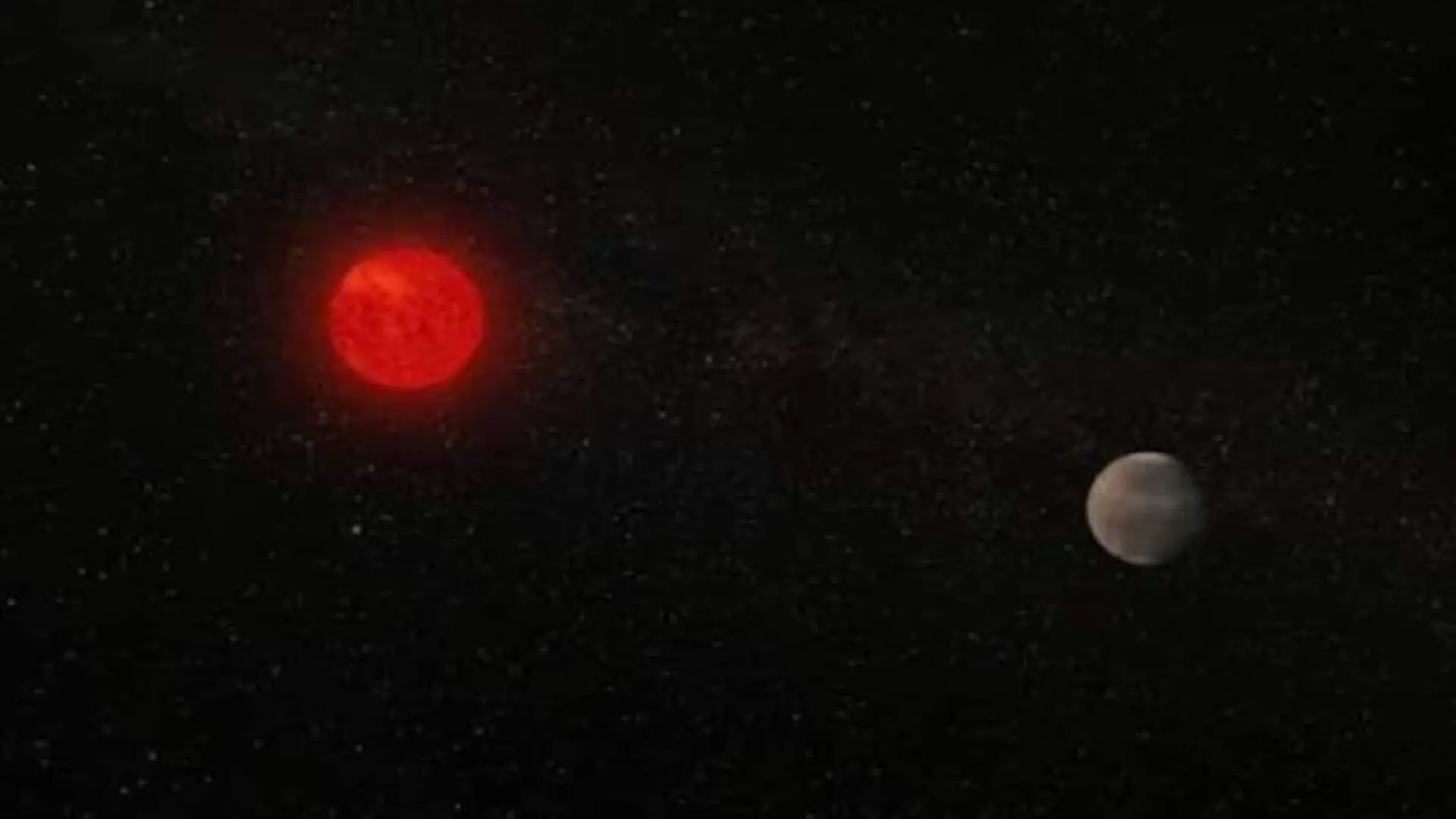
A new rocky super‑Earth, designated Gliese 3378b, has been confirmed orbiting a nearby red dwarf only 25 light‑years from Earth. The planet’s location inside its star’s habitable zone makes it a prime target for future atmospheric studies.
Gliese 3378b, also known as GJ 3378, LHS 1805 and TIC 322347050, circles its host star every 21.45 days and carries roughly 2.3 times the mass of Earth. The planet receives about 90 percent of the solar radiation Earth gets from the Sun, placing it squarely within the region where liquid water could exist if a suitable atmosphere is present.
Red Dwarfs: The Dominant Stellar Population
Red dwarfs account for roughly 70 percent of all stars in the Milky Way, according to research on low‑mass stars. Dr. Michael Endl of the University of Texas at Austin notes that this abundance makes red dwarfs a critical laboratory for understanding planetary system formation across the galaxy.
On a galactic scale, a distance of 25 light‑years is modest. Dr. Paul Robertson of the University of California, Irvine points out that the Milky Way spans about 100 000 light‑years, so Gliese 3378 is effectively a local neighbor.
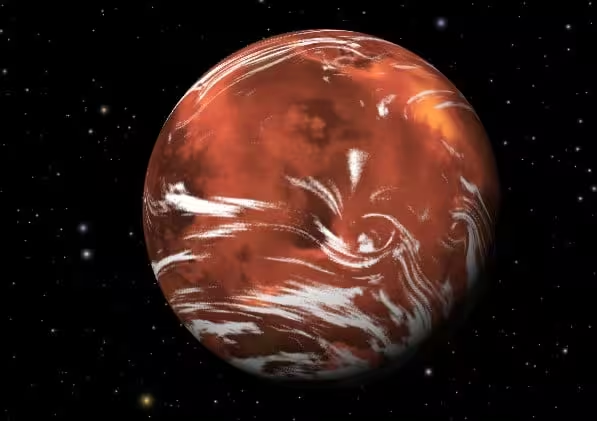
Observations Pinpoint a Habitable‑Zone Super‑Earth
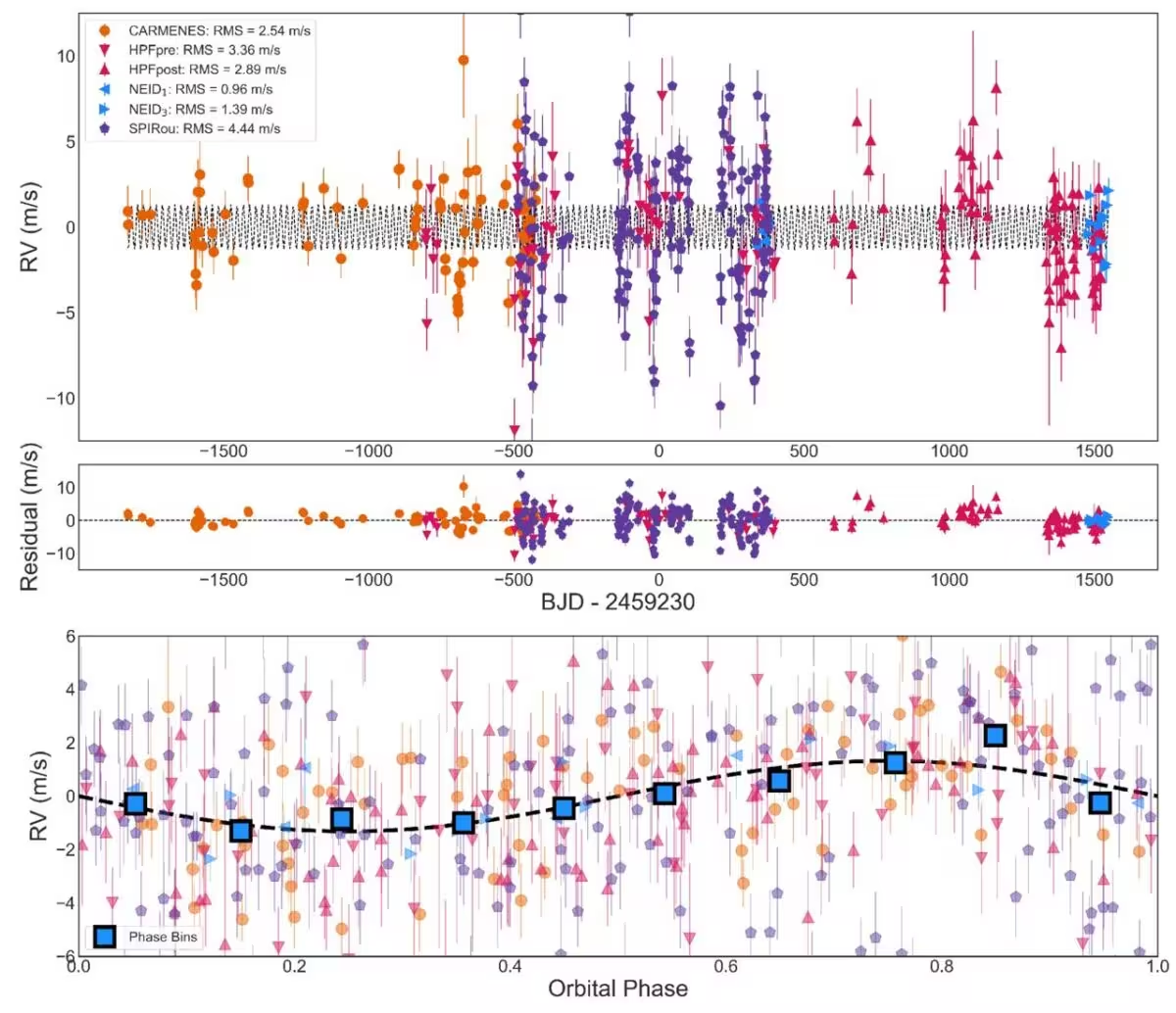
The team combined data from the Habitable‑zone Planet Finder on the Hobby‑Eberly Telescope at McDonald Observatory with measurements from the NEID Spectrometer on the WIYN Telescope at Kitt Peak National Observatory. Their analysis, published in The Astrophysical Journal, confirms the planet’s mass and orbital period.
According to the study, Gliese 3378b’s insolation is “about 90 percent of the radiation Earth receives from the Sun, so it’s right in the sweet spot,” says Robertson. Read the full paper for the detailed spectroscopic results.
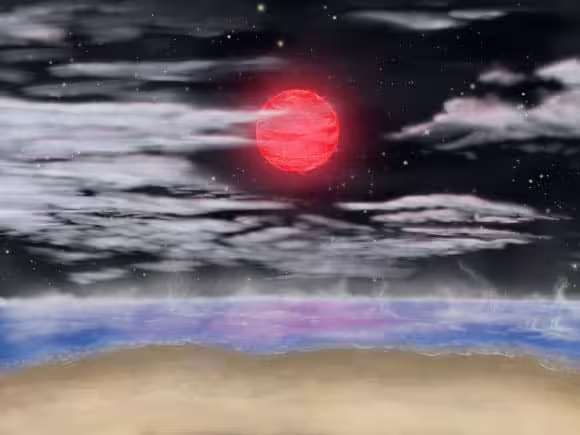
If an atmosphere is present, the planet’s surface temperature could allow liquid water, a key ingredient for habitability, according to the team’s models.
Atmospheric Outlook Remains Uncertain
Despite its favorable orbit, Gliese 3378b sits near the so‑called “cosmic shoreline,” a boundary where intense stellar radiation can erode planetary atmospheres over time. The authors cite Mars as a Solar‑System analogue where atmospheric loss has been significant.
“If you scale the Earth down to the size of an apple, its atmosphere would be about as thick as the skin of the apple,” Robertson explained. “That’s just enough to maintain the kinds of surface pressures where you can have liquid water.”
University of California, Irvine student Gogod James emphasizes that confirming an atmosphere would open the door to searches for biosignatures, liquid water, or other life‑related markers that depend on both atmospheric composition and stellar heating.
This article has been fact checked for accuracy, with information verified against reputable sources. Learn more about us and our editorial process.
Last reviewed on .
Article history
- Latest version
Reference(s)
- “Dr. Michael J. Endl | Ophthalmologist | Eye Doctor.”, March 18, 2019 Fichte, Endl & Elmer Eyecare <https://www.fichte.com/ophthalmologist/michael-j-endl-m-d/>.
- Iliyah, “Dr Paul Robertson | Artificial Intelligence in the Cockpit: New Systems Could Help Prevent Aviation Accidents • scientia.global.”, February 20, 2025 scientia.global <https://www.scientia.global/dr-paul-robertson-artificial-intelligence-in-the-cockpit-new-systems-could-help-prevent-aviation-accidents/>.
- <https://hpf.psu.edu/>.
- “Hobby-Eberly Telescope – The McDonald Observatory.” <https://mcdonaldobservatory.org/research/telescopes/HET>.
- Robertson, Paul., et al. “A Revised Mass and Period for the Habitable Zone super-Earth GJ 3378 b: A Planet Straddling the Cosmic Shoreline.” The Astrophysical Journal, vol. 1005, no. 1, June 30, 2026, pp. 32 American Astronomical Society, doi: 10.3847/1538-4357/ae732b. <https://iopscience.iop.org/article/10.3847/1538-4357/ae732b>.
Cite this page:
- Posted by Aisha Ahmed