Astronomers Discover Two Supermassive Black Holes Feeding Inside a Tiny Green Pea Galaxy
Astronomers have finally confirmed a rare, long-sought phenomenon within a tiny, chaotic galaxy, offering new insights into how these systems evolve.
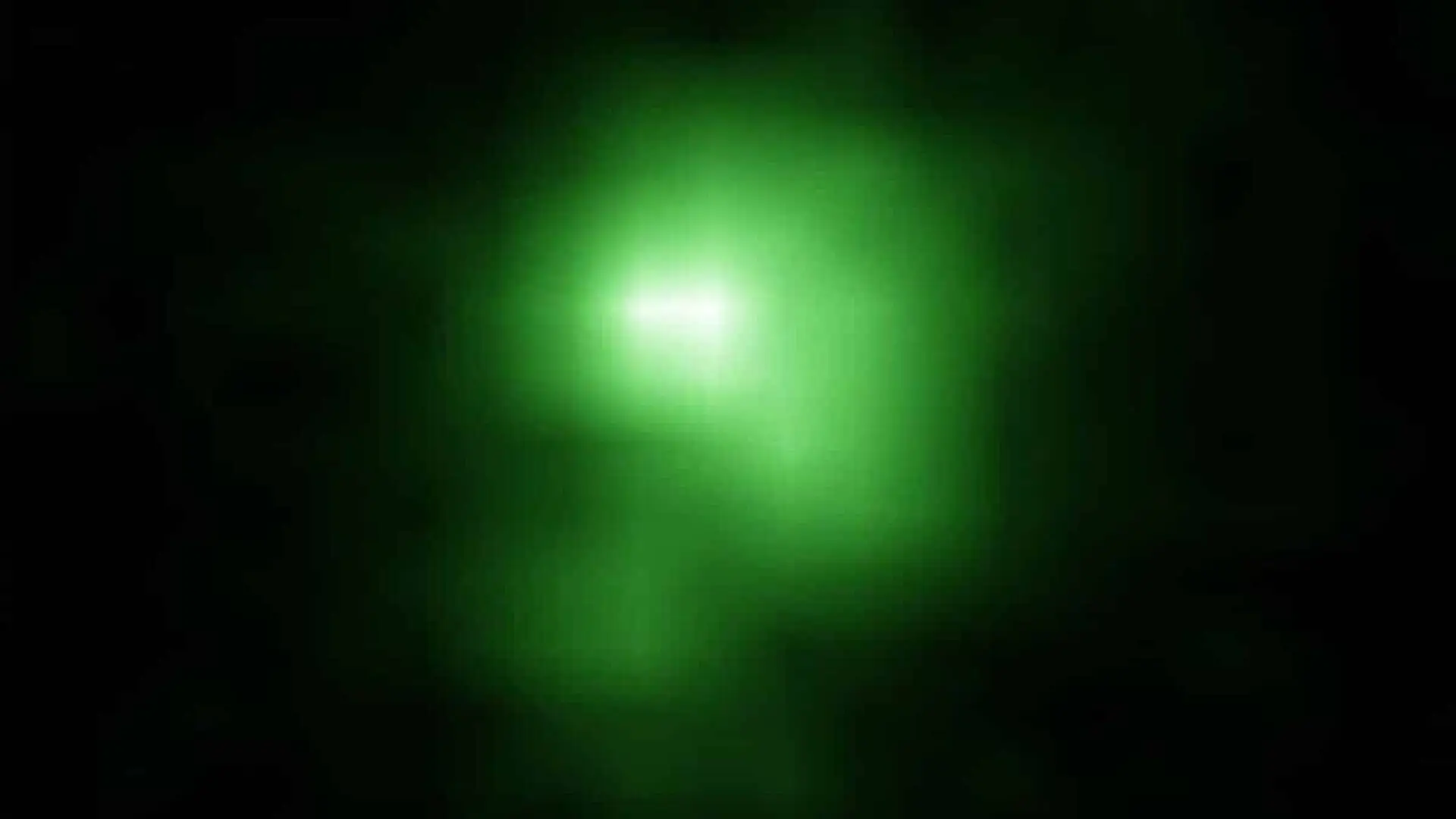
Astronomers have confirmed the existence of two supermassive black holes actively feeding within a single compact galaxy, marking a significant milestone in galactic research. The discovery, centered on the galaxy J1622+3521, identifies the first dual active galactic nucleus ever observed inside a so-called Green Pea galaxy.
Green Pea galaxies are characterized by their small size, rapid star-formation rates, and low chemical enrichment, offering a unique window into the conditions of the early universe. Because they mirror the growth patterns of nascent galaxies from billions of years ago, they are highly sought-after targets for researchers studying cosmic evolution. While these systems have long been suspected of harboring dual black holes, previous searches had failed to produce a confirmed candidate until now.
High-Energy Confirmation of a Dual System
A research team led by Konstantinos Kouroumpatzakis of the Czech Academy of Sciences utilized data from the Chandra X-ray Observatory and the Keck Observatory to identify the pair. The findings, outlined in a recent study submitted to the arXiv preprint server, confirm that the two black holes are separated by approximately 27,000 light-years.
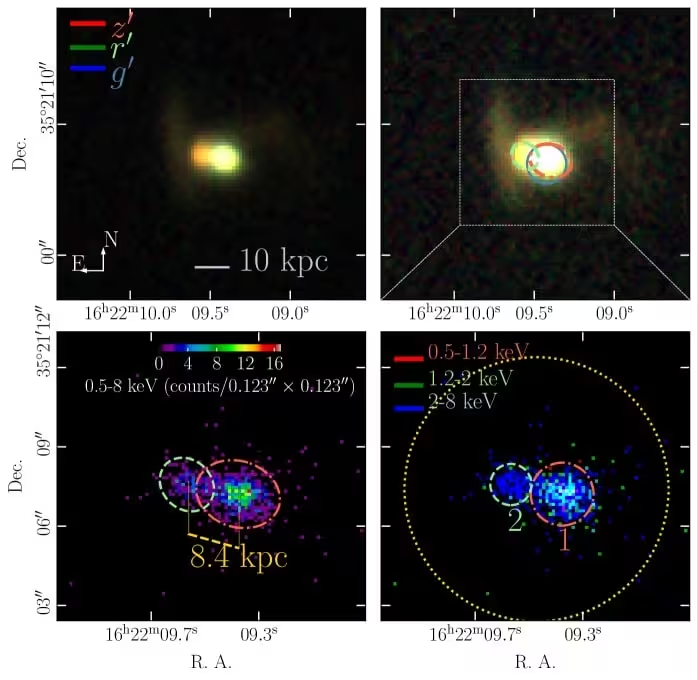
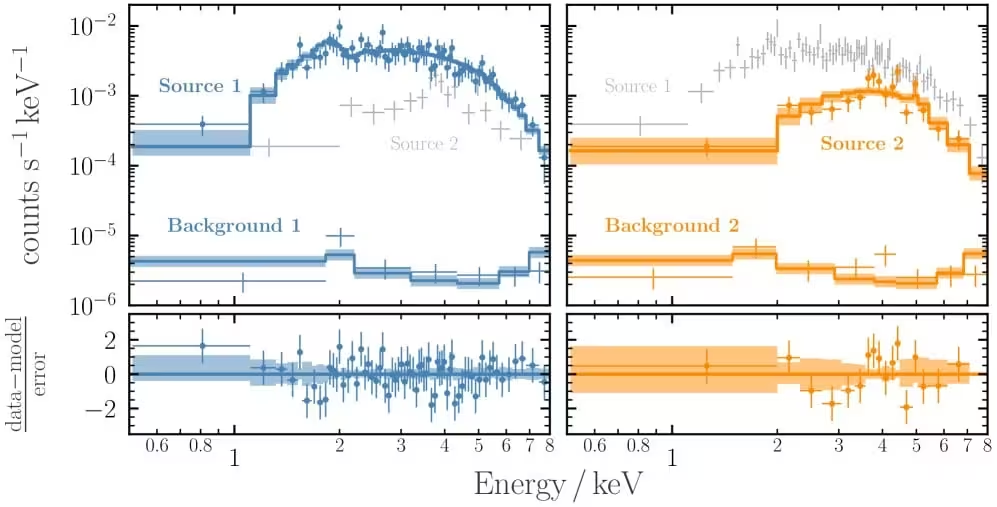
J1622+3521 initially attracted interest due to its disturbed appearance, which included two distinct optical cores and tidal debris—a hallmark of an ongoing galaxy merger. Chandra’s X-ray observations provided the critical proof, detecting two separate, high-energy sources that perfectly aligned with the galaxy’s dual nuclei. Estimates place the mass of these black holes at approximately 19.5 million and 20.5 million solar masses, respectively.
Spectroscopic Evidence of Galactic Interaction
Further investigation using the Keck Observatory revealed strong emission lines consistent with the presence of active galactic nuclei (AGN). By measuring the redshift of both components, the team determined they share a common systemic velocity, indicating they are bound within the same interacting system rather than being unrelated objects along the same line of sight.
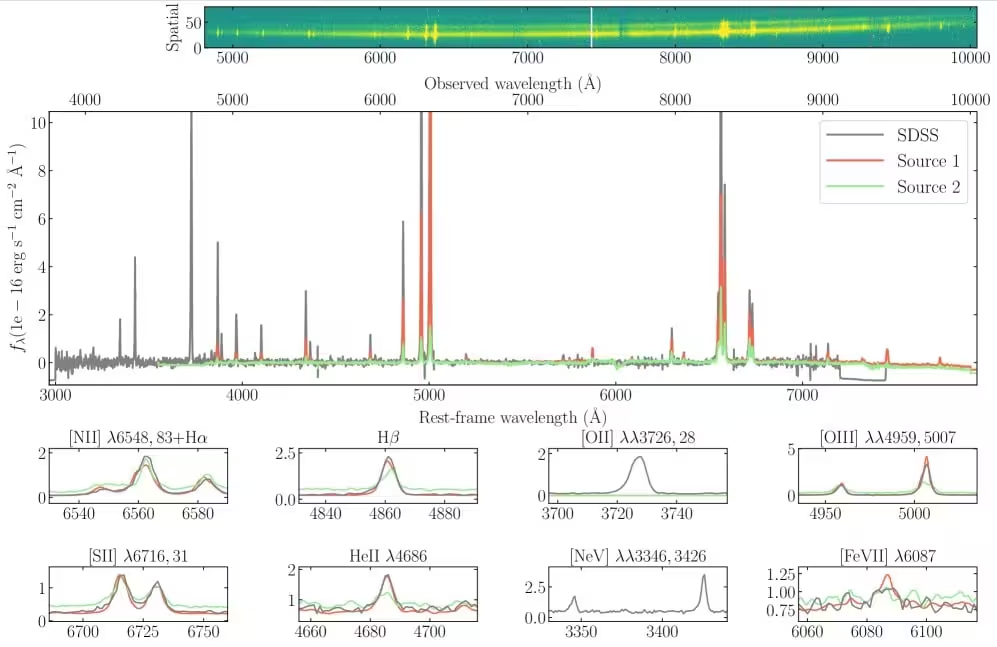
To distinguish between radiation from star formation and black hole accretion, the researchers analyzed He II emission patterns. The data confirmed that both centers of the galaxy are host to genuine accretion activity. The authors noted that while some emission might be obscured by dense gas, the current data offers compelling evidence for a dual-AGN system.
Implications for Early Universe Models
This discovery confirms that dual supermassive black hole growth can occur in compact, low-mass environments during galaxy mergers. By providing a nearby, observable example of this phenomenon, J1622+3521 allows astrophysicists to better understand the processes that drive the evolution of galaxies. It serves as a vital laboratory, demonstrating that even in these small, “green” systems, the intense gravitational influence of supermassive black holes can shape the development of their host galaxy.
This article has been fact checked for accuracy, with information verified against reputable sources. Learn more about us and our editorial process.
Last reviewed on .
Article history
- Latest version
Reference(s)
- Allen, Michael. “Chandra X-ray Observatory - NASA Science.”, June 16, 2023 NASA <https://science.nasa.gov/mission/chandra/>.
- “W. M. Keck Observatory.”, August 19, 2026 <https://keckobservatory.org/>.
- Kouroumpatzakis, Konstantinos. “Two Peas in a Pod: The First Confirmed Dual Active Galactic Nucleus within a Green Pea Galaxy System.” arXiv.org <https://arxiv.org/abs/2607.17729>.
- projects, Contributors. “large, low-density cloud of partially ionized hydrogenium.”, April 7, 2003 Wikimedia Foundation, Inc. <https://en.wikipedia.org/wiki/H_II_region>.
Cite this page:
- Posted by Aisha Ahmed