Adding Carbon to Epoxy Resins Rewrites How Heat Moves Across Temperatures
Precision tests from cryogenic levels to room temperature reveal that graphene oxide changes vibrational heat pathways rather than simply boosting conductivity.
Adding carbon filler to everyday plastic resins does much more than simply speed up heat flow, as researchers tracking temperatures from deep cryogenic up to room conditions have discovered. When materials scientists mix carbon nanomaterials into polymers, they often expect heat to move much faster through the resulting composite structure. However, recent measurements show that incorporating graphene oxide into a cured epoxy matrix completely rewrites how heat travels across different temperature scales, altering vibrational pathways rather than just boosting overall conductivity.
The experimental work, available on the arXiv preprint server and led by scientists from the Polish Academy of Sciences and the National Academy of Sciences of Ukraine, examined a series of epoxy resin mixtures containing graphene oxide mass fractions ranging from 0.21 percent up to 6.1 percent of the total composite mass. Using X-ray diffraction and Raman spectroscopy alongside precision thermal testing between 4.5 and 300 kelvin, the team found that the internal structure of the polymer changed in unexpected ways depending on how much carbon additive was present.
How Graphene Oxide Disrupted Ordered Stacking Inside Resins
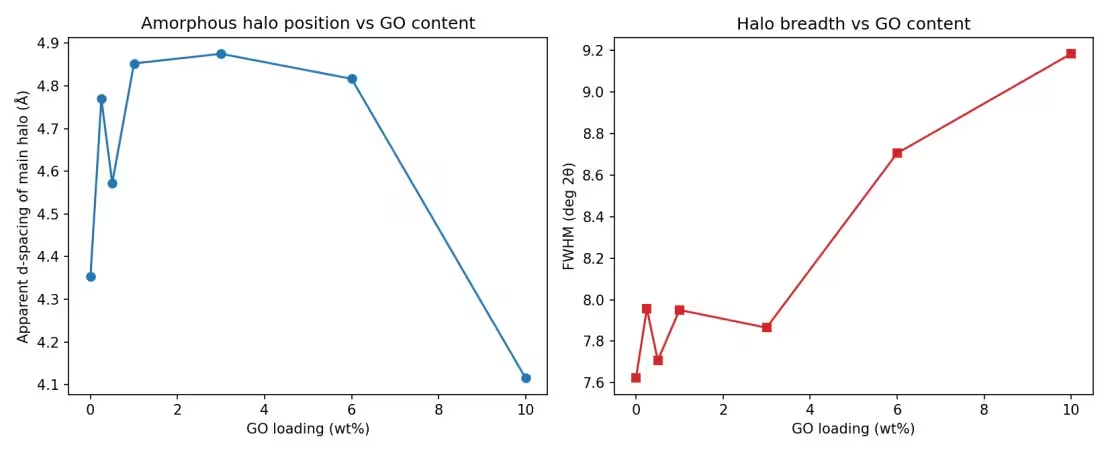
X-ray scattering analyses revealed that the typical sharp signature reflection of layered graphene oxide completely vanished in every tested composite sample. This absence indicates that the ordered stacking of the carbon sheets was heavily suppressed inside the cross-linked polymer matrix. Instead of forming neat stacks, the individual sheets interacted closely with the surrounding resin network, expanding intermolecular spacing within the polymer for lower additive concentrations.
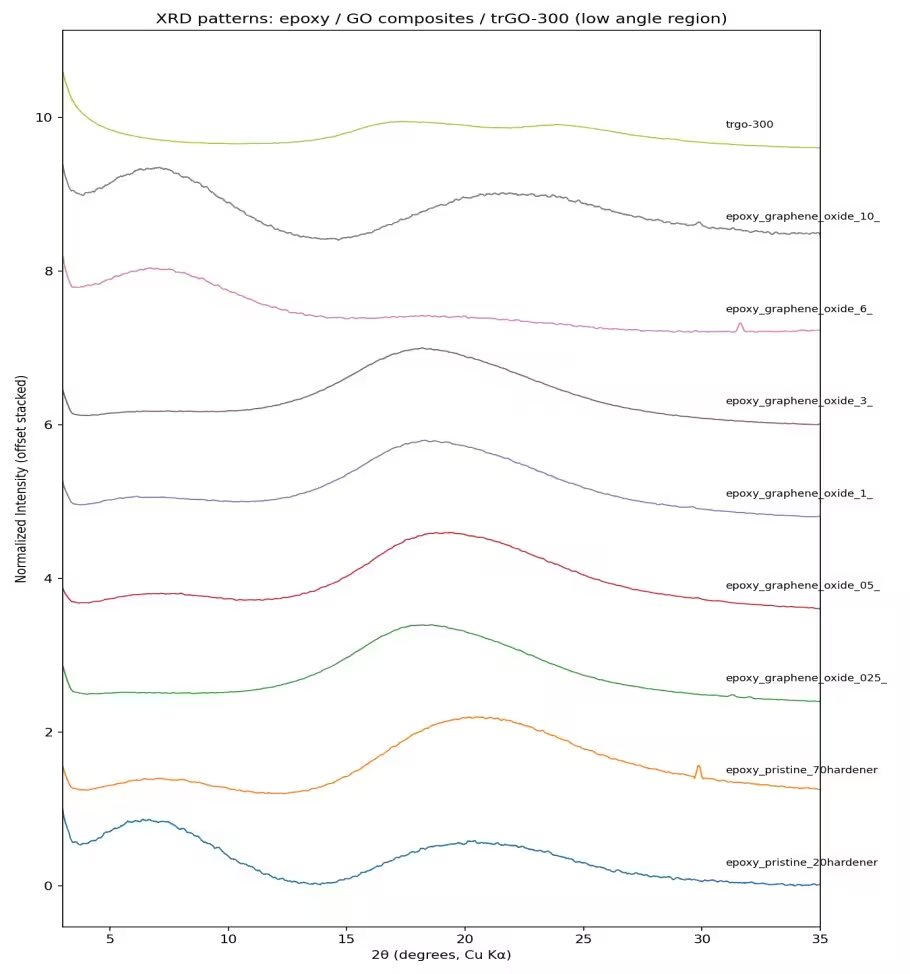
At the highest loading level of approximately 6.1 weight percent, however, the structural response shifted. The primary amorphous scattering halo moved toward higher diffraction angles and broadened significantly, pointing toward possible partial restacking or aggregation of the carbon filler alongside changes driven by higher curing-agent ratios. Raman spectroscopy confirmed the growing presence of the carbon phase by tracking characteristic vibrational bands, while showing that the baseline molecular fingerprint of the epoxy network remained largely stable up to moderate filler levels.
Why Heat Flow Shifts From Glass-Like Plateaus to Complex Channels
Pure epoxy resins typically behave like glass at low temperatures, displaying a weak plateau in thermal conductivity near liquid-helium temperatures before rising again upon heating. The measurements showed that low-concentration composites preserved this glass-like plateau near 5 to 15 kelvin. Yet as the graphene oxide content increased toward 4.4 and 6.1 weight percent, that low-temperature plateau vanished entirely from the experimental window.
To understand these trends, the authors applied a phenomenological multichannel model that breaks down thermal conductivity into a temperature-independent term and up to three activated pathways using Arrhenius-type contributions. These fitted components represent effective energy scales spanning from just a few kelvin up to several hundred kelvin. The appearance of a very low energy scale around 2 to 3 kelvin in the heavily loaded samples helped explain the qualitative shift in temperature dependence.
Limits of Simple Conductivity and What Comes Next
The thermal conductivity values for all tested composites remained within the low range typical of standard polymer insulators rather than jumping to match pure carbon materials. In fact, near room temperature, the sample with 4.4 weight percent graphene oxide showed a slightly lower thermal conductivity than the sample with 2.3 weight percent, demonstrating that heat transport does not scale in a simple monotonic fashion.
The researchers note that high interfacial thermal resistance between the polymer and the carbon filler likely plays a major role in keeping overall heat transport modest. While the multichannel equations successfully reproduce the experimental curves, the team emphasizes that individual fitting parameters should not be directly equated with specific microscopic vibrations without further theoretical backing. These findings establish a baseline for exploring how atomic disorder and boundary scattering dictate heat flow in disordered polymer composites.
The study was posted to the arXiv preprint server on November 18, 2026.
This article has been fact checked for accuracy, with information verified against reputable sources. Learn more about us and our editorial process.
Last reviewed on .
Article history
- Latest version
Reference(s)
- Jeżowski, A.. “Structure and Thermal Conductivity of Epoxy-Graphene Oxide Composites from 4.5 to 300 K.” arXiv.org <http://arxiv.org/abs/2611.24391v1>.
Cite this page:
- Posted by Anjali Singh