Cellular Metabolism Study Reveals Microbes Break Longstanding Biochemistry Rules
Chemistry

Cellular Metabolism Study Reveals Microbes Break Longstanding Biochemistry Rules

Computational analysis of optimal energy efficiency shows bacteria ditch textbook precursor rules and rely on highly variable energy strategies.
By Anjali Singh
Published:
Email this Article
Cellular Metabolism Study Reveals Microbes Break Longstanding Biochemistry Rules
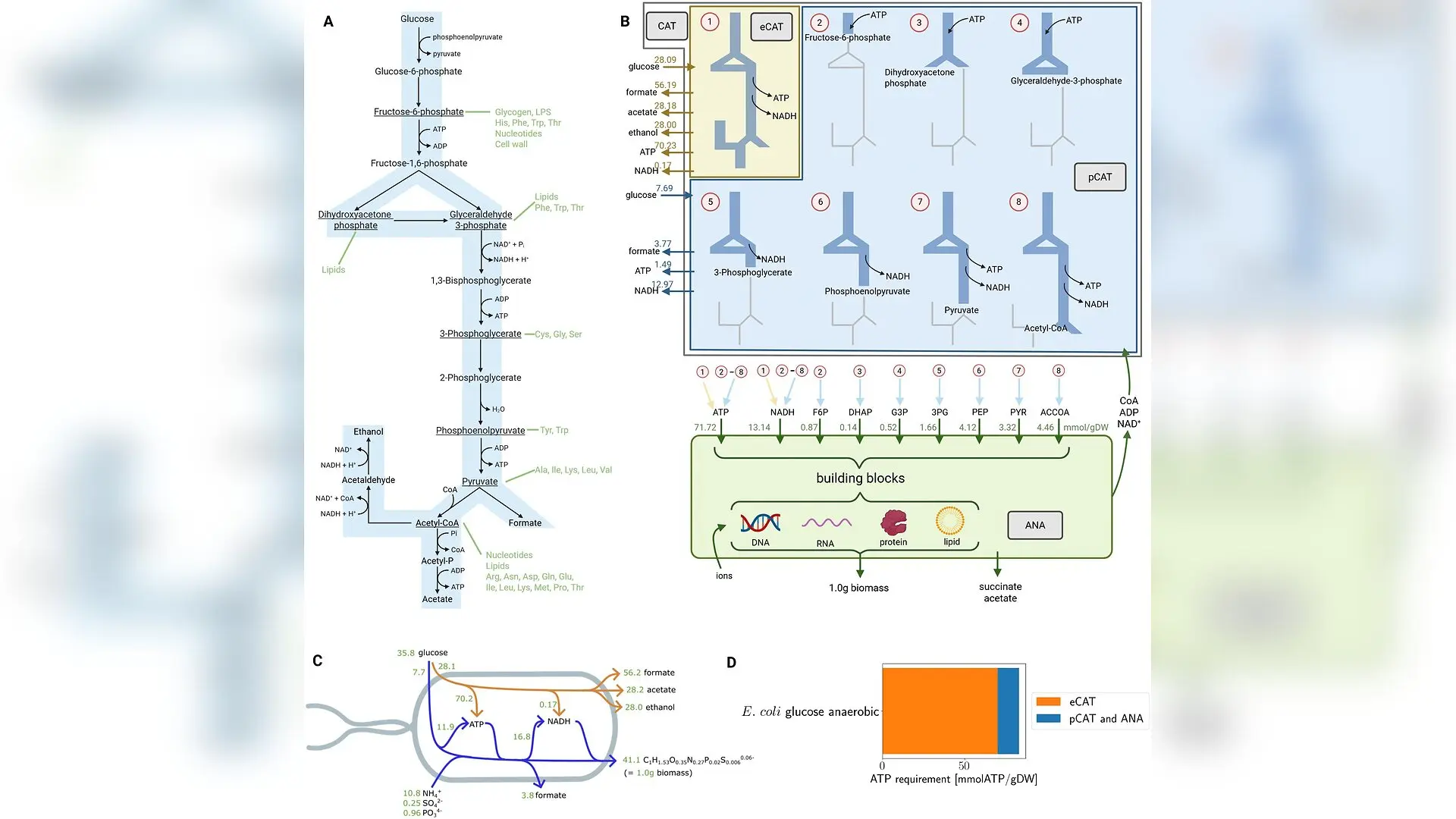
Energy catabolism, precursor catabolism and anabolism decomposition of the metabolic state of maximal energetic efficiency of Escherichia coli (E. coli), growing anaerobically with glucose as sole carbon and energy source. We computed the state of maximal energetic efficiency by setting the growth rate to 1 h–1 and minimizing the glucose uptake rate (minimum = 35.8 mmol glucose gDW–1). After the application of our decomposition method we obtain: A. the catabolic network supplying charged energy equivalents and precursors for anabolism and producing the catabolic products formate, acetate and ethanol. These are made in a 2:1:1 stoichiometry when only ATP (and no NADH) is supplied to anabolism. Building block molecules that can be made from the precursor molecules are shown in green. B. The energy catabolism (eCAT), precursor catabolism (pCAT) and anabolism (ANA), the identity of the exchanged intermediates and values for yield on biomass. ATP and NADH are produced by eCAT. ANA returns t Maaike Remeijer et al. / PLOS Computational Biology

A computational approach breaking down how microbes harvest energy and build biomass reveals that standard textbook rules about cellular metabolism may need rewriting. Single-celled organisms display surprising flexibility in how they split the energy-generating side of metabolism from the building-block side, defying long-held assumptions that all bacteria rely on a fixed universal toolkit.

How Microbes Split Energy Generation from Cellular Building Blocks

Microbial cells survive and grow by balancing two main metabolic engines. The first engine is catabolism, which breaks down nutrients to charge up energy carriers like adenosine triphosphate (ATP) and produce waste products. The second engine is anabolism, which uses that energy to stitch together amino acids, nucleic acids, and lipids into a living cell. Decades ago, classic biochemistry textbooks suggested that all bacteria route these processes through a fixed set of 12 precursor molecules to link nutrient breakdown with growth.

To test whether this rigid rule holds true across the microbial world, researchers examined genome-scale metabolic models for multiple species under dozens of different nutrient conditions. The details of this decomposition framework are published in PLOS Computational Biology. Instead of assuming a uniform set of reactions, the team used flux balance analysis to calculate metabolic states that achieve the highest possible energy efficiency, maximizing the dry weight of biomass produced per unit of nutrient consumed.
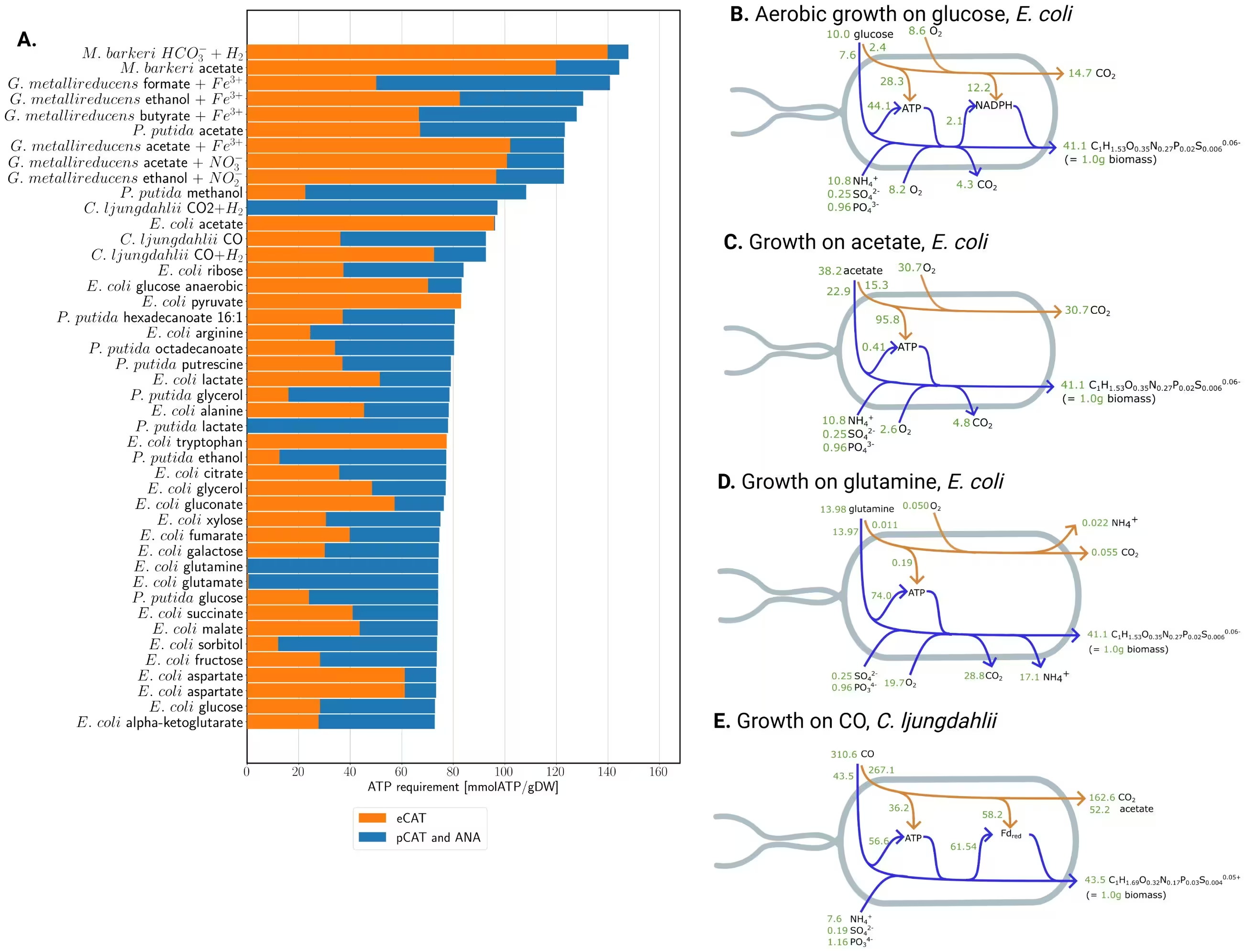
Fig 2: Species diversity in total ATP requirement per gram biomass and ATP-synthesis contributions of eCAT and pCAT. A. The mmol ATP per gram biomass requirement and the ATP synthesis contribution by eCAT and pCAT are shown across conditions. A comprehensive list of the performed simulations is given in Table B in S1 Appendix. Schematic overview of energy carrier economy for: B. Aerobic growth on glucose by E. coli below the critical growth rate for overflow metabolism. C. Aerobic growth on acetate by E. coli. D. Aerobic growth on glutamine by E. coli. E. Growth of Clostridium ljungdahlii (C. ljungdahlii) on carbon monoxide. Created in BioRender. Bruggeman, F. (2026) https://BioRender.com/oqnqdt5.
Species diversity in total ATP requirement per gram biomass and ATP-synthesis contributions of eCAT and pCAT. A. The mmol ATP per gram biomass requirement and the ATP synthesis contribution by eCAT and pCAT are shown across conditions. A comprehensive list of the performed simulations is given in Table B in S1 Appendix. Schematic overview of energy carrier economy for: B. Aerobic growth on glucose by E. coli below the critical growth rate for overflow metabolism. C. Aerobic growth on acetate by E. coli. D. Aerobic growth on glutamine by E. coli. E. Growth of Clostridium ljungdahlii (C. ljungdahlii) on carbon monoxide. Created in BioRender. Bruggeman, F. (2026) https://BioRender.com/oqnqdt5. Credit: Maaike Remeijer et al. / PLOS Computational Biology

By mathematically separating the networks into energy-producing catabolism, precursor-producing catabolism, and anabolism, the study exposed a staggering amount of biological variation. Rather than sharing a universal set of 12 precursors, different microbes utilize entirely different chemical starting points depending on their surrounding environment and available food sources. In fact, when the researchers forced microbes to use the classic 12-precursor list under optimal energy conditions, the standard network configuration failed to support growth.

Why Acetyl-CoA Stands Alone as a Universal Metabolic Constant

Among all the precursor molecules examined across various species and growth conditions, only a single compound remained constant. Acetyl-CoA serves as the sole universal precursor shared across every tested organism and environment. Every other intermediate molecule involved in building cellular components shifts depending on whether the microbe relies on glycolysis, the pentose phosphate pathway, or the tricarboxylic acid cycle.

The total energy cost required to manufacture one gram of dry biomass also fluctuates widely, ranging from 4.1 to 13.7 grams of dry weight per mole of ATP. The proportion of ATP generated during precursor production varies from zero to 100 percent depending on the nutrient source. When Escherichia coli consumes glutamine as its sole energy and carbon source, almost all of its ATP is synthesized directly during precursor metabolism rather than through standard energy catabolism.
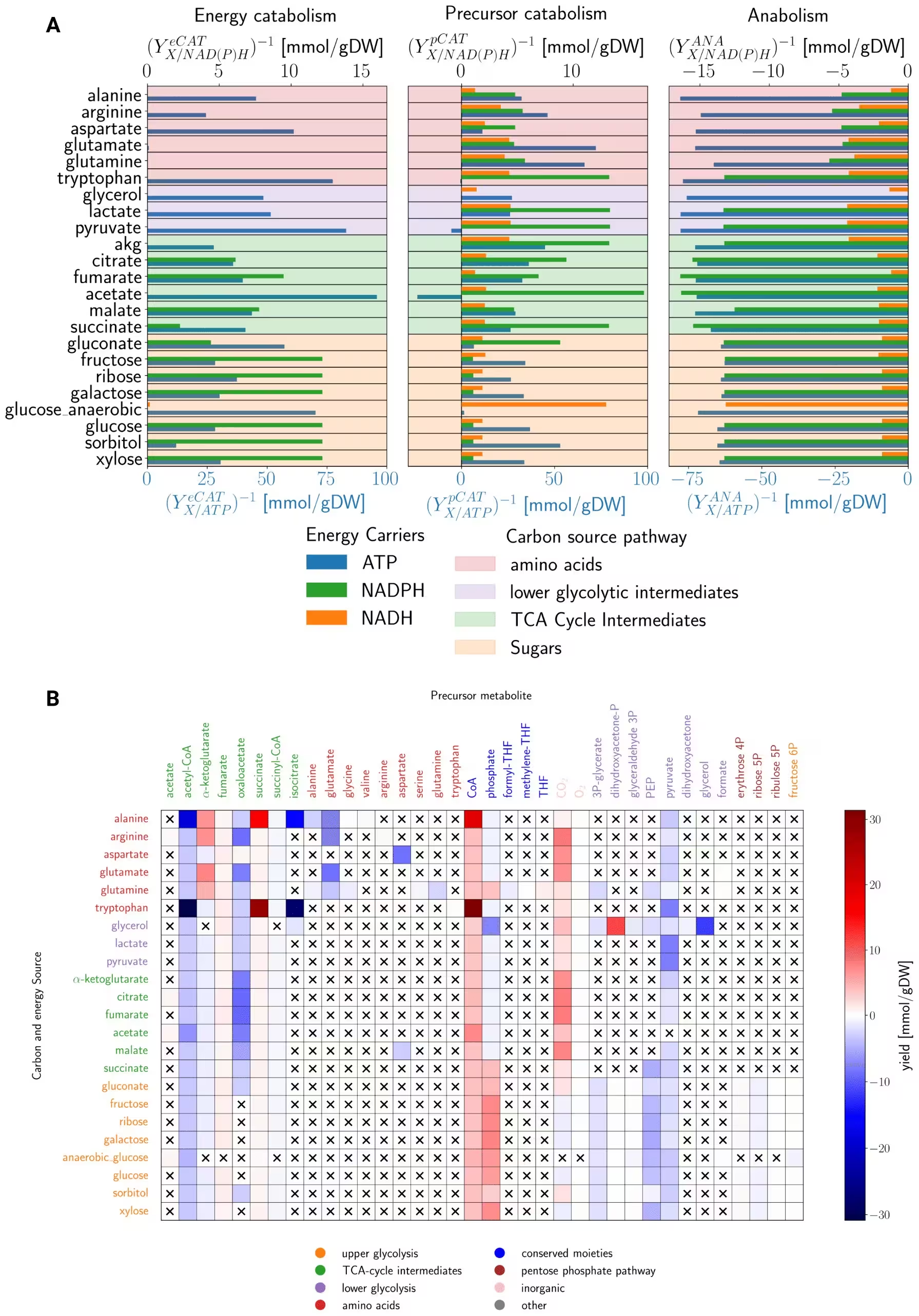
Fig 3: E. coli’s variation in exchange and production of charged energy carriers and precursor usage. A. The total amount of ATP, NADH and NADPH produced or consumed in eCAT, pCAT and ANA across 23 different energy sources of E. coli. B. Overview of the consumed precursor metabolites and anabolic products produced by ANA across the 23 different energy sources considered in panel A. The color indicates the stoichiometric coefficient in the macrochemical equation of ANA. An ‘x’ indicates that a precursor is not used in this condition. An overview of the performed simulations in E. coli is given in Table B in S1 Appendix. Created in BioRender. Bruggeman, F. (2026) https://BioRender.com/9u1c6hi.
E. coli’s variation in exchange and production of charged energy carriers and precursor usage. A. The total amount of ATP, NADH and NADPH produced or consumed in eCAT, pCAT and ANA across 23 different energy sources of E. coli. B. Overview of the consumed precursor metabolites and anabolic products produced by ANA across the 23 different energy sources considered in panel A. The color indicates the stoichiometric coefficient in the macrochemical equation of ANA. An ‘x’ indicates that a precursor is not used in this condition. An overview of the performed simulations in E. coli is given in Table B in S1 Appendix. Created in BioRender. Bruggeman, F. (2026) https://BioRender.com/9u1c6hi. Credit: Maaike Remeijer et al. / PLOS Computational Biology

What These Findings Mean for Industrial Biotechnology

Mapping these hidden stoichiometric relationships provides a powerful roadmap for metabolic engineering. Many valuable industrial chemicals are produced as byproducts of microbial catabolism. By understanding how precursor synthesis and energy production couple together, bioengineers can manipulate cellular demands to force microbes into higher product yields.

However, the study also highlights the limits of trying to generalize microbial physiology. Because microbes adapt their internal wiring to fit specific ecological niches, researchers must account for species-specific metabolic diversity rather than relying on generalized biochemical templates. These insights pave the way for more accurate computer simulations of both single-cell organisms and complex microbial communities.

The research was published in PLOS Computational Biology on November 13, 2026.

Fact Checked

This article has been fact checked for accuracy, with information verified against reputable sources. Learn more about us and our editorial process.

Last reviewed on .

Article history

  • Latest version

Reference(s)

  1. Remeijer, Maaike., et al. “Entangled stoichiometric objectives shape microbial catabolism.” PLOS Computational Biology, vol. 22, no. 11, November 13, 2026, pp. e1014942 Public Library of Science (PLoS), doi: 10.1371/journal.pcbi.1014942. <https://doi.org/10.1371/journal.pcbi.1014942>.

Cite this page:

Singh, Anjali. “Cellular Metabolism Study Reveals Microbes Break Longstanding Biochemistry Rules.” BioScience. BioScience ISSN 2521-5760, 14 November 2026. <https://www.bioscience.com.pk/en/subject/chemistry/entangled-stoichiometric-objectives-shape-microbial-catabolism>. Singh, A. (2026, November 14). “Cellular Metabolism Study Reveals Microbes Break Longstanding Biochemistry Rules.” BioScience. ISSN 2521-5760. Retrieved November 14, 2026 from https://www.bioscience.com.pk/en/subject/chemistry/entangled-stoichiometric-objectives-shape-microbial-catabolism Singh, Anjali. “Cellular Metabolism Study Reveals Microbes Break Longstanding Biochemistry Rules.” BioScience. ISSN 2521-5760. https://www.bioscience.com.pk/en/subject/chemistry/entangled-stoichiometric-objectives-shape-microbial-catabolism (accessed November 14, 2026).
End of the article