Physicists Resolve Debate Over Superconducting Nickelate Models
Advanced quantum calculations reveal how hidden electronic bands shape the behavior of high-temperature nickel-oxide superconductors.
Physicists have resolved a long-standing theoretical debate regarding how to accurately model infinite-layer nickelate superconductors, a material class discovered in 2019 that exhibits unconventional superconducting properties similar to high-temperature copper oxides. By comparing different electronic models using advanced computing techniques, the researchers found that simpler single-band frameworks can successfully explain superconductivity, provided that the electron filling is adjusted correctly to account for hidden orbital effects. The study, available on the arXiv preprint server, demonstrates that capturing complex optical properties requires incorporating additional orbitals into the theoretical calculations.
Unraveling the Physics of Layered Nickel Oxides
Infinite-layer nickelates consist of layered square lattices of nickel ions embedded in oxygen ligands, sharing a structural analogy with copper-oxide superconductors known as cuprates. Early theoretical studies posited that a single electronic band dominated by the nickel $3d_{x^2-y^2}$ orbital could account for strong electron correlations and unconventional superconductivity. However, recent high-resolution spectroscopy experiments revealed additional electronic pockets near the Fermi surface, including a hybridized band often referred to in the literature as an interstitial-$s$ orbital. This extra band complicated theoretical efforts to identify the true minimal effective model and sparked debates over whether nickelates are governed primarily by Mott physics, driven by single-orbital localization, or Hundness physics, which involves multi-orbital correlations.
To address this challenge, Ao Zhang and colleagues employed first-principles density-functional theory combined with dynamical mean-field theory, abbreviated as DFT+DMFT, to simulate the strongly correlated electronic structures and optical spectra of LaNiO$_2$. The authors constructed and compared multiple effective models ranging from a simple 1-band model to a comprehensive 6-band model that explicitly includes all nickel $3d$ orbitals plus the interstitial-$s$ orbital. Their calculations show that 5-band models lacking the interstitial-$s$ orbital tend to overestimate multi-orbital Hund-metal behavior, predicting reduced quasiparticle coherence and suppressed spin correlations that contradict experimental observations.
Restoring Mott Physics Through Orbital Inclusion and Filling Adjustments
When the researchers incorporated the interstitial-$s$ band in the 6-band model, the simulations recovered characteristic Mott physics, showing enhanced quasiparticle coherence and strong mass renormalization specifically on the nickel $3d_{x^2-y^2}$ orbital. The team also evaluated a filling-adjusted 5-band model, referred to as the 5-band* model, in which the chemical potential was tuned to account for the self-doping induced by the interstitial-$s$ band. Once the electron filling of the nickel $3d_{x^2-y^2}$ orbital was accurately adjusted to near half-filling, the 5-band* model yielded correlation properties and optical responses very similar to those of the 6-band model.
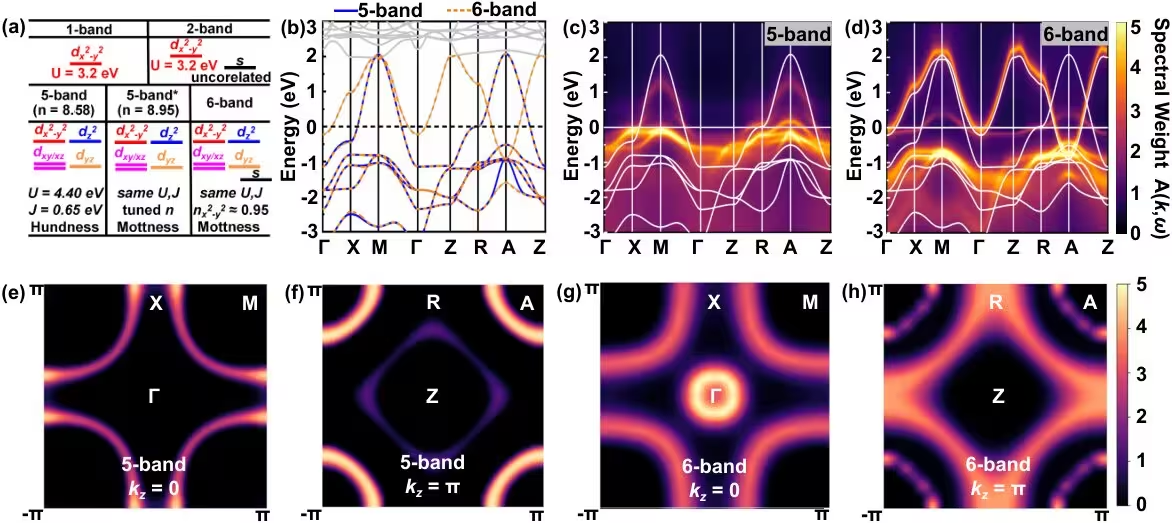
This finding explains why simpler 1-band models have historically succeeded in reproducing experimentally observed superconducting domes in nickelates despite ignoring multi-orbital complexity. The authors report that while the 1-band framework remains an adequate and efficient tool for describing superconductivity, it becomes insufficient when researchers investigate multi-band phenomena such as optical conductivities. The interstitial-$s$ band provides an additional channel that contributes substantially to the low-frequency Drude weight, which measures how easily charge carriers move through the material.
Balancing Simplicity and Accuracy in Quantum Materials
The study highlights that the accuracy of a theoretical model cannot be judged solely by the number of orbitals it contains. Instead, the appropriate choice of model depends strictly on the specific physical properties being investigated. Neglecting essential auxiliary bands can lead to incorrect conclusions about single-band versus multi-band correlation physics, while including them helps reconcile theoretical predictions with experimental data from advanced spectroscopic measurements.
The study was posted to the arXiv preprint server on November 18, 2026.
This article has been fact checked for accuracy, with information verified against reputable sources. Learn more about us and our editorial process.
Last reviewed on .
Article history
- Latest version
Reference(s)
- Zhang, Ao. “Reconciling Models for Infinite-Layer Nickelate Superconductors: Role of Interstitial-$s$ Band or $A$-Pocket.” arXiv.org <http://arxiv.org/abs/2611.24288v1>.
Cite this page:
- Posted by Bilal Abbasi