Supernova Remnant IC 443 Reveals Dual Gamma-Ray Engines
New modeling splits the famous remnant into a potential particle accelerator core and an extended radiation halo.
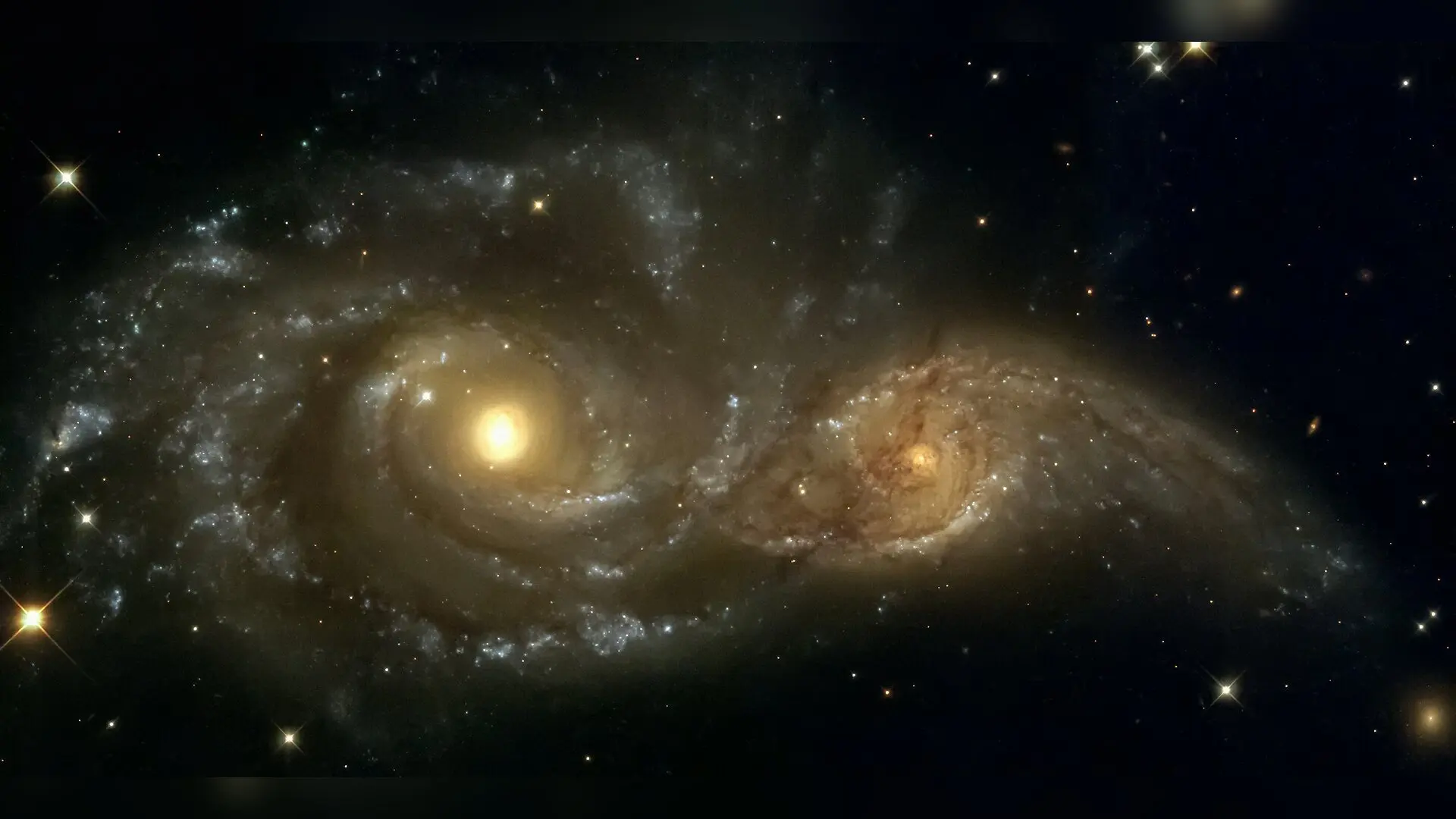
High-energy gamma-ray observations of the middle-aged supernova remnant IC 443 reveal that its emission is split into two distinct components that challenge traditional single-source models. Located roughly 1,500 light-years away, this 3,000 to 30,000-year-old remnant in our galaxy has long puzzled astrophysicists attempting to trace the origins of cosmic rays.
By analyzing data from the Large High Altitude Air Shower Observatory (LHAASO), researchers determined that the remnant’s high-energy output separates cleanly into a compact inner region and a much larger, diffuse halo. The findings, available on the arXiv preprint server, suggest that different physical engines drive each part of the structure.
Decoding the Compact Core C0 and Its PeVatron Potential
The first component, designated C0, sits inside the remnant and maintains a compact spatial distribution consistent with a point source. The authors modeled C0 using a hadronic scenario, which accounts for finite source sizes and the way high-energy protons escape into surrounding molecular clouds. In this framework, protons collide with ambient gas to produce gamma-ray emission through neutral pion decay, a process clearly visible in the spectral data.
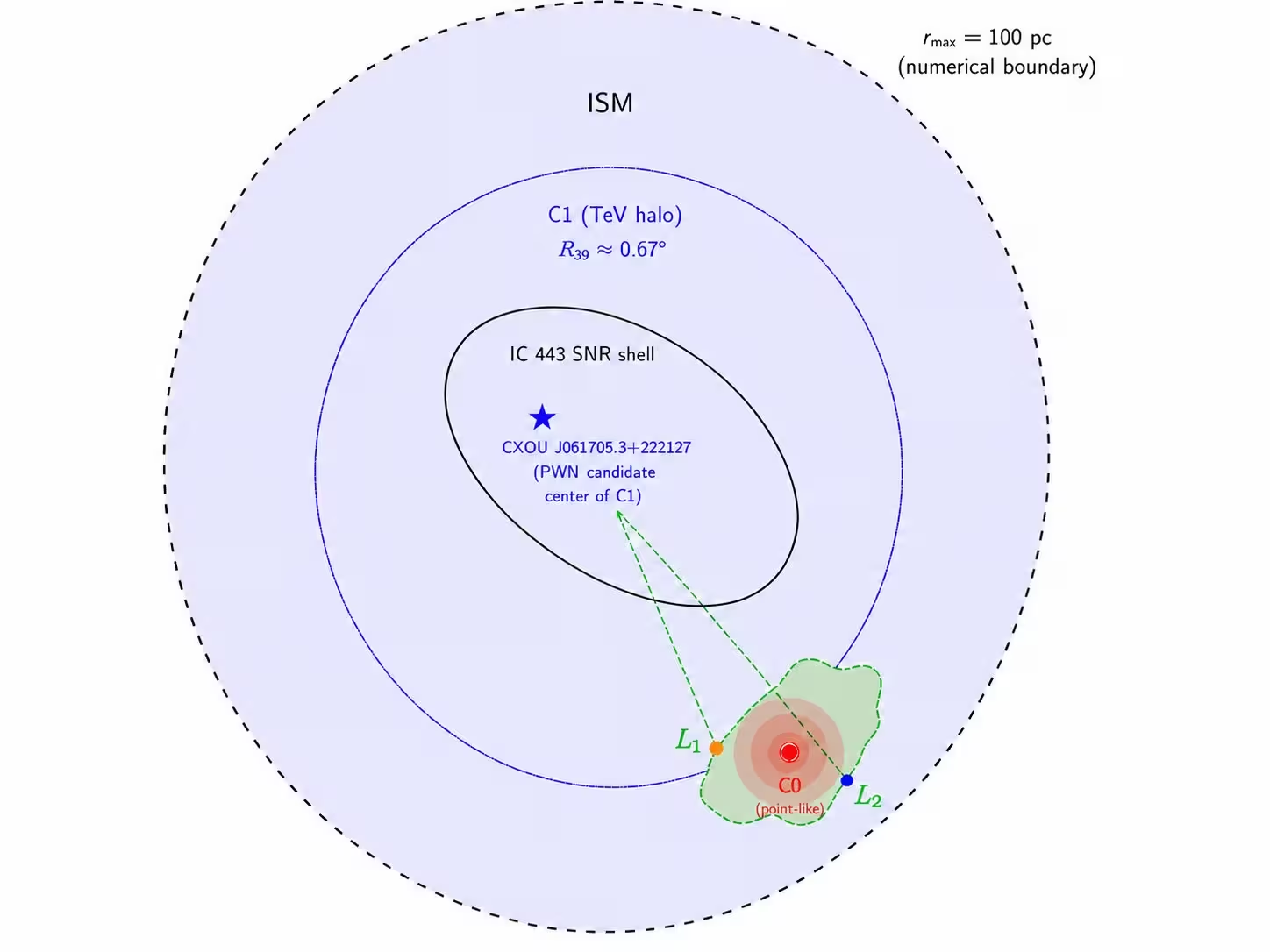
The modeling results indicate that the maximum energy of particles escaping from this core reaches the peta-electronvolt scale. This high energy threshold points to the possibility that component C0 acts as a PeVatron, an accelerator capable of boosting cosmic rays to extreme energies within our galaxy. The diffusion coefficient for protons around C0 appears significantly suppressed, which increases the frequency of particle collisions and strengthens the resulting gamma-ray signature.
Unraveling the Extended Halo Component C1
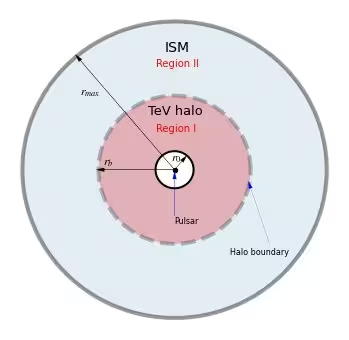
In contrast, the second component, C1, spreads across a much wider region with an angular extent of approximately 0.67 degrees, far exceeding the size of the inner core. To understand this diffuse glow, the team employed a multi-zone leptonic transport model centered on the nearby pulsar wind nebula associated with neutron star CXOU J061705.3+222127. High-energy electrons injected near the pulsar undergo advection, diffusion, and radiative energy losses as they travel outward.
The analysis indicates that the gamma-ray emission from C1 originates primarily from inverse Compton scattering, where energetic electrons collide with ambient galactic background light, such as the cosmic microwave background and infrared radiation fields. The diffusion coefficient in this outer region is found to be roughly two orders of magnitude lower than the standard interstellar medium average. This trapped environment prevents fast particle leakage and allows electrons to accumulate, creating conditions favorable for a TeV halo.
Broader Implications for Galactic Cosmic Ray Physics
The dual-component nature of IC 443 demonstrates that middle-aged supernova remnants cannot always be explained by a single emission mechanism. Instead, the object serves as a bridge connecting supernova remnants, pulsar wind nebulae, and TeV halos into a unified evolutionary picture.
While the models successfully reproduce the spectral energy distributions for both regions, the authors note several limitations in their approach. The assumptions of spherical symmetry and uniform gas density simplify complex three-dimensional interstellar environments where magnetic fields and molecular cloud structures are highly irregular. Future observations combining higher angular resolution gamma-ray data with deep radio and X-ray surveys will help clarify the exact contributions of hadronic and leptonic processes in complex remnants.
The study was posted to the arXiv preprint server on November 18, 2026.
This article has been fact checked for accuracy, with information verified against reputable sources. Learn more about us and our editorial process.
Last reviewed on .
Article history
- Latest version
Reference(s)
- Xian, Yujun. “Possible origins of the two γ-ray components C0 and C1 in IC 443.” arXiv.org <http://arxiv.org/abs/2611.24300v1>.
Cite this page:
- Posted by Aisha Ahmed