AI Pipeline Accurately Predicts How Pathogen Proteins Attack Human Cells
A new open-source tutorial uses machine learning to forecast bacterial interactions with human proteins, cutting down the need for costly lab experiments.

Computers can now predict how human cells and dangerous bacteria interact by analyzing simple protein sequences in a matter of minutes. Researchers developed a complete step-by-step machine learning pipeline to forecast host-pathogen protein-protein interactions without the massive costs of traditional laboratory experiments.
How Machine Learning Decodes Bacterial Invasions
Pathogens rely on specialized proteins to slip past human defenses and cause infectious diseases. Mapping these molecular handshakes is essential for designing targeted drugs and vaccines, but wet-lab experiments remain slow and expensive. To solve this bottleneck, a new computational tutorial published in PLOS One demonstrates how to harness artificial intelligence for rapid interaction forecasting.
The workflow guides scientists through six distinct Google Colab notebooks covering everything from data preparation to final model deployment. By breaking down the process into manageable stages, researchers with limited computational backgrounds can train and test predictive systems.
Building and Testing the Predictive Models
The team gathered a positive dataset of 4,459 experimentally verified human-bacterial protein interactions from the Bacterial and Viral Bioinformatics Resource Centre. This collection included proteins from four major disease-causing genera: Bacillus, Escherichia coli, Francisella, and Yersinia. Because gold-standard negative datasets do not exist in nature, the authors generated non-interacting pairs computationally using random selection across human proteins from UniProt and the bacterial proteomes.
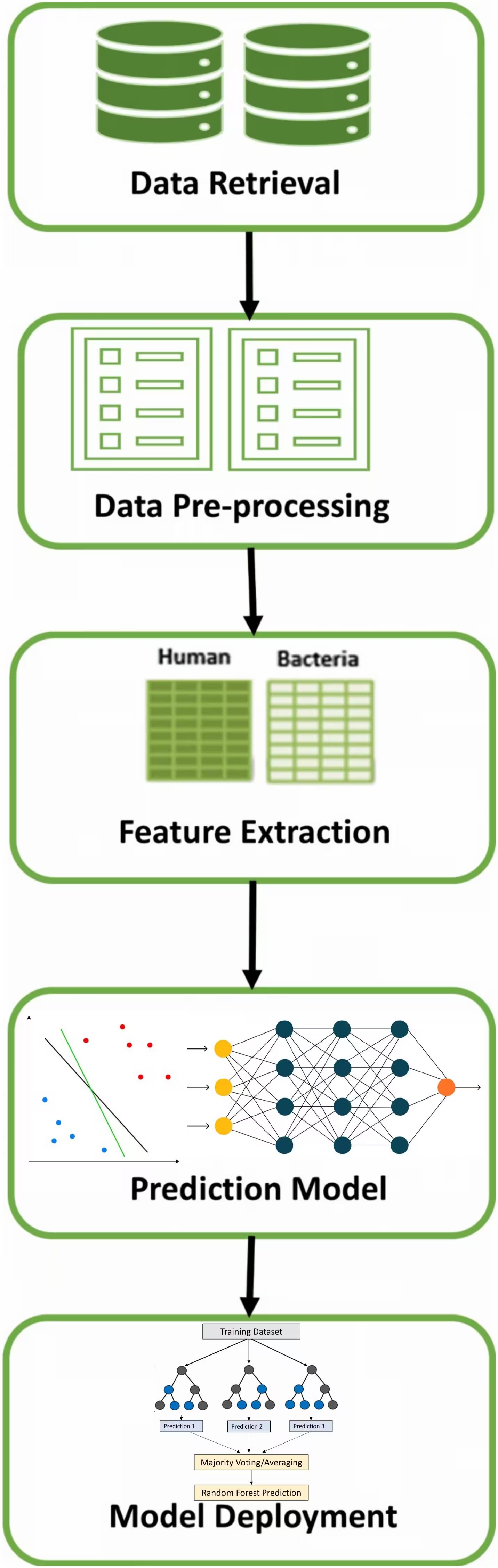
To prevent data leakage, the researchers implemented a host-disjoint homology-aware partitioning strategy using CD-HIT with a 40% sequence identity threshold. This ensured that closely related host proteins did not appear in both the training and testing sets. Feature extraction transformed raw amino acid sequences into numerical vectors using Amino Acid Composition alone, as well as a combination of Pseudo-Amino Acid Composition and Conjoint Triad descriptors via the iFeature toolkit.
Comparing Six Different Classifiers Across Class Ratios
The study evaluated six popular machine learning algorithms: Logistic Regression, Support Vector Machine, Random Forest, Multi-layer Perceptron, Extreme Gradient Boosting, and Light Gradient Boosting Machine. Tests were run across a balanced 1:1 ratio and imbalanced 1:5 and 1:10 positive-to-negative ratios to observe how data distribution affects performance.
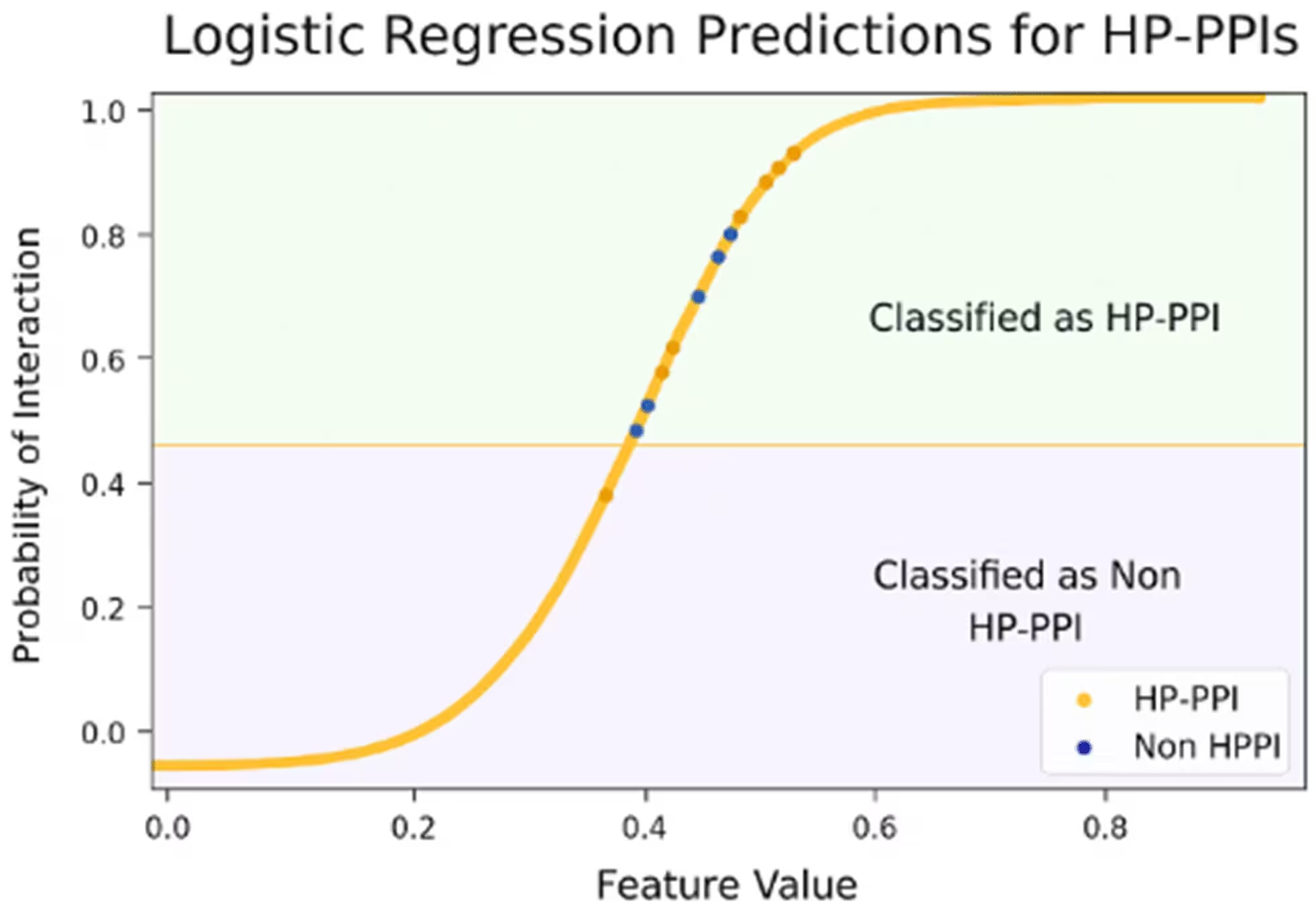
For the balanced dataset using combined features, Extreme Gradient Boosting achieved an accuracy of 0.896, a sensitivity of 0.868, and an area under the receiver operating characteristic curve of 0.955. When handling imbalanced data with a 1:10 ratio, Extreme Gradient Boosting reached an overall accuracy of 0.972 with combined features. After hyperparameter tuning through ten-fold cross-validation, Light Gradient Boosting Machine emerged as the top-performing model based on Matthews correlation coefficient values.
Understanding Generalization Limits and Future Directions
Leave-One-Pathogen-Out validation revealed significant variation when the models attempted to predict interactions for a pathogen held entirely out of training. The models performed best when predicting Bacillus interactions, while Escherichia coli yielded the lowest scores, highlighting limitations in generalizing to entirely novel species.
The authors note that while the current tutorial relies on handcrafted sequence features, future improvements could integrate protein large language models and 3D structural data. The complete pipeline provides a flexible, accessible foundation for studying infectious disease mechanisms and accelerating drug discovery.
The research was published in PLOS One on November 17, 2026.
This article has been fact checked for accuracy, with information verified against reputable sources. Learn more about us and our editorial process.
Last reviewed on .
Article history
- Latest version
Cite this page:
- Posted by Hassan Raza