Mat Pilates Fails to Speed Up Recovery During Breast Cancer Radiation
A randomized trial of 156 women shows that mind-body exercise classes during radiation therapy do not accelerate physical fitness or lower depression rates.
A structured exercise program combining mind-body movements and light strengthening does not speed up physical recovery or lower depression rates for women undergoing standard radiation therapy for breast cancer, according to new research. While physical health naturally rebounds over time following treatments like lumpectomies and mastectomies, adding supervised Mat Pilates sessions twice weekly during radiation does not alter that trajectory.
Breast cancer remains the most diagnosed cancer among women worldwide, with approximately 2.3 million new cases predicted globally in recent years. Radiation therapy serves as a standard post-surgical treatment that effectively reduces local recurrence rates by up to 70 percent. However, the rigorous weeks of radiation frequently trigger debilitating side effects, including severe fatigue, skin irritation, anxiety, and a significant drop in physical activity levels.
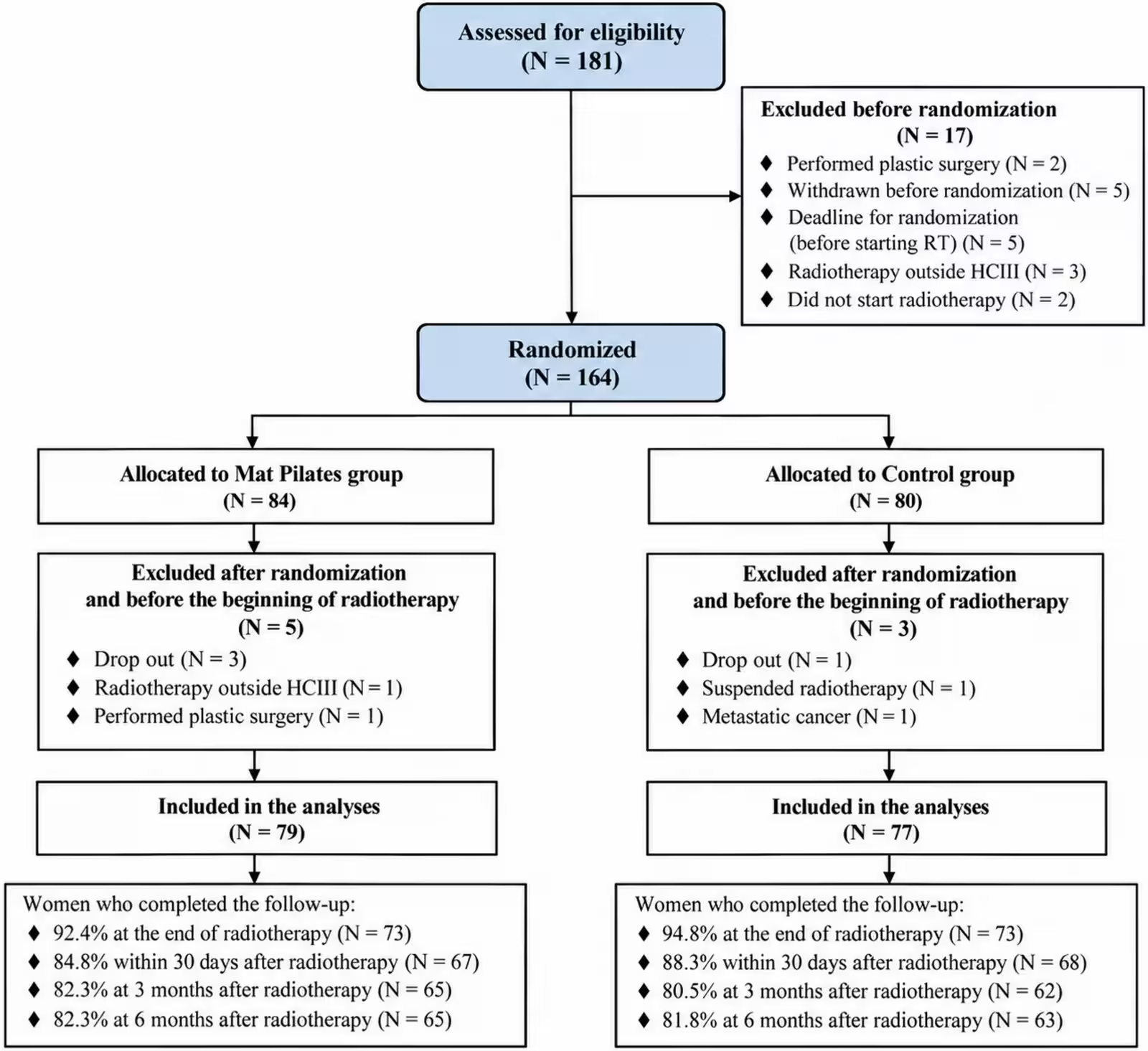
To investigate whether targeted exercise could mitigate these challenges, researchers conducted a clinical trial involving 164 women aged 18 and older diagnosed with stage 0 to III breast cancer. The findings were published in Supportive Care in Cancer by Daniele Medeiros Torres and colleagues at the National Institute of Cancer in Rio de Janeiro, Brazil.
How the Clinical Trial Was Structured
Eligible patients were randomly assigned either to a control group receiving standard care and home exercises or to an intervention group that attended supervised Mat Pilates sessions. Out of the total participants, 156 women completed the rigorous follow-up evaluations, comprising 79 individuals in the Mat Pilates group and 77 in the control group.
The Pilates intervention took place right at the hospital physiotherapy gym twice a week throughout the duration of each patient’s radiation schedule, which lasted from three to six weeks and amounted to between 7 and 12 total sessions. Each 60-minute session was led by certified physiotherapists using mats, Swiss balls, and light-to-moderate resistance elastic bands. Adherence was moderate, with about 67 percent of participants attending at least 70 percent of their prescribed classes.
What the Physical and Mental Assessments Revealed
The research team tracked multiple health markers at baseline, immediately after radiation ended, and at 30 days, 3 months, and 6 months post-treatment. Physical capacity was measured using handgrip strength tests with a hand dynamometer and the 2-Minute Step Test, where participants marched in place to a set rhythm. Flexibility was evaluated via standard sit-and-reach box tests, while mental health was monitored using the 15-item Geriatric Depression Scale.
Statistical analyses revealed no significant group-by-time interactions for handgrip strength, functional exercise capacity, or flexibility. This indicates that women attending Mat Pilates did not experience faster or greater physical improvements than those receiving standard care alone. Similarly, tracking the development of new mental health struggles among women without depressive symptoms at baseline showed no significant differences between the two groups.
Why Improvements Occurred Without the Intervention
Despite no added benefit from the Pilates classes specifically, both groups of women demonstrated measurable physical recovery over the six-month tracking period. Handgrip strength and step test scores rose significantly by six months post-radiation compared to baseline measurements, and flexibility scores also improved temporarily.
The authors suggest these general improvements may stem from continuous encouragement to maintain regular daily physical activities as tolerated, alongside the regular physical assessments that kept participants engaged in their recovery. Furthermore, the two-day-per-week frequency and short duration of the Pilates exposure may have been too brief to yield distinct physical advantages over routine home activity.
Limitations and Future Directions for Patient Care
The trial faced several limitations that should be considered when interpreting the results. The intervention period was relatively short, and loss to follow-up reached nearly 19 percent by the final six-month mark. Additionally, the study was originally powered to detect changes in fatigue rather than secondary physical markers.
While structured Mat Pilates did not outperform routine care in this specific window, researchers emphasize that physical rehabilitation remains vital for cancer survivors. Future investigations with larger sample sizes and higher exercise doses will help clarify what specific fitness regimens best support patients navigating post-surgical recovery.
The research was published in Supportive care in cancer : official journal of the Multinational Association of Supportive Care in Cancer on November 14, 2026.
This article has been fact checked for accuracy, with information verified against reputable sources. Learn more about us and our editorial process.
Last reviewed on .
Article history
- Latest version
Reference(s)
- Torres, Daniele Medeiros., et al. “Changes in functional capacity, flexibility and depressive symptoms in women with breast cancer submitted to adjuvant radiotherapy: randomized controlled clinical trial with mat pilates.” Supportive Care in Cancer, vol. 34, no. 12, November 14, 2026 Springer Science and Business Media LLC, doi: 10.1007/s00520-026-11448-6. <https://doi.org/10.1007/s00520-026-11448-6>.
Cite this page:
- Posted by Sana Malik