New Brain-Computer Interface Framework Decodes Continuous Hand Movement Across Different Patients
A two-stage neural decoding architecture separates velocity anchoring from trajectory refinement to improve motor control generalization across disparate brain recordings.

When human hands reach, grasp, or lift objects, the brain encodes this continuous movement across multiple temporal scales rather than as a series of isolated snapshots. Traditional brain-computer interfaces struggle to generalize this neural control across different individuals and recording systems because direct mappings often entangle subject-specific variability with task-dependent motion patterns. To overcome these hurdles, researchers recently introduced a framework called AMRT, which stands for Anchoring Motion and Refining Trajectories. The new approach uses a two-stage design that separates short-range velocity estimation from long-horizon trajectory correction. Across three public datasets involving scalp electrical recordings and intracranial brain signals, the authors report that the framework successfully generalizes to unseen trials, new subjects, and distinct movement tasks. The study is available on the arXiv preprint server.
How Brain Signals Translate Into Continuous Motion
Brain-computer interfaces translate electrical activity from the central nervous system into commands for external devices such as computer cursors and robotic limbs. While many existing decoding studies focus on classifying discrete actions, real-world motor control requires smooth, moment-to-moment adjustments. Reconstructing continuous hand trajectories from electrophysiological signals remains difficult because neural signals vary substantially across individuals and recording setups.
Furthermore, standard decoding methods typically try to predict absolute position or velocity directly in a single step. Direct position models are closely tied to specific starting states and task workspaces, whereas direct velocity models tend to accumulate integration errors over time. Drawing inspiration from how the motor cortex separately encodes movement direction, speed, and population dynamics, the team designed AMRT to bridge local motion tendencies with global trajectory consistency.
A Two-Stage Architecture for Generalizable Decoding
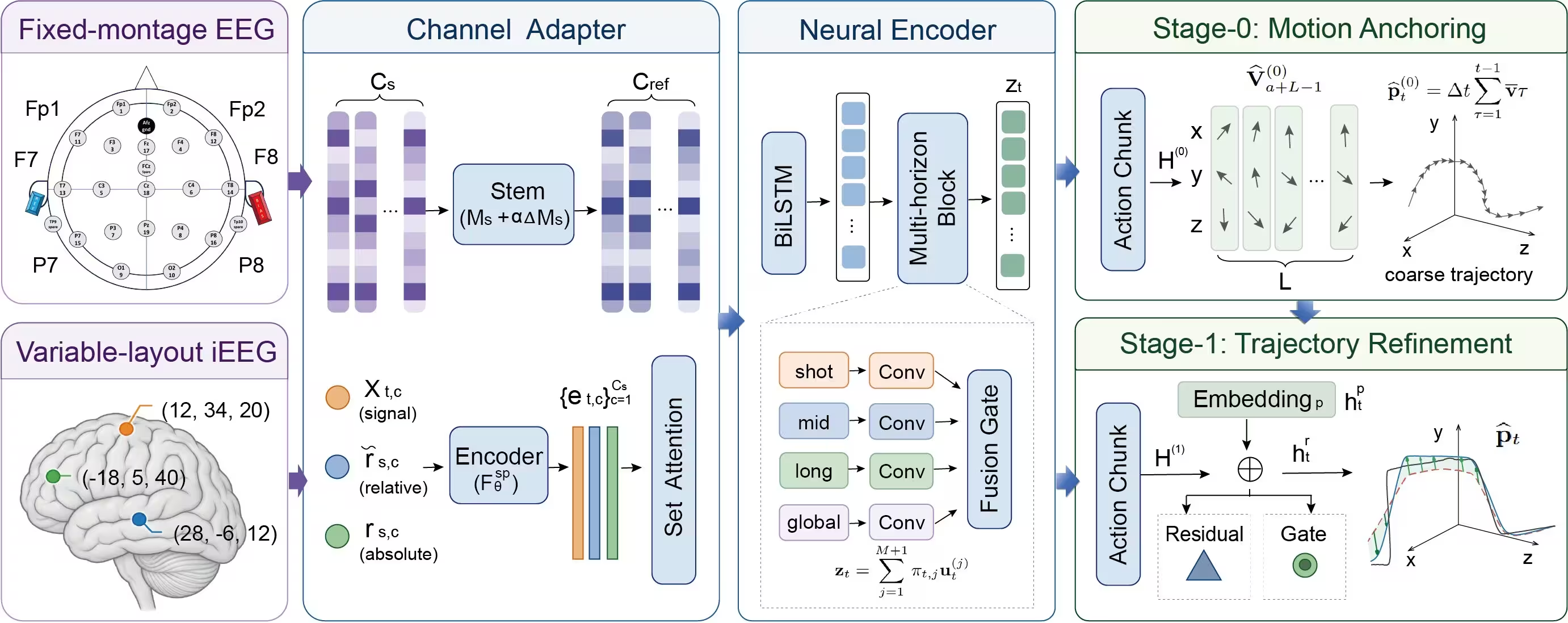
The AMRT framework relies on a modular architecture divided into channel adaptation, multi-horizon encoding, and a two-stage decoding process. Because electrode configurations vary widely between scalp electroencephalography (commonly known as EEG) and intracranial recordings (known as iEEG), the system utilizes modality-aware channel adapters. Standardized EEG montages use exact projections with learnable residuals, while variable iEEG layouts treat contacts as coordinate-annotated sets, aggregating them using spatial queries with masked attention.
Once aligned, a multi-horizon neural encoder processes the temporal context using bidirectional recurrent layers and multi-scale convolutional branches combined with global attention. The decoding pipeline is structured into two distinct operational phases:
- Stage-0 (Motion Anchoring): Predicts an intermediate velocity chunk from the encoded neural representation, establishing locally coherent estimates of movement direction and speed.
- Stage-1 (Trajectory Refinement): Combines the frozen neural memory with the coarse trajectory state to predict residual corrections and a gating mechanism that modulates correction strength over longer horizons.
This decomposition allows the first stage to anchor transferable local motion tendencies while the second stage explicitly compensates for accumulated integration drift.
Performance Across Diverse Datasets and Generalization Settings
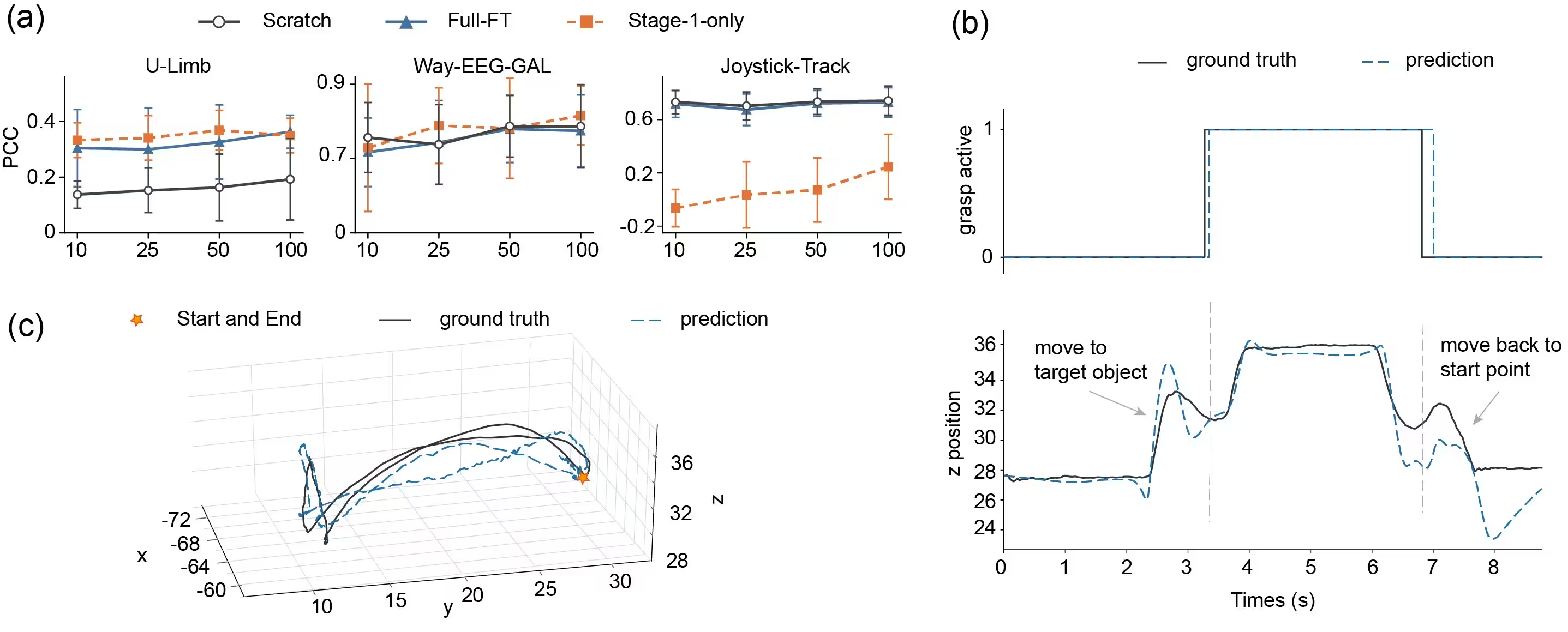
The researchers evaluated their framework across three heterogeneous datasets spanning different movement paradigms and recording modalities, including WAY-EEG-GAL for grasp-and-lift tasks, U-Limb for diverse upper-limb movements, and Joystick-Track for continuous cursor tracking. Under cross-trial evaluations, AMRT consistently achieved the highest trajectory Pearson correlation coefficient across settings, with substantial improvements over baseline models on complex tasks like U-Limb.
When tested on unseen subjects under a leave-one-subject-out protocol, the framework maintained stable performance without requiring target-subject training data. Additional few-shot calibration experiments showed that adapting only the trajectory refinement module in Stage-1 provides a reliable strategy when calibration data are scarce. Cross-dataset transfer experiments further indicated that pretraining can successfully capture reusable neural representations, though transfer success depends heavily on source-target compatibility and the nature of the neural recordings.
The study was posted to the arXiv preprint server on November 16, 2026.
This article has been fact checked for accuracy, with information verified against reputable sources. Learn more about us and our editorial process.
Last reviewed on .
Article history
- Latest version
Reference(s)
- Shen, Fanqi. “Anchoring Motion, Refining Trajectories: Generalizable Continuous Neural Decoding.” arXiv.org <http://arxiv.org/abs/2611.21335v1>.
Cite this page:
- Posted by Hassan Raza