JWST Reveals Unprecedented Power to Spot Cold Sub-Jupiter Worlds
Analysis of 165 nearby stars shows the space telescope surpasses ground-based observatories in hunting distant, low-mass exoplanets.
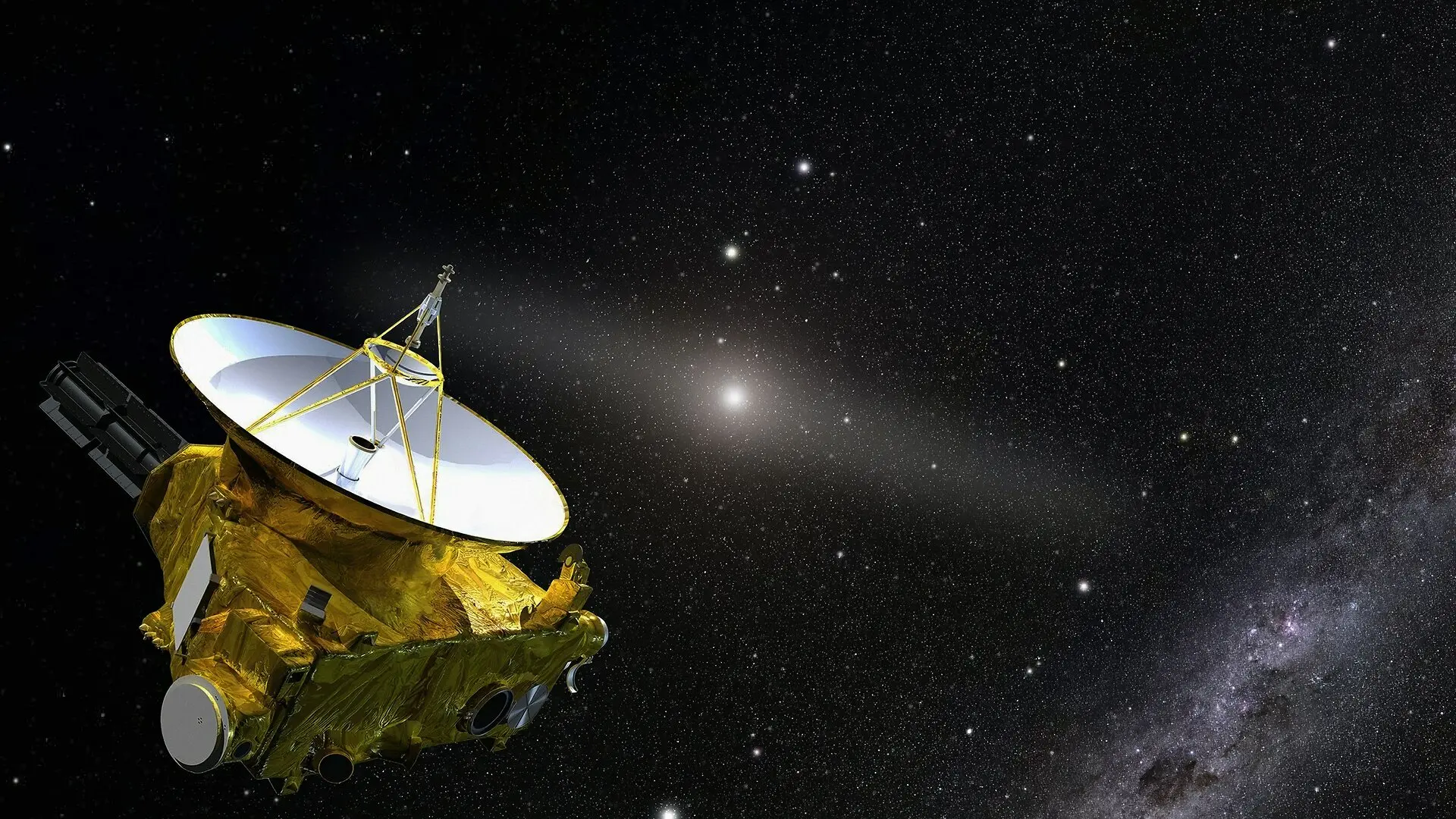
Astronomers peering into the cosmos with the James Webb Space Telescope (JWST) have discovered that its advanced infrared eye is uniquely tuned to spot cold, elusive worlds far from their host stars. By combining data from three dedicated observational campaigns targeting 165 nearby stars, researchers evaluated how effectively the space observatory can detect sub-Jupiter mass exoplanets hidden in wide orbits.
Unlocking a New Cosmic Frontier Beyond 20 AU
Directly imaging planets outside our solar system is notoriously difficult because blinding starlight washes out the faint glow of orbiting bodies. Ground-based telescopes face an even steeper climb due to atmospheric distortion and thermal radiation. However, JWST bypasses Earth’s atmosphere entirely, opening a pristine window in the infrared spectrum where young, cooling planets shine brightest while their parent stars dim.
The study, available on the arXiv preprint server, outlines a sensitivity analysis of three major JWST programs known as GO-4050, GO-5835, and SURVEY-6005. Led by Giovanni M. Strampelli and an international collaboration, the team focused on nearby young stellar associations and moving groups. These loose clusters of stars share similar ages and distances, making them ideal hunting grounds for newborn planetary companions.
How Cold Can JWST See?
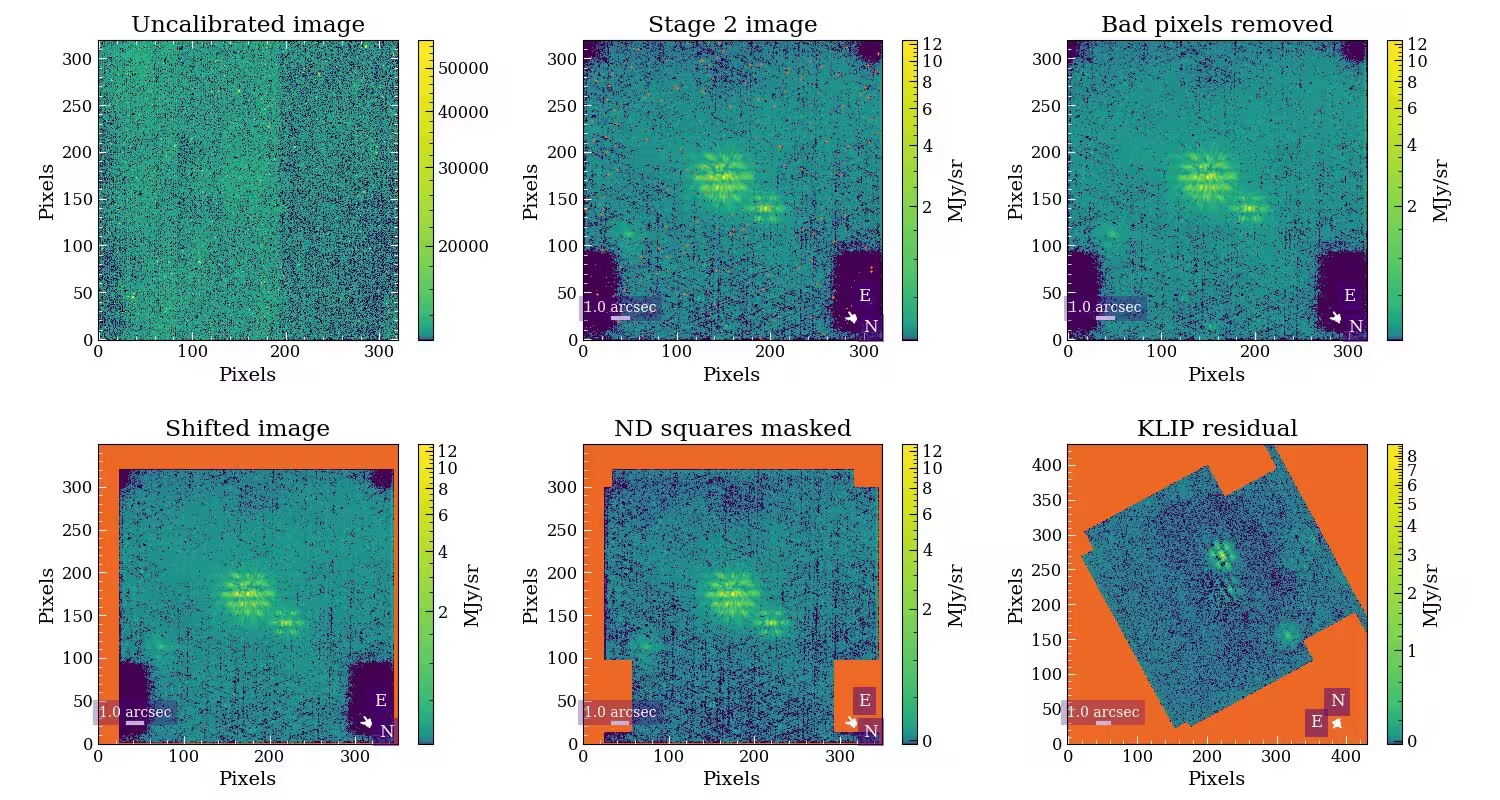
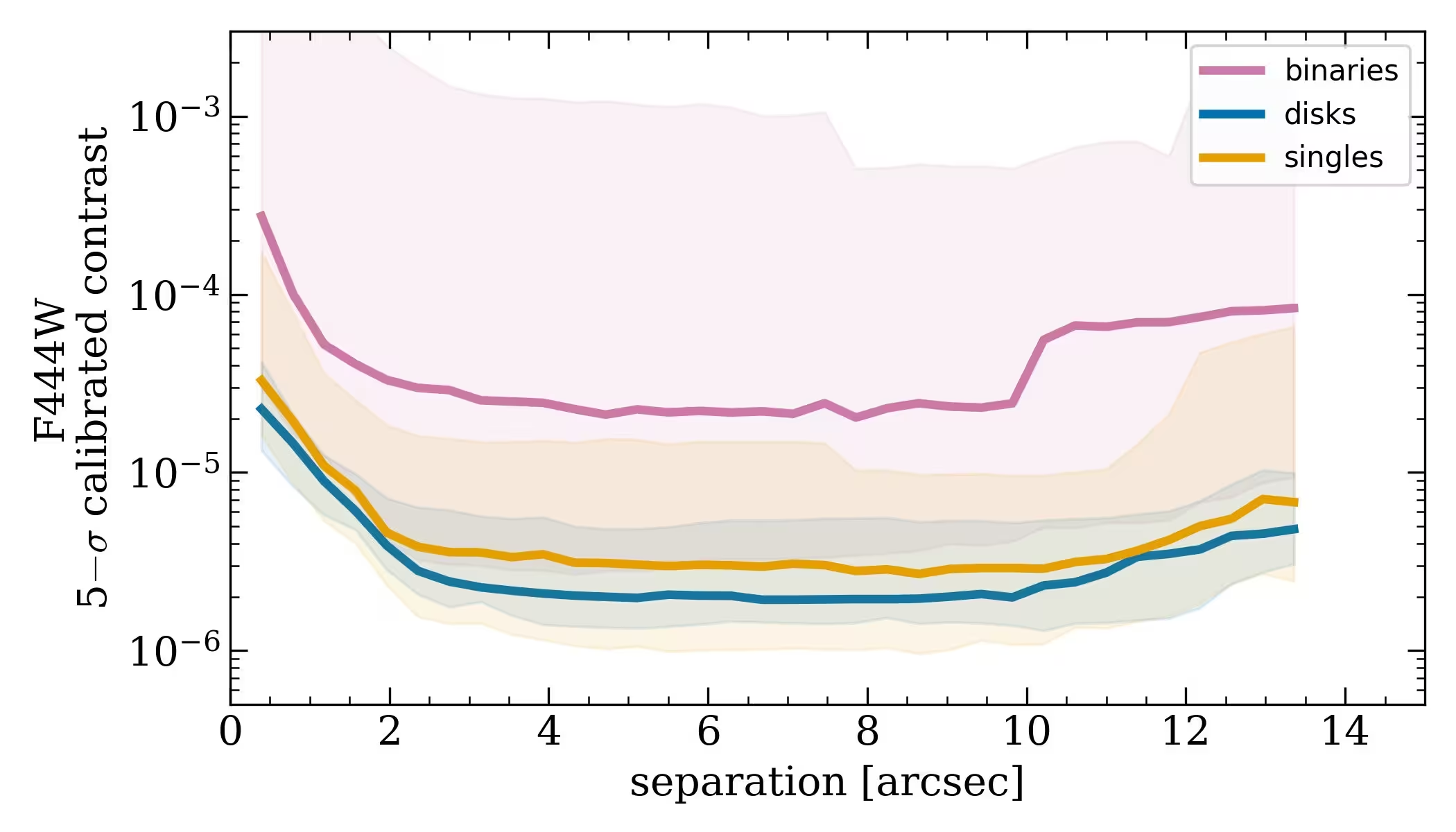
To determine what JWST is truly capable of finding, the authors processed uncalibrated data using specialized pipelines and built a massive reference library of point spread functions to subtract stellar glare. They found that the telescope is sensitive to sub-Saturn to Jupiter mass exoplanets with effective temperatures as low as 250 Kelvin (about minus 23 degrees Celsius) at separations of roughly 2 arcseconds. That corresponds to vast distances of 20 to 500 astronomical units, a region where planets are notoriously difficult to characterize.
The Role of Atmospheric Chemistry and Clouds
A major focus of the research was understanding how atmospheric models affect detectability. At temperatures below 350 Kelvin, exoplanet atmospheres are heavily influenced by cloud decks and complex chemistry. The team tested various atmospheric scenarios, including equilibrium and disequilibrium chemistry alongside different ratios of carbon to oxygen and iron to hydrogen.
The analysis revealed that chemical variations and cloud opacities can significantly alter the thermal glow of a planet. For instance, enhanced metallicity and certain disequilibrium states tend to suppress infrared emissions, pushing the temperature detection limits higher. Despite these hurdles, the findings confirm that JWST easily outperforms existing ground-based facilities, such as the Very Large Telescope’s SPHERE instrument, when searching for worlds lighter than one Jupiter mass at wide separations.
What Happens Next in the Hunt for Distant Worlds?
Predicting how many planets these surveys will ultimately uncover depends heavily on theoretical population models. When applying core accretion synthetic population models and empirical demographic distributions, the researchers calculated expected survey yields ranging from less than one detection up to about four or five new exoplanets, depending on whether planetary systems follow standard distributions or feature enhanced populations of wide-orbit sub-Jupiters.
While the true yield remains to be seen as ongoing follow-up observations validate candidate sources, this sensitivity framework provides a vital roadmap. By charting the limits of what JWST can see, astronomers are laying the groundwork to solve the mystery of how gas giant and sub-giant planets form in the outer reaches of stellar systems.
The study was posted to the arXiv preprint server on November 16, 2026.
This article has been fact checked for accuracy, with information verified against reputable sources. Learn more about us and our editorial process.
Last reviewed on .
Article history
- Latest version
Reference(s)
- Strampelli, Giovanni. “The JWST Sub-Jupiters Survey: Observed Sensitivities to the Wide-Separation, Cold, Sub-Jupiter Exoplanet Population.” arXiv.org <http://arxiv.org/abs/2611.21468v1>.
Cite this page:
- Posted by Nida Rehman