Distant Monster Black Hole Caught Flipped Between Rare Cosmic States
Analysis of seven years of telescope data reveals how particle surges inside a relativistic jet override traditional classification boundaries.
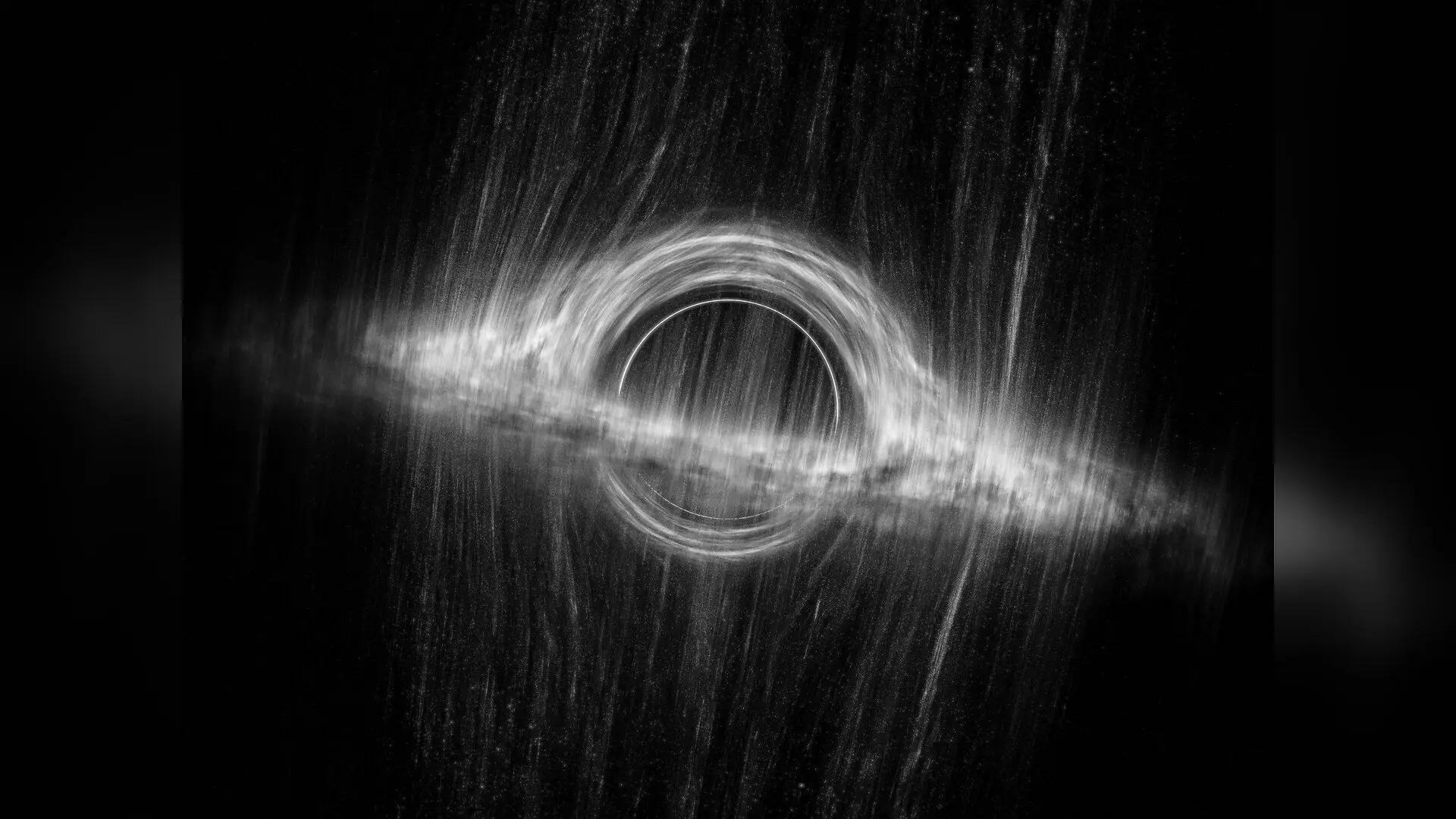
A distant active galaxy known as OQ 334 is challenging astronomers’ understanding of cosmic shifting objects by displaying erratic, multi-year transformations that defy standard classifications. Located at a redshift corresponding to a distance where the universe was much younger, this monster black hole powers a relativistic jet of plasma pointed almost directly at Earth. A team of researchers recently examined archival and telescope data spanning from December 2017 to September 2024, available as a preprint study published on the arXiv preprint server, to track how the object flickers across multiple wavelengths of light.
Decoding the Changing Nature of Blazars
OQ 334 is classified as a changing-look blazar, a rare type of active galactic nucleus that switches its observable identity between two major categories: flat-spectrum radio quasars, which feature strong emission lines in their spectra, and BL Lacertae objects, which appear nearly featureless. Astronomers have debated whether these transitions are caused by sudden changes in how matter feeds onto the central black hole or by bright jet flares that swamp the background glow of the galaxy. The research team analyzed 64 observations from NASA’s Neil Gehrels Swift Observatory alongside gamma-ray data from the Fermi Large Area Telescope and optical measurements from ground-based surveys.
By studying three distinct X-ray flare events labeled X1, X2, and X3, the authors tracked how the high-energy photon index evolved during active phases. During the first two flares, the X-ray spectrum softened and then hardened as the object transitioned between states, matching previous models of changing-look behavior. However, the third and brightest flare, recorded in mid-2024, behaved entirely differently. Instead of softening, it remained exceptionally hard, matching the spectral signatures of a quasar state even at its peak brightness.
What Drives Extreme Jet Flare Evolution
The investigators modeled the broadband spectral energy distribution using a one-zone leptonic framework to understand the physical processes inside the plasma jet. The model assumes a spherical emission region filled with relativistic electrons moving through a magnetic field. Results indicate that the magnetic field remained weak and relatively constant across the outbursts, implying that the flaring activity is driven by changes in the electron population rather than magnetic fluctuations.
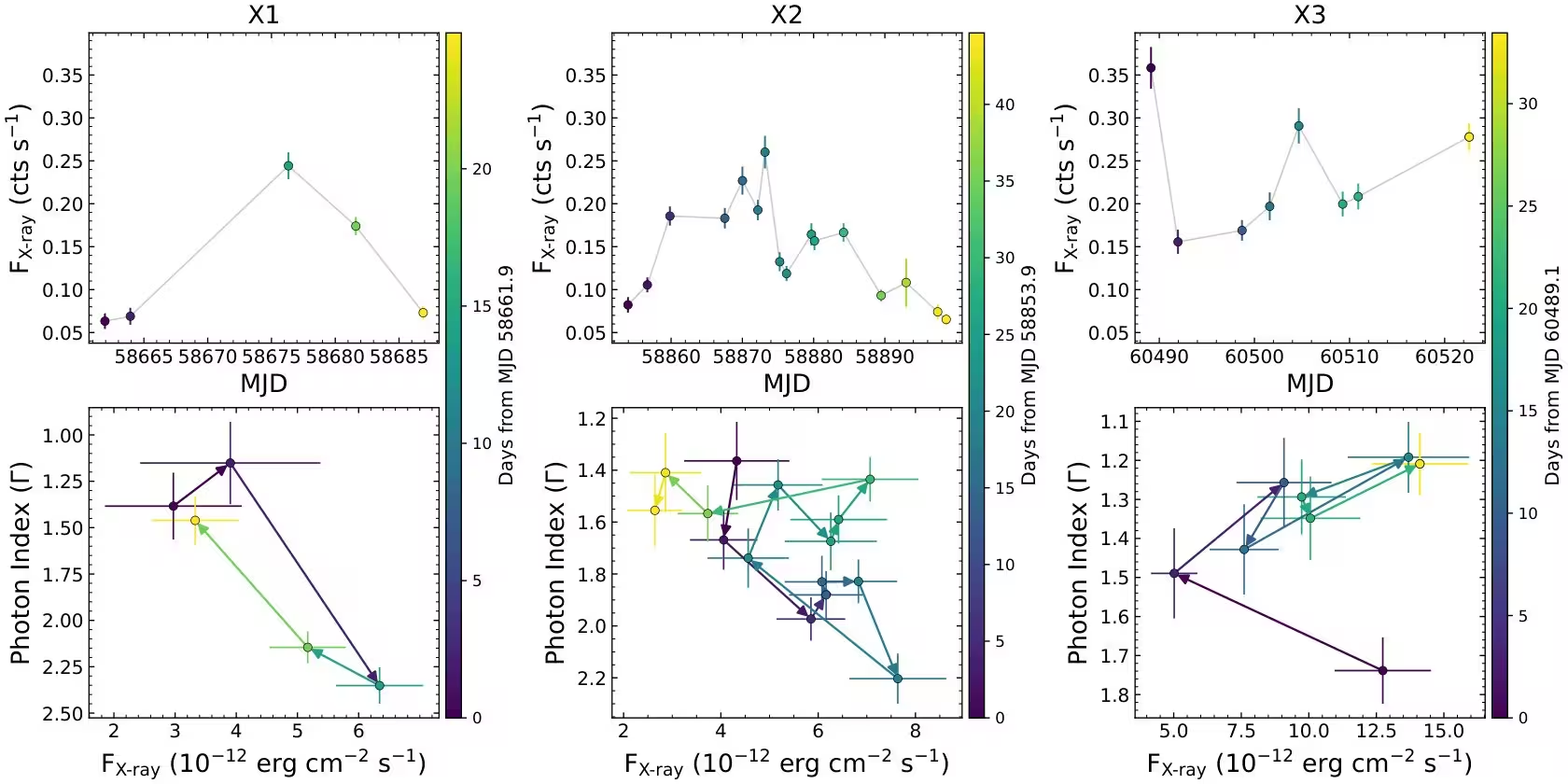
The analysis revealed that the emission region is particle-dominated and far from energy equipartition, with electron energy densities significantly exceeding magnetic energy densities. As the source progressed through its outbursts, the X-ray emission transitioned from being influenced by synchrotron radiation to complete dominance by inverse-Compton scattering, where high-energy electrons collide with ambient photons and boost them into X-rays and gamma-rays.
Limitations and Future Observations
While the multi-wavelength dataset provides a comprehensive look at OQ 334 over a seven-year period, the authors note certain observational limitations, such as incomplete temporal coverage during the rise and fall of the third flare. Furthermore, simultaneous optical spectroscopy would be required to definitively confirm whether the observed state changes are entirely driven by jet-continuum dilution of the broad emission lines. The findings indicate that changing-look behavior in active galactic nuclei involves complex shifts in particle acceleration and cooling mechanisms rather than a uniform evolutionary sequence.
The study was posted to the arXiv preprint server on November 16, 2026.
This article has been fact checked for accuracy, with information verified against reputable sources. Learn more about us and our editorial process.
Last reviewed on .
Article history
- Latest version
Reference(s)
- K, Navaneeth. “X-ray Flare Evolution and Changing-Look Nature of the TeV Blazar OQ 334.” arXiv.org <http://arxiv.org/abs/2611.21518v1>.
Cite this page:
- Posted by Aisha Ahmed