Ancient Black Hole Collisions Could Soon Be Detected by Space and Ground Observatories
Theoretical models show how invisible remnants of the universe’s first stars might reveal themselves through gravitational wave ripples.
A new theoretical study suggests that the invisible remnants of the universe’s very first stars could soon reveal themselves through ripples in spacetime. Researchers have modeled how ancient black holes born from pristine gas clouds at a redshift of 20 spiral inward and collide, creating gravitational wave signals that upcoming observatories might capture.
The universe’s first generation of stars, known as Population III, formed from pure hydrogen and helium more than 13 billion years ago in small dark matter minihaloes with a mass around one million solar masses. As these primordial gas discs fragmented, they gave birth to massive stellar bodies that eventually collapsed into black holes. To understand whether these dense remnants could sink toward the center of their host haloes and merge with a central black hole before the system was disrupted, a team of astrophysicists developed a semi-analytical framework published in the arXiv preprint server.
How Stellar Migration and Gas Drag Shape Ancient Black Hole Mergers
As satellite black hole remnants formed across the primordial disc, they experienced a constant drag force from both surrounding dark matter and dense gas. This process, known as dynamical friction, caused their orbits to decay over time. The researchers tracked this orbital shrinking alongside the growth of a central black hole fed by gas accretion and repeated mergers.
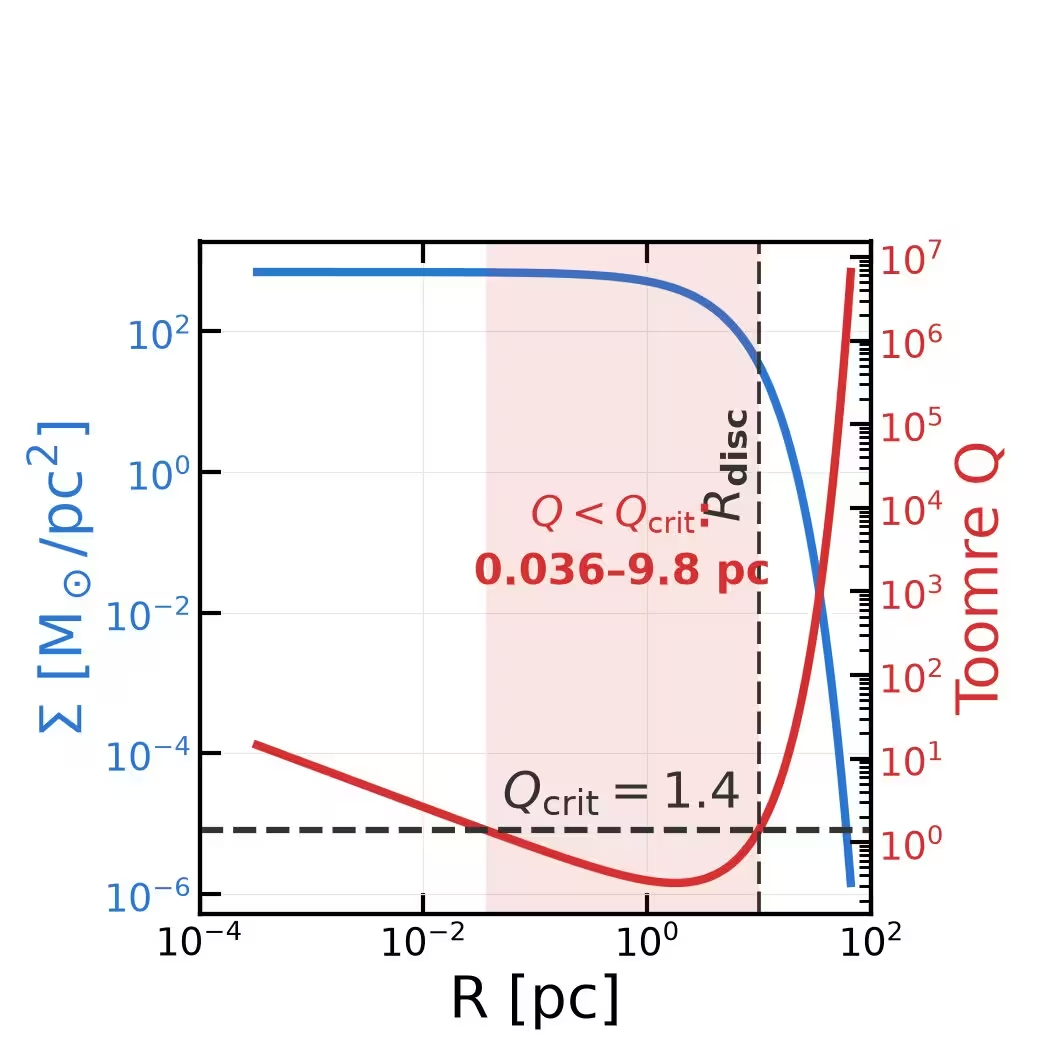
The study found that the detectability of these ancient collisions depends heavily on specific astrophysical conditions, such as the initial mass function of the stars and how efficiently the central black hole consumes surrounding gas. Because different gravitational wave detectors operate across distinct frequency bands, space-based instruments and ground-based facilities prefer entirely different cosmic recipes.
Why Space and Ground Detectors Target Different Black Hole Masses
Space-based observatories excel at spotting heavier systems operating at lower frequencies. The team found that the Laser Interferometer Space Antenna (LISA) is ideally suited for detecting mergers involving massive central black holes with masses between 1,000 and 10,000 solar masses. These environments require efficient gas accretion and a top-heavy stellar mass distribution where heavier stars form more readily.
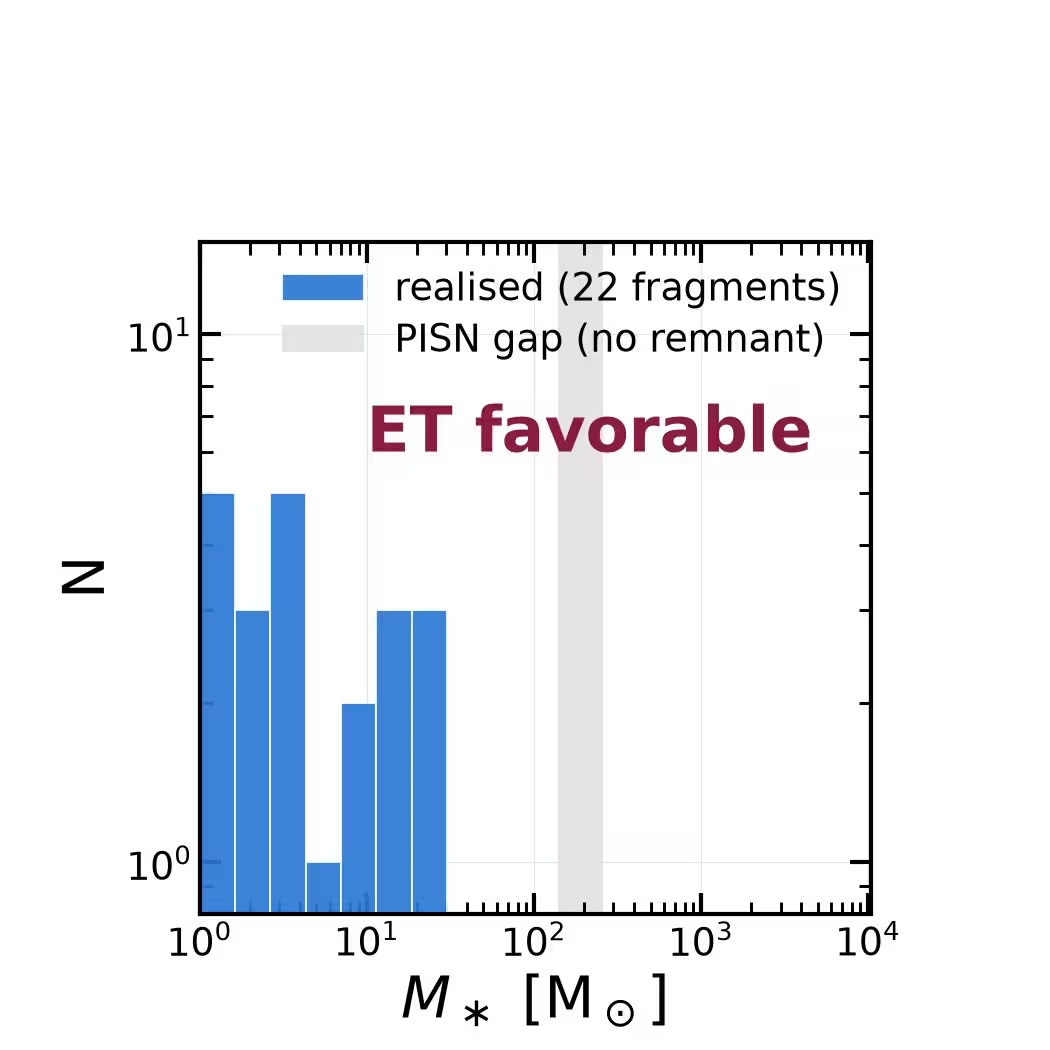
In contrast, ground-based facilities like the Einstein Telescope are sensitive to higher frequencies, making them primed to catch lighter systems. The analysis indicates that ground detectors favor lower-mass black holes with slower gas accretion rates and steeper stellar mass distributions. In these scenarios, primary black holes remain relatively small, around a few tens of solar masses, allowing their inspiral signals to reach frequencies above one hertz where ground instruments have peak sensitivity.
What These Complementary Signals Mean for Early Universe Astronomy
While the current model simulates outcomes within a single representative halo rather than calculating total cosmological rates, the findings point to a powerful synergy between future instruments. Space and ground detectors look into different regions of mass and mass-ratio parameter space, meaning they act as complementary probes of the early universe.
Future extensions of this research will need to incorporate the complex hierarchical assembly histories of host minihaloes across cosmic time. By combining observations from multiple frequency bands, astronomers hope to map out how the very first stars seeded the supermassive black holes observed in the early cosmos.
The study was posted to the arXiv preprint server on November 16, 2026.
This article has been fact checked for accuracy, with information verified against reputable sources. Learn more about us and our editorial process.
Last reviewed on .
Article history
- Latest version
Reference(s)
- Bhatt, Maulik. “Gravitational Waves from Population III Black Hole Mergers in Primordial Gas Disks: Constraining Astrophysical Scenarios with the Laser Interferometer Space Antenna and the Einstein Telescope.” arXiv.org <http://arxiv.org/abs/2611.21580v1>.
Cite this page:
- Posted by John Williams