Distant Binary Star System Surprises Astronomers With Conflicting Outburst Signals
Observations of ASASSN-15af reveal rare shifting behavior in an eclipsing cataclysmic variable located 392 light-years from Earth.
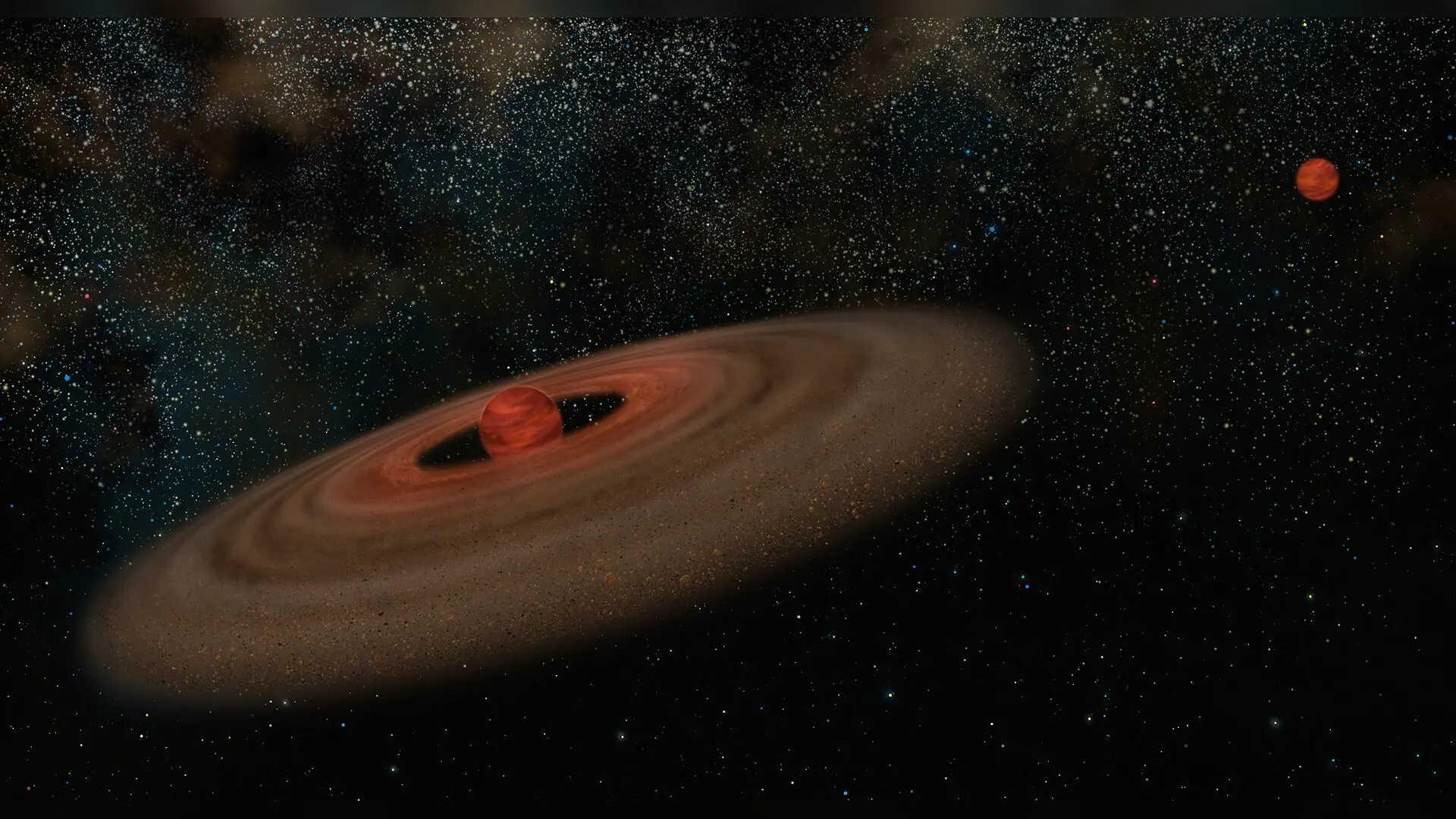
Astronomers tracking a peculiar binary star system known as ASASSN-15af have uncovered a restless stellar laboratory located roughly 392 light-years from Earth. The system features a dense white dwarf star feeding on a low-mass companion, generating wild outbursts and shifting behavior that challenges standard models of stellar evolution.
Cataclysmic variable stars are interacting binaries where material from a normal star spills onto a dense, dead stellar remnant. In the case of ASASSN-15af, which has an orbital period of just 3.596 hours, the system sits safely above the canonical period gap that normally separates different classes of these objects. An international research team examined space telescope observations available on the arXiv preprint server to decode how the system changes when it brightens.
How a Misidentified Star Revealed a Hidden Binary
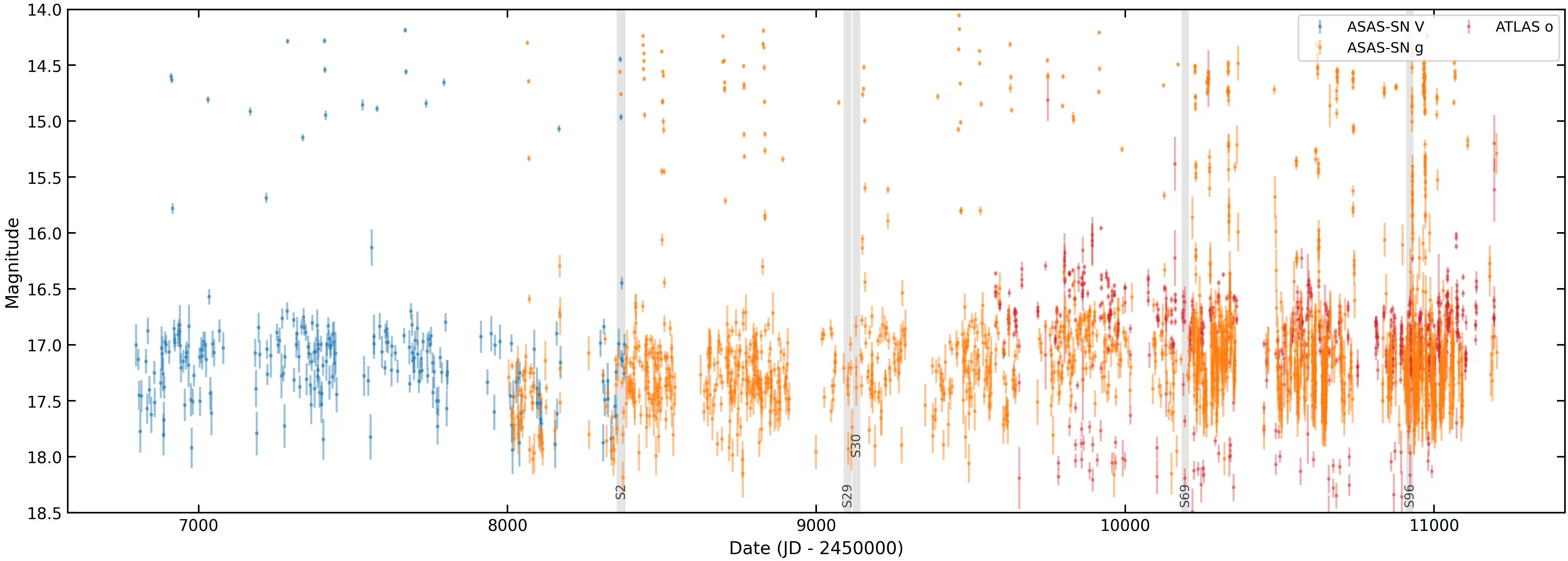
Before astronomers understood its true nature, ASASSN-15af was mistakenly cataloged as a young, flaring star associated with the Orion constellation due to an erroneous database cross-match. Recent surveys corrected this error, pointing out that the object is actually a compact binary system undergoing recurring dwarf nova outbursts. Ground-based monitoring spanning over 4,400 days revealed that the system erupts roughly every 69 days, brightening by several magnitudes as its accretion disk flares up.
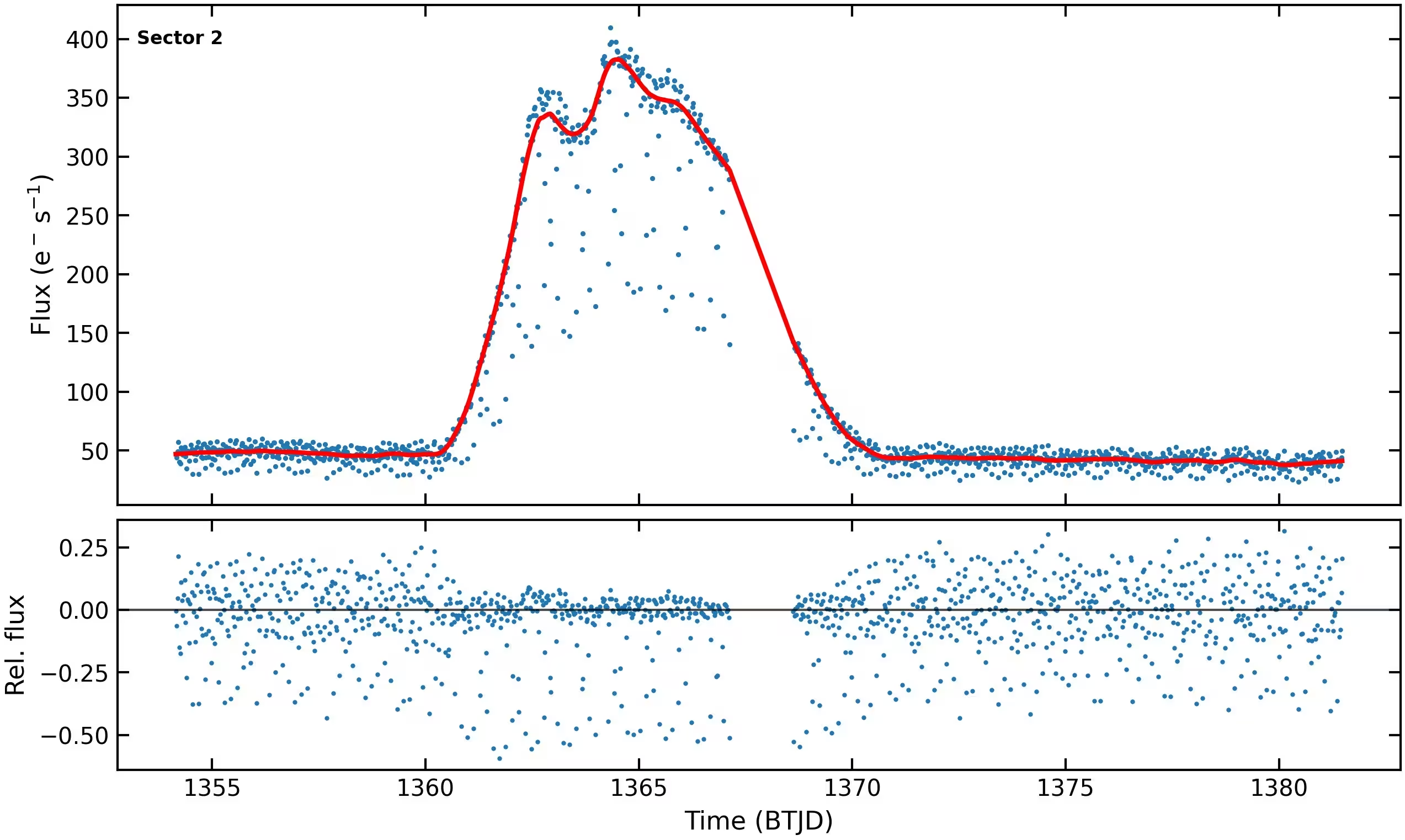
Space-based photometry from NASA’s Transiting Exoplanet Survey Satellite (TESS) provided high-cadence light curves that captured hundreds of eclipses. During these events, the companion star passes directly in front of the glowing accretion disk and white dwarf, blocking their light and allowing researchers to map the system’s geometry with high precision.
Surprising Signals Traveling in Opposite Directions
The most puzzling discovery emerged when the authors analyzed how the system’s baseline light changes outside of eclipses during different outbursts. In normal cataclysmic variables, brightness variations usually follow predictable patterns, but ASASSN-15af showed opposing behaviors during two separate eruption events captured by TESS.
During one outburst in Sector 2, the dominant brightness modulation dropped to a period roughly 1.6 percent shorter than the orbital period. This signature points toward a negative superhump, a phenomenon typically linked to retrograde nodal precession in a tilted accretion disk. Yet during a later outburst in Sector 96, the dominant signal shifted to a period about 3.1 percent longer than the orbit, resembling a positive superhump driven by a precessing, eccentric disk.
The researchers note that observing both modes in separate outbursts within the same system is rare, especially above the period gap. The ratio of these two period offsets sits near 0.51, matching empirical trends seen in other complex binaries where disk geometry shifts between eruptions.
What Happens When the Accretion Disk Brightens
By comparing quiescent periods against outburst phases, the team mapped out dramatic shifts in eclipse morphology. During the Sector 96 outburst, the depth of the primary eclipse increased significantly, and its flux-weighted centroid shifted earlier by nearly 67 seconds. Meanwhile, the physical width of the eclipse core remained largely unchanged.
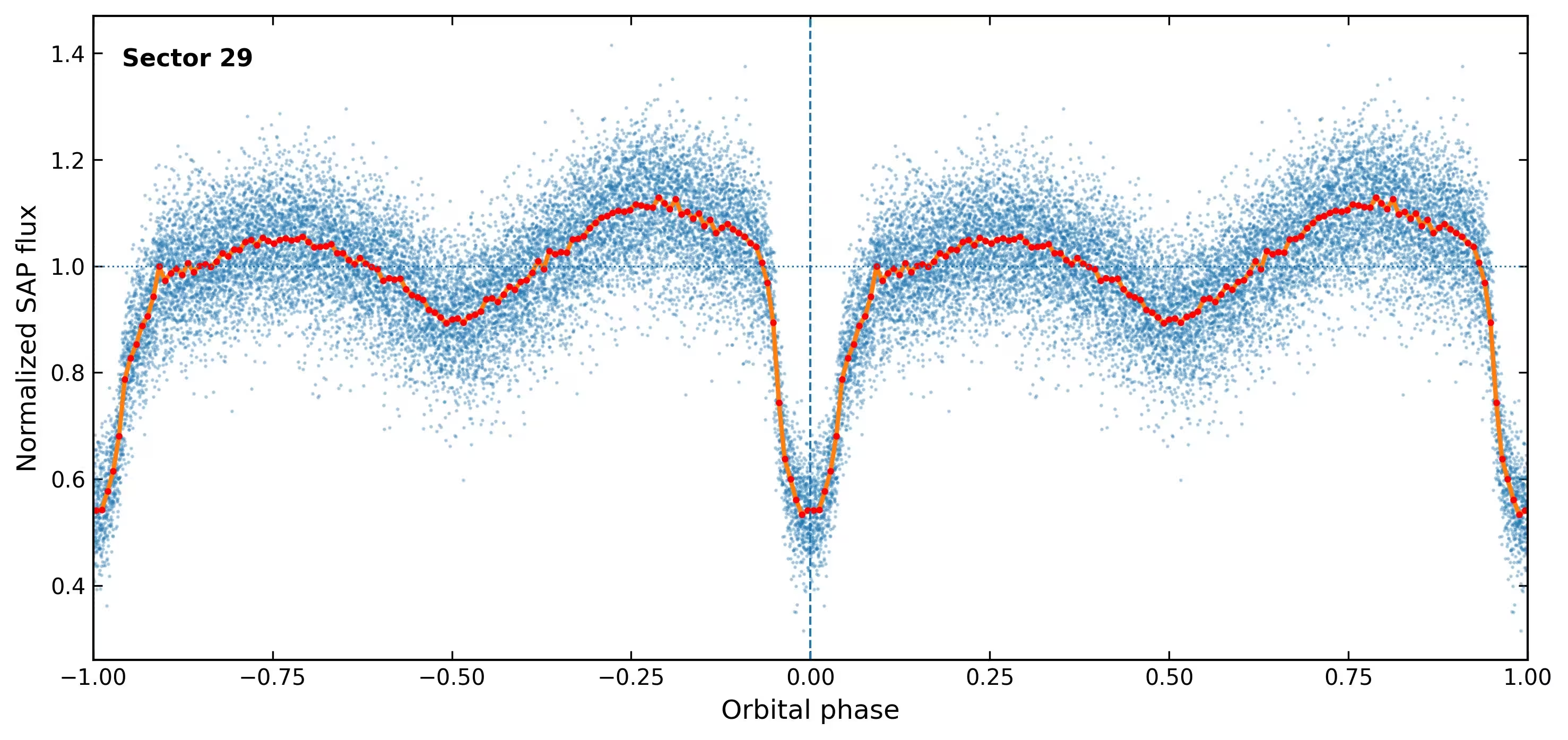
The authors explain that these changes occur because the accretion disk itself becomes immensely bright during an outburst, overshadowing the constant light of the companion star. This sudden flooding of light alters the center of luminosity in the system, shifting the timing of the minimum light observed from Earth without requiring any major disruption to the underlying stellar orbits.
While the eclipse timing data showed a slight curvature over time, the team cautions against interpreting this as long-term orbital decay, noting that accretion-driven variability can easily mimic such trends. Future multi-band photometry and time-resolved spectroscopy will be essential to measure the exact masses of the stars and determine whether ASASSN-15af shares traits with rare systems like SW Sextantis stars.
The study was posted to the arXiv preprint server on November 14, 2026.
This article has been fact checked for accuracy, with information verified against reputable sources. Learn more about us and our editorial process.
Last reviewed on .
Article history
- Latest version
Reference(s)
- Ogunwale, Bisi. “ASASSN-15af: An Eclipsing Cataclysmic Variable above the Period Gap Showing Both Positive and Negative Superhump-like Signals.” arXiv.org <http://arxiv.org/abs/2611.19093v1>.
Cite this page:
- Posted by Nida Rehman