Alien Wind Simulations Reveal Dunes That Can Migrate Backward Against The Gale
New computer models of wind-blown sand across planetary environments show that dense atmospheres can force ripples to move backward as antiripples.
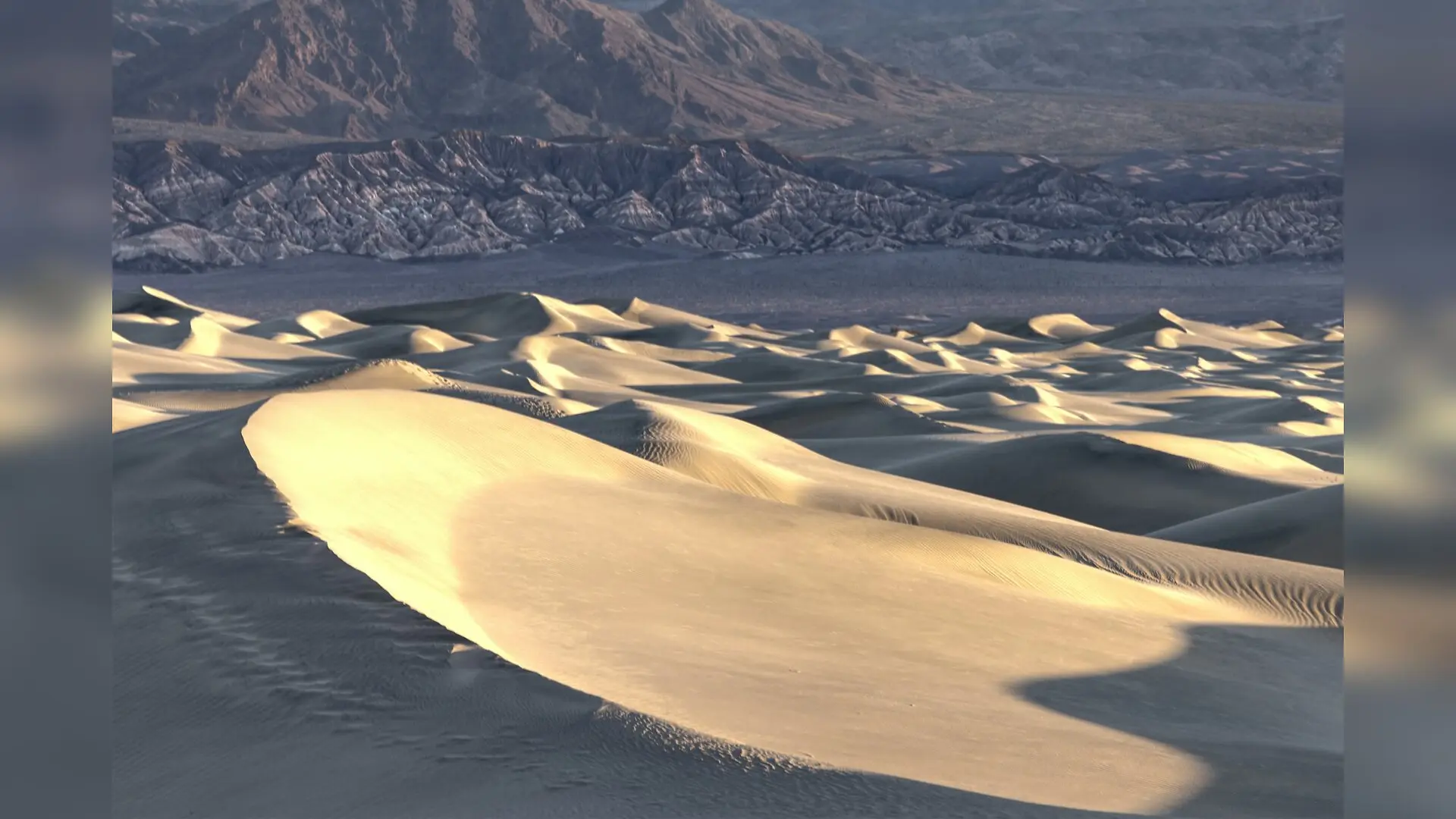
Wind-blown sand on alien worlds behaves in ways that upend textbook physics, with atmospheric pressure dictating whether ripples march forward with the gale or slide backward against the wind. Researchers investigating the fundamental mechanics of wind-driven sediment transport have simulated alien dunes to discover how tiny surface features scale across diverse planetary environments.
The study, published in arXiv by C. W. Lester, O. Duran, and A. B. Murray, addresses a long-standing puzzle in planetary geology. For decades, scientists debated whether wind-blown ripples—known as aeolian ripples—are shaped entirely by grains bouncing along the ground or by fluid pressure waves similar to those seen underwater. Recent laboratory experiments revealed that two distinct sizes of ripples often coexist on Earth and Mars, pointing to two separate formation mechanisms operating at once.
What Controls the Spacing of Wind-Blown Ripples?
To isolate how smaller features called impact ripples form, the authors utilized a specialized discrete element method numerical model. This computational approach tracks individual grain-to-grain collisions coupled with a simplified fluid boundary layer. By testing conditions ranging from the thin, carbon dioxide-heavy atmosphere of Mars to the crushing, high-pressure environment of Venus, the team mapped how atmospheric density and wind speed alter ripple geometry.
The simulations reveal that under low-intensity transport conditions close to the movement threshold, impact ripple wavelengths remain remarkably constant at roughly 200 times the average grain diameter. This spacing is dictated by the spatial lag between where an energetic grain strikes the sand bed and where it splashes fresh grains upward. However, when wind speeds and transport rates increase into a high-intensity regime, the spacing breaks free from grain size and instead scales directly with the average hoplength of bouncing particles.
Why Venusian Dunes Might Move Backward Against the Wind
Perhaps the most startling theoretical outcome involves how fast these ripples migrate across a landscape. While Earth-bound ripples march steadily downwind, the calculations indicate that migration speeds plummet in dense atmospheres. Under conditions mimicking Venus or when exceptionally coarse grains are present on Earth, the direction reverses completely. The simulations show that these features become stationary or transform into antiripples, propagating backward against the prevailing wind.
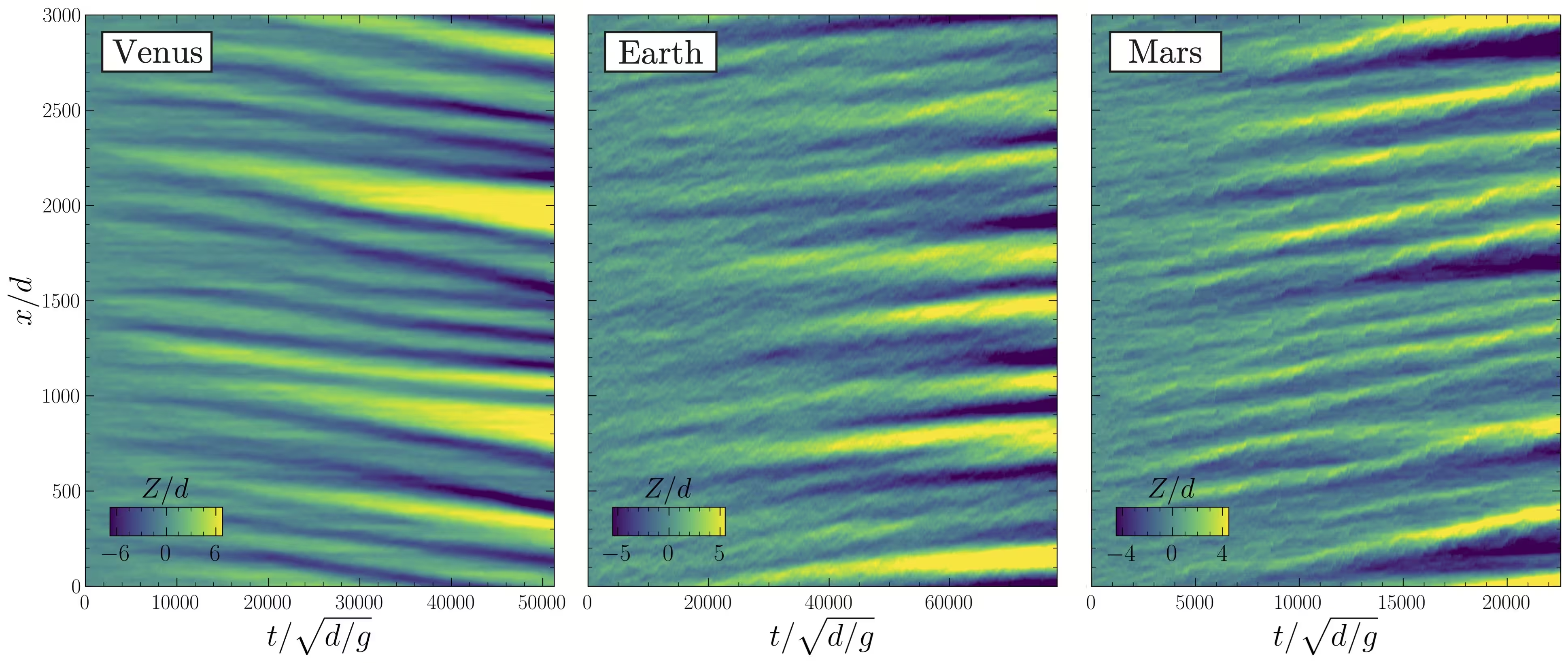
This reversal happens because the critical hoplength shrinks dramatically when the density ratio between the solid grains and the surrounding fluid drops below a certain threshold. In the dense atmosphere of Venus, where the gas exerts a much heavier drag relative to the sand density, the mechanics of particle splashes alter the forward progression of the bedform.
Putting Alien Physics to the Test in Terrestrial Labs
While the prospect of backward-moving antiripples remains to be confirmed in nature or wind-tunnel tests, the framework helps resolve decades of contradictory field data. On Earth, fine sand allows both impact ripples and larger hydrodynamic ripples to overlap at nearly identical scales, confusing past observations. By separating the two phenomena mathematically, the model accounts for why some experiments report fixed grain-scale spacing while others show dramatic variations driven by wind shear velocity.
The authors emphasize that future experimental work will be necessary to test these scaling laws across different materials and to search for the elusive antiripple phase space. Unraveling these microscopic grain interactions not only clarifies desert dynamics on modern Earth but also provides a reliable tool for reading the ancient atmospheric history encoded in the frozen sandstone of Mars and other rocky bodies.
The study was posted to the arXiv preprint server on November 16, 2026.
This article has been fact checked for accuracy, with information verified against reputable sources. Learn more about us and our editorial process.
Last reviewed on .
Article history
- Latest version
Reference(s)
- Lester, C.. “Scaling of impact ripples across planetary conditions.” arXiv.org <http://arxiv.org/abs/2611.21575v1>.
Cite this page:
- Posted by Michael Ellison