Patients Rate Digital Doctor Messaging High on Convenience but Low on Speed
A survey of 500 primary-care app users reveals that administrative tasks thrive via text, while slow response times and urgent clinical questions expose system limits.
When 500 patients in Israel used smartphone applications to message their family doctors, they reported high satisfaction with the convenience of avoiding clinic waiting rooms, but struggled with slow replies and questions about care quality. The study evaluated how everyday users navigate text-based communication with their primary-care physicians across the nation’s four health maintenance organizations.
The cross-sectional study surveyed Hebrew-speaking adults who had actively used a digital health application to message their regular family doctor within the preceding six months. While virtual healthcare expanded dramatically following the pandemic, little research has examined how people experience asynchronous messaging, where patients initiate contact by typing a request and wait for a clinician to reply later. The research was published in PLOS Digital Health, detailing how patient demographics and request types shape digital health interactions.
What Users Value Most in Digital Health Apps
Participants rated their overall user experience on a five-point scale, resulting in a favorable average score of 4.11 out of 5. Continued-use intention received the highest praise with a mean score of 4.52, followed closely by convenience at 4.30 and usability at 4.26. Users overwhelmingly agreed that digital messaging saved them travel time, transit costs, and the hassle of physical appointments.
However, the data revealed clear friction points in the digital service. Perceived response time and the belief that the system enables high-quality care without an in-person visit received the lowest ratings, both averaging 3.90. These scores suggest that while patients appreciate the digital convenience, they remain skeptical about waiting for answers and whether complex medical issues can be safely managed without a physical examination.
Why Administrative Tasks Work Better Than Clinical Questions
Administrative tasks, such as requesting prescription renewals or specialist referrals, made up 64.2 percent of all reported requests, while clinical questions accounted for the remaining 35.8 percent. Statistical models showed that administrative requests were linked to significantly higher ratings for convenience, usability, and continued-use intention. Simple bureaucratic requests have clear, predictable outcomes that translate well to text exchanges.
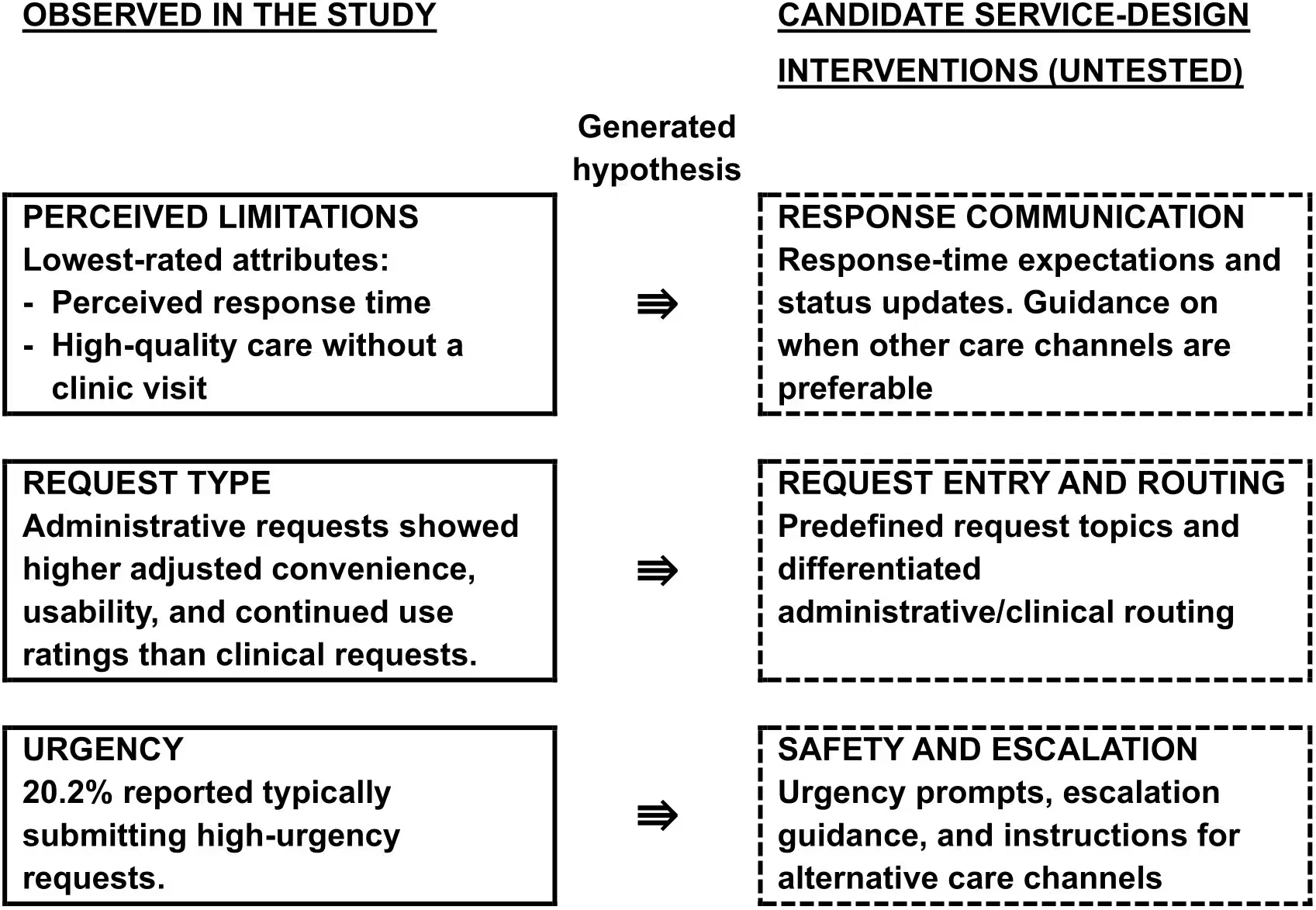
In contrast, clinical issues often require nuanced back-and-forth dialogue or physical checks that text boxes cannot easily accommodate. The authors suggest that separating administrative workflows from clinical inquiries could streamline digital platforms. For instance, routine paperwork could be automatically routed to nursing or administrative personnel, freeing up doctors to handle complex medical symptoms.
The Hidden Risks of High-Urgency Requests
About 20.2 percent of respondents reported that their typical messages involved high-urgency health concerns, a finding that highlights a potential safety hazard in asynchronous systems. Because patients send messages before a doctor reviews the severity, time-sensitive medical problems may sit unread in an inbox while a patient waits for a response. The authors emphasize that digital platforms need better guidance to help users recognize when a symptom requires an immediate phone call, video visit, or emergency room trip rather than a text message.
Furthermore, self-perceived health status influenced user ratings. Respondents who reported good health gave higher scores for response times and continued-use intentions, yet reported lower usability scores than those reporting poorer health. Meanwhile, high-income respondents reported significantly greater trust in the system, pointing to persistent disparities in digital comfort and reliance.
Study Limitations and Next Steps
The study relies entirely on self-reported perceptions from a convenience sample of 500 online-panel participants rather than objective clinical data or actual message logs. Because the survey required internet access and Hebrew fluency, the findings cannot represent the experiences of digitally underserved populations, non-users, or minority groups facing language barriers. Future investigations should combine surveys with real-world system timestamps and clinical outcomes to better measure how digital tools impact primary-care workflows.
The research was published in PLOS Digital Health on November 16, 2026.
This article has been fact checked for accuracy, with information verified against reputable sources. Learn more about us and our editorial process.
Last reviewed on .
Article history
- Latest version
Reference(s)
- Morag, Ido. “Asynchronous primary-care messaging in health maintenance organization digital applications: User experience, workflow, and service design priorities.” PLOS Digital Health, vol. 5, no. 11, pp. e0001841, doi: 10.1371/journal.pdig.0001841. <https://doi.org/10.1371/journal.pdig.0001841>.
Cite this page:
- Posted by Michael Ellison