Novel Spatial Chunking Algorithm Shatters Protein Folding Limits
A new computational architecture bypasses exponential scaling walls to uncover an ultra-dense packing configuration for a 50-residue protein.
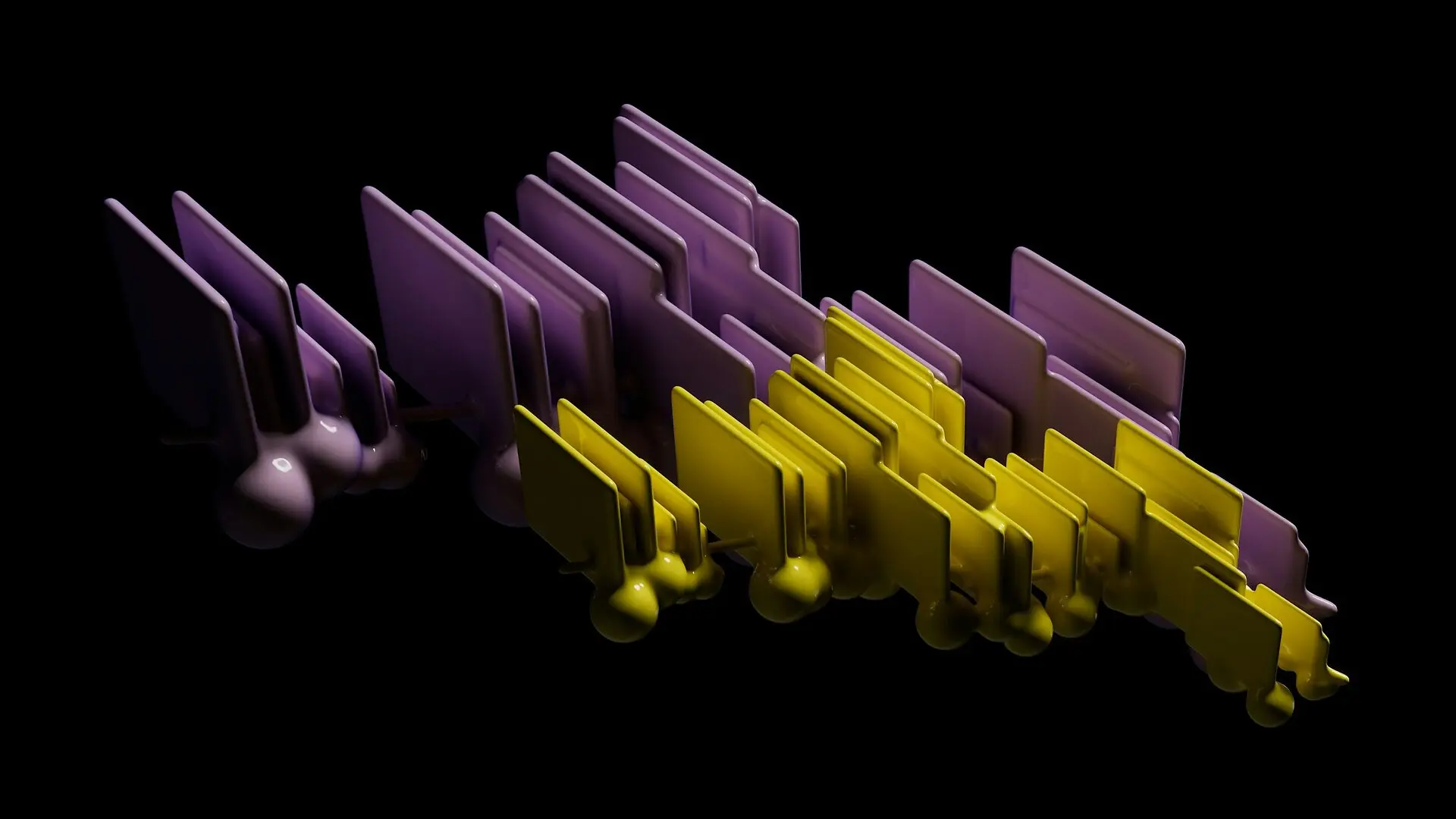
Researchers have shattered a long-standing computational bottleneck in synthetic biology by discovering an ultra-dense packing configuration for a 50-residue protein sequence. The breakthrough tackles the inverse protein folding problem, which asks how to deduce an amino acid chain that will spontaneously fold into a specific 3D shape.
How Spatial Chunking Overcomes Exponential Complexity
Designing protein sequences from scratch is notoriously difficult because the possible arrangements grow exponentially with the length of the chain. For a modest polypeptide chain, the raw search space explodes to twenty to the power of $N$, overwhelming traditional computing power. Standard optimization algorithms rely on random, single-variable point mutations that frequently become trapped in local energy wells, unable to coordinate the multi-variable shifts required to find stable structures.
To solve this, the author Kandula Eswara Sai Kumar available on the arXiv preprint server proposed a hybrid architecture called Topological Spatial Chunking Simulated Annealing. Instead of evaluating the entire chain at once or relying purely on random changes, the system groups variables based on their two-dimensional Euclidean spatial proximity rather than their linear order along the chain. By focusing on localized windows of up to six variables, the algorithm can solve sub-problems deterministically through exact enumeration.
Shattering Established Benchmarks in Structural Biology
The study evaluated this method using the standard Hydrophobic-Polar lattice model, a simplified framework that abstracts proteins into binary chains of hydrophobic elements that collapse inward and polar elements that interact with water. By enforcing a strict biological budget penalty that outweighs local energy rewards, the system treats sequence composition as a hard constraint.
When tested on 20-mer, 25-mer, 50-mer, and 64-mer topologies over 1,500 macroscopic iterations, the approach successfully bypassed widely accepted heuristic boundaries. For the complex 50-mer topology, classical benchmark literature universally identified a 21-contact state with a binding energy of minus 420 as the limiting global threshold. The new spatial chunking architecture discovered an unprecedented packing configuration yielding 22 spatial contacts and a binding energy of minus 440.
Balancing Thermal Shocks and Computational Overhead
To prevent the optimization process from stalling in deadlocks, the framework incorporates dynamic reheating and continuous elitism caching. When stagnation is detected, the algorithm applies targeted thermal volatility to eject the structure from shallow traps without destroying previously attained global minima.
While the hybrid model introduces a higher constant-time penalty than naive simulated annealing due to internal exact-solver compilations, its wall-clock execution latency remains flat even as combinatorial scales expand. The author suggests that future iterations could combine this structural refinement technique with generative deep learning models to rapidly optimize flexible hinge loops and dense hydrophobic cores.
The study was posted to the arXiv preprint server on November 14, 2026.
This article has been fact checked for accuracy, with information verified against reputable sources. Learn more about us and our editorial process.
Last reviewed on .
Article history
- Latest version
Reference(s)
- Kumar, Kandula. “Simulated Annealing with Topological Spatial Chunking for De Novo Protein Sequence Design.” arXiv.org <http://arxiv.org/abs/2611.19158v1>.
Cite this page:
- Posted by Omar Mirza