Nine DNA Hot Spots Reveal How AI Distinguishes Coding Genes
A lightweight neural network achieves 91.87 percent accuracy while exposing the hidden sequence positions that guide genetic classification.
Nine specific hot spots within DNA sequences drive how artificial intelligence distinguishes protein-building regions from non-coding DNA, according to a recent study. While deep neural networks have grown remarkably accurate at parsing genetic data, researchers often struggle to explain how these computational models make their choices.
To unpack this hidden decision-making process, computer scientists Rayhaneh Shabani Nia and Ali Karkehabadi from the University of California, Davis, developed a streamlined computational model. Their findings are available in a study published on the arXiv preprint server (2026). The researchers designed a compact convolutional neural network, a type of algorithm commonly used for pattern recognition, featuring roughly 91,145 trainable parameters to analyze genetic strings.
How the Compact Model Achieved High Accuracy
The research team tested their network using 100,000 DNA sequences of fixed length, each measuring 200 nucleotides, drawn from the standardized Genomic Benchmarks dataset. These sequences provided an even split between protein-coding regions from human transcripts and non-coding intergenomic regions. Despite its lightweight architecture, the model achieved a validation accuracy of 91.87 percent, outperforming baseline models such as HyenaDNA.
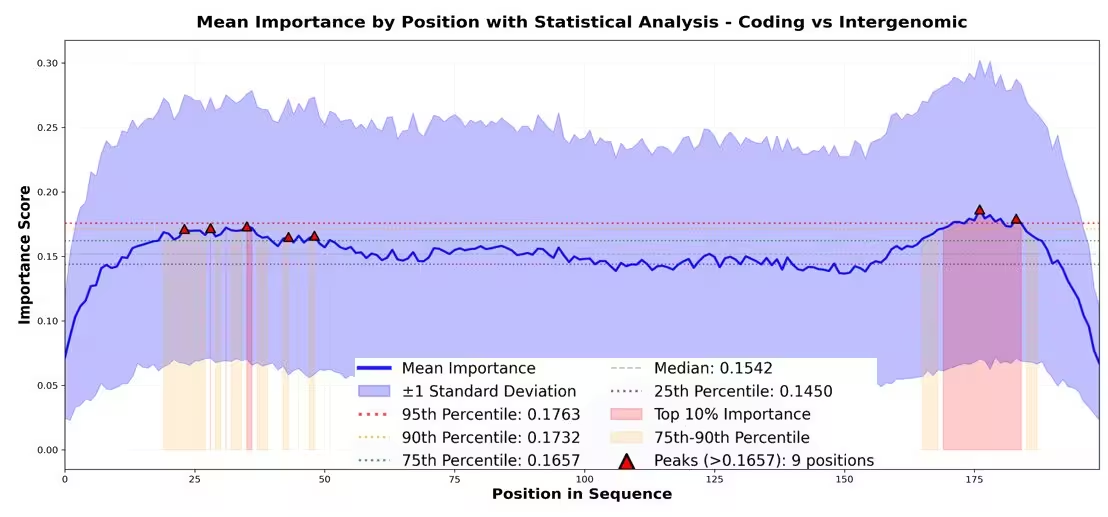
Rather than treating the network as a black box, the authors applied post-training gradient-based analysis to evaluate input embeddings. By measuring how sensitive the model output was to specific nucleotide changes, the team calculated position-level importance scores across 1,000 sequences. This approach revealed where the algorithm concentrated its attention when deciding whether a stretch of DNA coded for proteins.
Which Genomic Regions Drive Predictions
The positional importance profile identified two consistent high-impact regions located at positions 20 to 40 and 160 to 190. Further class-specific comparisons demonstrated that coding sequences concentrated their importance scores between positions 20 and 100. In contrast, intergenomic sequences placed their primary emphasis further down the strand, specifically between positions 150 and 190.
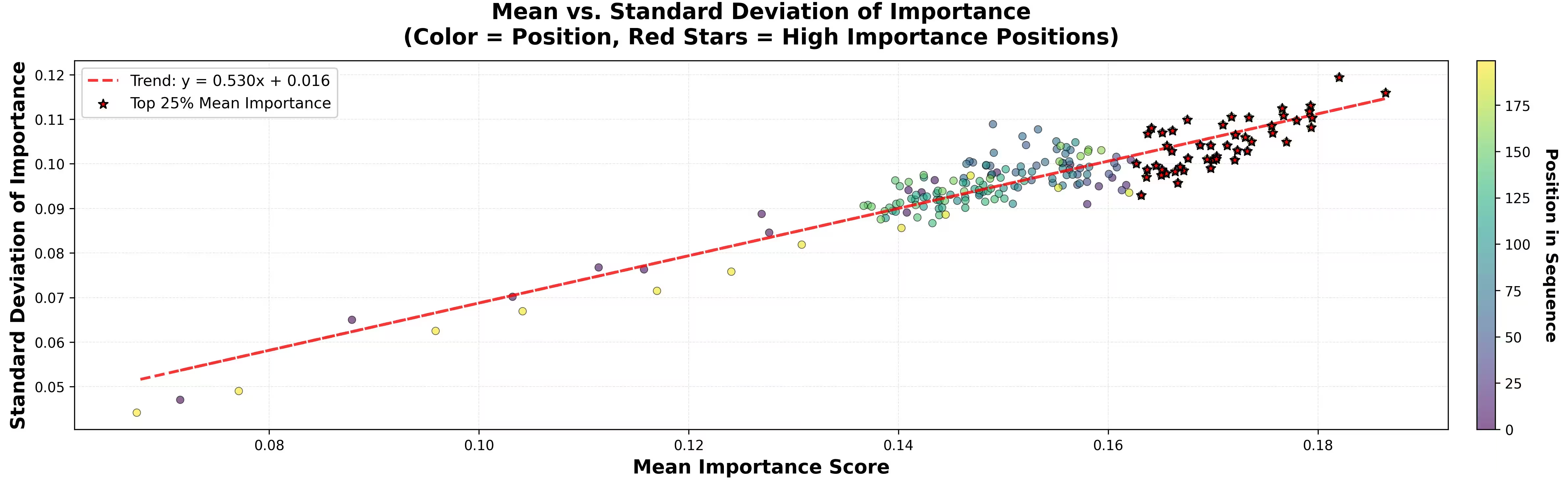
The analysis also uncovered a positive correlation between mean importance scores and standard variation, with a correlation coefficient of 0.530. This statistical link suggests that the most influential positions in the DNA strands also exhibited stronger context-dependent variation across different samples. The authors note that these patterns mirror known biological realities, including periodic importance peaks that align with reading-frame signals and promoter locations.
What These Patterns Reveal About AI in Genomics
The distinct importance ranges observed by the model reflect expected biological differences, such as GC-rich codon patterns in coding regions versus regulatory motif signatures in intergenomic spaces. Because the algorithm learned these distinctions without explicit human annotations, the work indicates that high predictive accuracy and internal interpretability can coexist in genomic AI models.
The authors point out that while the approach successfully maps out where the network focuses its attention, these insights remain a step toward biology-driven hypothesis generation. Future work will need to validate these gradient-based signatures against fully annotated genomic elements and independent datasets to confirm how reliably the model captures genuine biological drivers.
The study was posted to the arXiv preprint server on November 15, 2026.
This article has been fact checked for accuracy, with information verified against reputable sources. Learn more about us and our editorial process.
Last reviewed on .
Article history
- Latest version
Reference(s)
- Nia, Rayhaneh. “Deep Sequence Model for Genome Wide Discovery of Coding and Regulatory Element Signatures.” arXiv.org <http://arxiv.org/abs/2611.20255v1>.
Cite this page:
- Posted by Faisal Qureshi