Hidden Social Pressures Shape Heart Risks During Cancer Therapy
Combining personal financial and food hardships reveals cardiovascular vulnerabilities that broad neighborhood maps miss.

When women with breast cancer face food insecurity and financial strain, their bodies and daily habits shift in ways that can elevate long-term heart disease risks. A team led by researchers at the University of Pennsylvania Abramson Cancer Center tracked how individual-level social factors shape cardiovascular health during cancer treatments. Their analysis, published in Cancer, reveals that combining multiple personal hardships provides a much clearer picture of heart risks than relying on broad neighborhood scorecards.
How Personal Hardships Drive Heart Risks in Cancer Care
Modern cancer therapies, including targeted drugs and chemical treatments, have dramatically improved survival rates for millions of patients. Yet cardiovascular disease remains a leading cause of illness and death among cancer survivors, partly because life-saving treatments can exert toxic effects on the heart. While doctors have long studied biological vulnerabilities, researchers are increasingly recognizing that non-medical pressures play a critical role in shaping patient health.
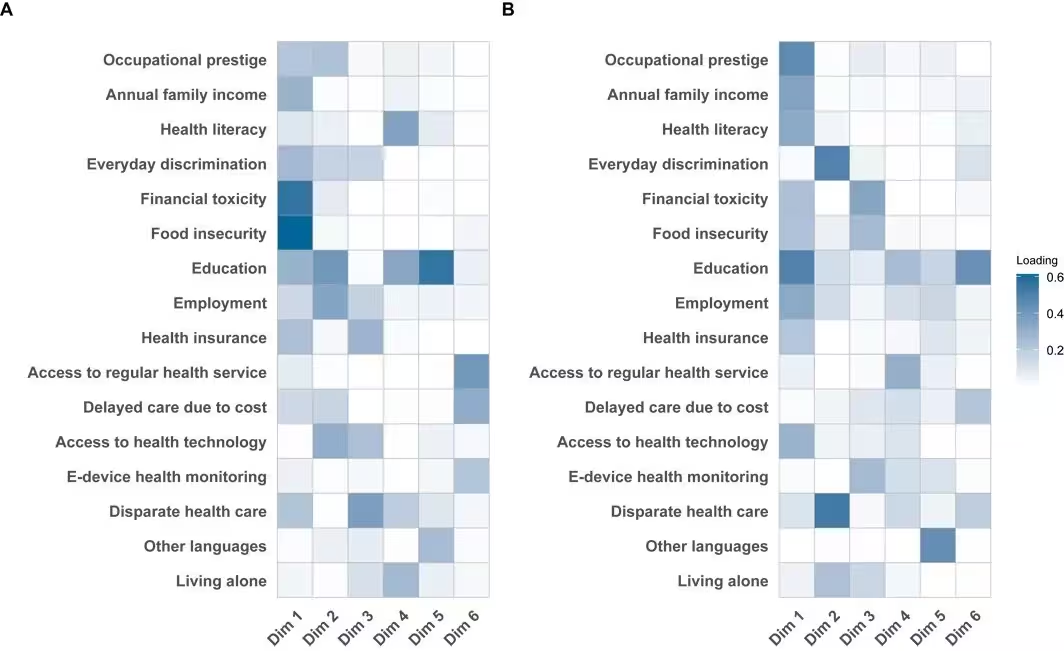
To capture these pressures, the investigators analyzed two prospective longitudinal cohorts involving 193 women with breast cancer and 195 men with prostate cancer who were starting potentially cardiotoxic therapies. Instead of examining isolated challenges like income or housing alone, the team used a data-driven statistical technique called factorial analysis of mixed data. This approach integrated 16 different individual-level social and economic variables into six overarching dimensions for each cancer type, accounting for roughly 50 percent of the total variability in the participants’ social profiles.
What the Data Revealed Across Different Patient Populations
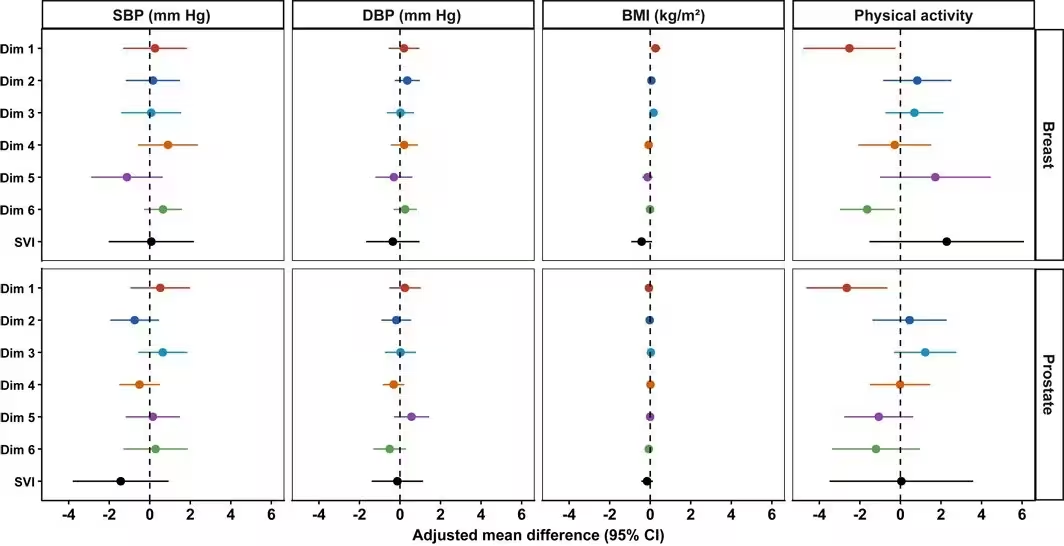
Among the women with breast cancer, the primary social dimension reflected a combination of food insecurity and financial toxicity. The study found that every one-interquartile range increase in this hardship score linked to a 0.3-kilogram-per-meter-squared increase in body mass index and a 2.5-point drop in moderate-to-vigorous physical activity over the course of a year. A separate dimension tied to healthcare access and delayed care also associated with lower physical activity levels. Meanwhile, the men with prostate cancer experienced different primary pressures, where a core dimension capturing lower education, occupational prestige, income, and employment associated with a 2.6-point reduction in physical activity scores.
Furthermore, the prostate cancer cohort showed clear shifts in blood pressure thresholds. Men with higher social vulnerability scores along the primary dimension faced elevated odds of exceeding standard blood pressure limits over time. Interestingly, when the researchers evaluated the neighborhood-level social vulnerability index as a broad area-based comparison, it failed to show statistically significant longitudinal associations with continuous or categorical blood pressure changes.
Why Individual-Level Screening Matters for Clinical Practice
The authors point out that relying solely on neighborhood-wide maps can obscure substantial differences among individuals living within the same zip code. By capturing granular details about a person’s financial stability, health literacy, and daily living conditions at the time of diagnosis, care teams can better spot patients who struggle to maintain physical activity or manage blood pressure. Physical activity offers well-established cardioprotective benefits, yet only a small fraction of survivors maintain their exercise routines during active treatment.
The researchers note several limitations in their work, including a modest sample size drawn from a single health system and a 12-month follow-up window that restricts long-term cardiac outcome tracking. Exploratory analyses also hinted that associations involving diastolic blood pressure might vary by race, though those subgroup observations require further confirmation. Future investigations with larger, diverse populations will be necessary to validate these integrated social metrics and determine how best to incorporate them into routine oncology care.
The research was published in Cancer on November 15, 2026.
This article has been fact checked for accuracy, with information verified against reputable sources. Learn more about us and our editorial process.
Last reviewed on .
Article history
- Latest version
Reference(s)
- Jung, Wonyoung., et al. “Integration of individual‐level social determinants of health and associations with cardiovascular risk factors in breast and prostate cancer.” Cancer, vol. 132, no. 22, November 13, 2026 Wiley, doi: 10.1002/cncr.70674. <https://doi.org/10.1002/cncr.70674>.
- Posted by Faisal Qureshi