Primate MicroRNA Drop Points to New Oral Cancer Biomarker
A newly explored genetic link between microRNA loss and inflammation pathways offers high diagnostic accuracy in tissue samples.

A tiny regulatory molecule found only in primates plunges to remarkably low levels inside the most common type of mouth cancer, pointing to a potential new path for early diagnosis. Oral squamous cell carcinoma accounts for roughly nine out of ten mouth-related malignancies, and doctors often detect it too late because routine physical exams struggle to spot precancerous changes reliably.
To uncover how gene regulation breaks down in these tumors, researchers examined public transcriptomic data from the NCBI Gene Expression Omnibus repository. By integrating three microarray datasets comprising both patient tumor samples and healthy control tissues, the team identified 1,656 consistently dysregulated genes across the cohorts. Further bioinformatics screening mapped out which of these abnormal genes might be controlled by microRNAs, which are small non-coding RNA molecules that normally fine-tune gene activity and keep cells stable.
The investigation focused on a primate-specific microRNA known as hsa-miR-548c-3p, which is part of a family distributed across human chromosomes. Using prediction algorithms from miRDB and TargetScan alongside sequence analysis tools, the authors found that 379 of the abnormally expressed genes matched potential targets for this microRNA. When they cross-referenced these targets with the Kyoto Encyclopedia of Genes and Genomes database, two key genes stood out because they also belong to the interleukin-17 pro-inflammatory signaling pathway, which is heavily linked to aggressive tumor growth and immune evasion. Those genes were SRSF1, which encodes a splicing factor that promotes tumor survival, and FOSL1, a transcription factor subunit involved in cell proliferation.
How Tissue Samples and Gene Expression Analysis Revealed the Link
To test these computational predictions in actual patients, the team collected tissue specimens from 50 individuals diagnosed with oral squamous cell carcinoma at the Pakistan Institute of Medical Sciences in Islamabad. Each patient provided paired cancerous tissue and adjacent normal tissue under sterile surgical conditions with formal ethical approval. Total ribonucleic acid was extracted using the TRIzol method, converted to complementary DNA, and analyzed using quantitative reverse transcription polymerase chain reaction to measure relative expression levels.
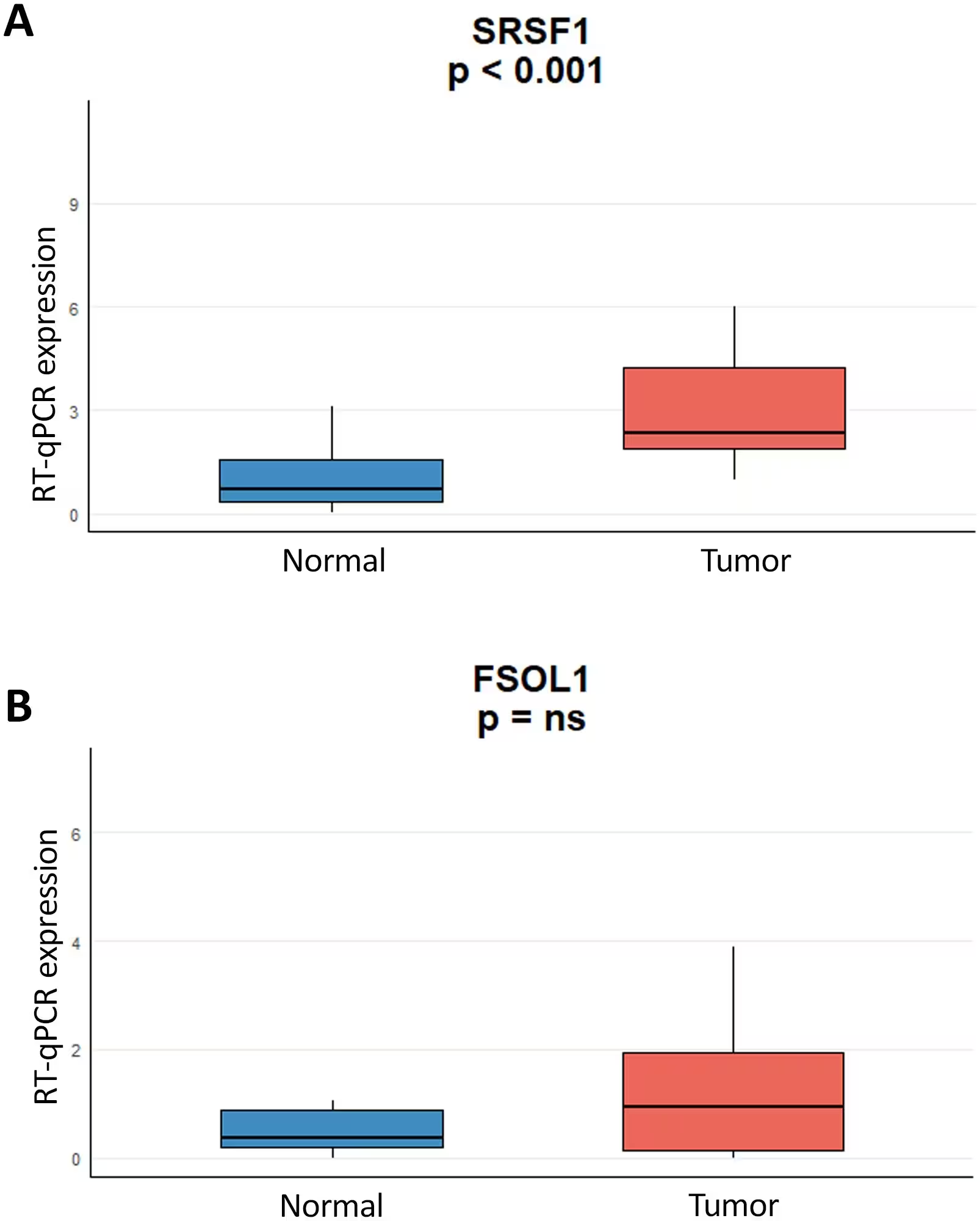
The experimental results showed that miR-548c-3p experienced a significant downregulation in tumor tissues compared to healthy controls. Independent validation using external publicly available datasets, including GSE69002 and GSE124566, confirmed this sharp reduction in cancer samples. Conversely, the predicted target gene SRSF1 exhibited a robust upregulation, showing roughly a 3.3-fold increase in tumor samples and displaying an inverse expression pattern relative to the microRNA. Spearman rank correlation analysis revealed a strong inverse association between the levels of miR-548c-3p and SRSF1, while FOSL1 showed a moderate inverse correlation. These findings were published in PLOS One as part of an open-access study detailing the molecular signatures of oral malignancies.
What These Diagnostic Biomarkers Mean for Future Screening
Because both miR-548c-3p and SRSF1 showed dramatic expression differences between cancerous and normal tissues, the researchers conducted receiver operating characteristic analysis to evaluate their potential as diagnostic markers. The microRNA achieved a striking area under the curve value of 0.976, while the target gene SRSF1 reached an area under the curve of 0.885, indicating high sensitivity and specificity in distinguishing tumor samples from healthy tissue. Repeated cross-validation and bootstrap resampling confirmed the stability of these performance metrics across independent subsets of data.
Despite these promising statistical figures, the authors noted several limitations in their work. The current findings remain associative rather than causal, meaning that laboratory experiments such as luciferase assays and cell-line overexpression or knockdown tests will be necessary to prove direct regulatory control. Furthermore, validating these biomarkers in larger patient cohorts and exploring whether they can be detected reliably in non-invasive fluids like saliva will be essential before any clinical translation can take place.
The research was published in PLOS One on November 16, 2026.
This article has been fact checked for accuracy, with information verified against reputable sources. Learn more about us and our editorial process.
Last reviewed on .
Article history
- Latest version
Reference(s)
- Nasim, Mubeen Tabish., et al. “Downregulation of miR-548c-3p potentially drives IL-17 pathway dysregulation in oral squamous cell carcinoma.” PLOS One, vol. 21, no. 11, November 16, 2026, pp. e0362467 Public Library of Science (PLoS), doi: 10.1371/journal.pone.0362467. <https://doi.org/10.1371/journal.pone.0362467>.
Cite this page:
- Posted by Elizabeth Taylor