Hidden Lab Biases and Background Noise Threaten Pathogen Detection in Sequencing Data
A new study reveals how DNA extraction choices and software settings create false alarms in metagenomic pathogen screening.
A tiny shift in laboratory methods can completely change whether a dangerous pathogen is spotted or missed in a complex environmental sample. Researchers have tracked how different steps in genetic sequencing alter the detection of disease-causing organisms.
Why Sequencing Complexity Creates Blind Spots for Decision Makers
Detecting invisible threats like bacteria and viruses in wastewater, air filters, or animal tissue is a major challenge for public health and biosecurity. Traditional tests look for specific known organisms, but they often fail when faced with emerging diseases or engineered agents. To solve this, scientists increasingly turn to metagenomic next-generation sequencing, a technique that reads all the genetic material in a sample without needing prior clues about what might be hiding inside. Yet, simply running a sample through a sequencer does not guarantee a clear or actionable answer. Different extraction kits, library preparation protocols, and computer analysis software can introduce significant bias, turning a straightforward identification into a guessing game.
To understand where these errors creep in, a team of researchers built a massive, well-characterized matrix of experimental samples to test how variables affect sensitivity and specificity. The study is published in PLOS One. The authors systematically altered biological targets, genome sizes ranging from small viral segments to large bacterial chromosomes, target concentrations, background complexities, and sequencing platforms to measure their exact impact on final results.
How DNA Extraction Kits Introduce More Bias Than Sequencers
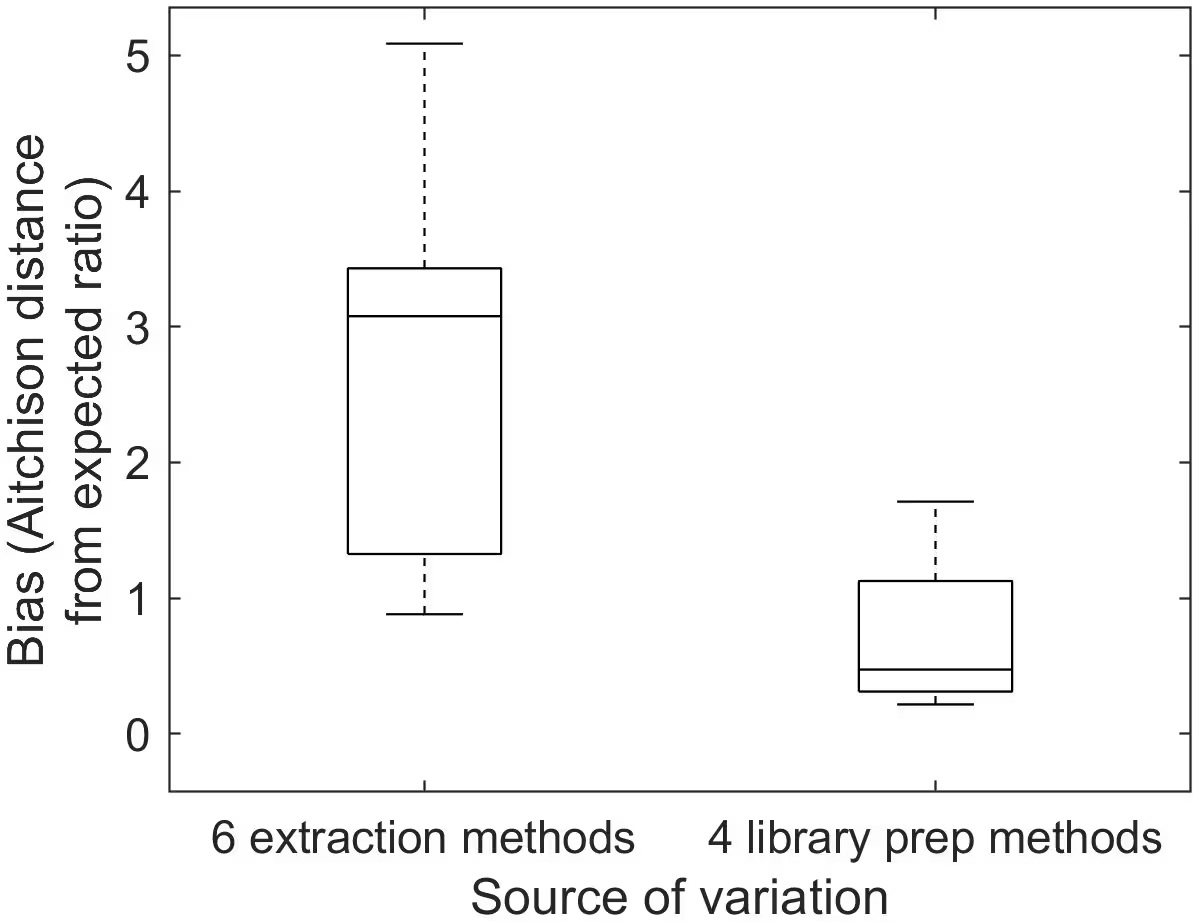
When processing samples, the choice of laboratory protocol matters enormously. The team discovered that commercial nucleic acid extraction kits—the chemical reagents used to crack open cells and isolate DNA or RNA—introduced much greater variability in recovered community composition than the subsequent sequencing library preparation methods. Using a standardized microbial mix containing eight bacteria and two eukaryotes, the researchers found that different extraction protocols skewed the final proportions of recovered organisms significantly. In contrast, comparing different sequencing platforms, such as short-read Illumina technology and long-read Oxford Nanopore systems, revealed that library preparation introduced comparatively minor compositional shifts.
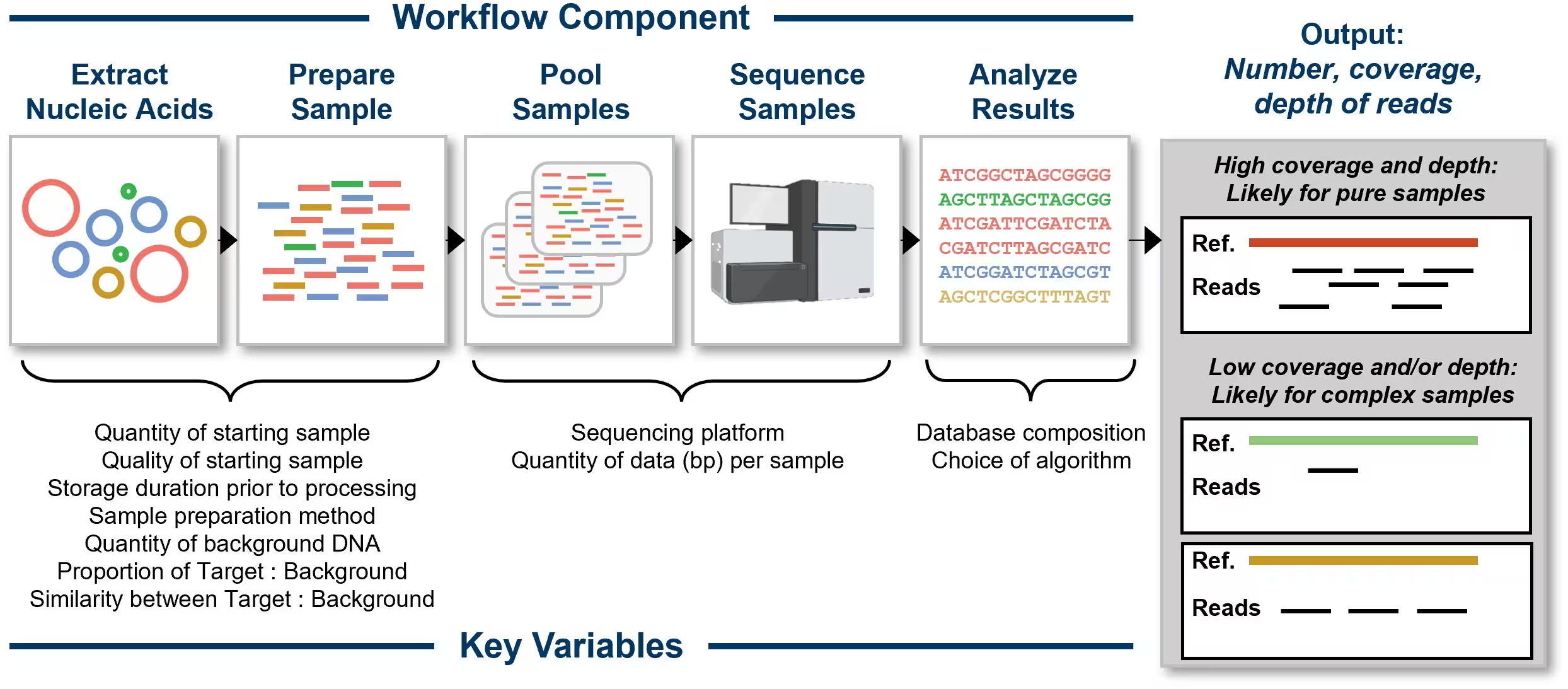
Once the samples were sequenced, the researchers uncovered another hurdle known as the limit of blank. Even in blank samples containing no added target organism, genetic sequences often mapped to the reference genomes of the targets due to background noise or algorithm parameters. Interestingly, long-read sequencing runs showed a noise floor hundreds of times higher than short-read Illumina runs, effectively masking low-abundance targets. This difference stems from software settings, as long-read mapping algorithms use more permissive alignment rules to accommodate higher error rates, which inadvertently lets false positive matches slip through.
The Hidden Trap of Closely Related Species and Near-Neighbors
Another major complication arises when samples contain organisms closely related to the target of interest. To test this, the team added varying ratios of Bacillus thuringiensis, a common soil bacterium and insecticide, alongside Bacillus anthracis Sterne, a surrogate for the anthrax bacterium, into an aerosol background. Because their genomes share high similarity, nearly a third of the genetic reads from one species incorrectly mapped to the reference genome of the other when standard global alignment tools were used.
When high concentrations of Bacillus thuringiensis were introduced without any anthrax present, more than two percent of the total bases in the sample falsely mapped to the anthrax genome. The researchers showed that while broad database searches can trigger false alarms, restricting analysis to curated, species-specific genomic regions helps clean up the signal, though at the cost of reduced sensitivity for very rare targets.
Can Computer Simulations Replace Endless Laboratory Testing?
Because running physical experiments for every possible environmental background and pathogen combination is impractical, the researchers developed a computational simulation framework. By generating synthetic reads and spiking them into real aerosol metagenomic datasets, they tested how different software algorithms handle noisy data. The simulations revealed that while sequencing maintains high recall and catches targets when depth is sufficient, precision plummets when target-to-background ratios are low because of misclassification events.
The team created a generalizable mathematical model linking target mass fraction to the percentage of bases mapping to the target. This model allows laboratories to estimate required sequencing depths for specific detection thresholds. The findings emphasize that defining performance metrics with known sensitivity and false alarm rates is essential before genetic sequencing data can safely guide high-stakes public health decisions.
The research was published in PLOS One on November 16, 2026.
This article has been fact checked for accuracy, with information verified against reputable sources. Learn more about us and our editorial process.
Last reviewed on .
Article history
- Latest version
Reference(s)
- Mallek, Jennifer L.., et al. “Experimental and computational insights for broad, metagenomic next-generation sequencing-based biodetection in complex environments.” PLOS One, vol. 21, no. 11, November 16, 2026, pp. e0361775 Public Library of Science (PLoS), doi: 10.1371/journal.pone.0361775. <https://doi.org/10.1371/journal.pone.0361775>.
Cite this page:
- Posted by Elizabeth Taylor