New AI Tool Continuously Predicts Extended ICU Stays Using Routine Hospital Data
Genetics

New AI Tool Continuously Predicts Extended ICU Stays Using Routine Hospital Data

Updated every four hours, a machine learning model accurately forecasts ICU stays longer than a week across two major health systems.

By Faisal Qureshi
Published:
Email this Article
New AI Tool Continuously Predicts Extended ICU Stays Using Routine Hospital Data
Photo by Galina Nelyubova on Unsplash

A new machine learning tool can continuously forecast whether a patient will remain in an intensive care unit for longer than a week, potentially helping hospitals manage critical bed shortages and staffing needs. Intensive care units consume roughly 13 percent of hospital costs in the United States, and with hospital occupancy rates averaging 75 percent, institutions face mounting pressure to optimize patient flow and resource allocation.

Traditional predictive scoring systems typically generate a single static estimate during the first 24 hours of a patient admission. These older models struggle to account for unexpected complications, clinical deterioration, or organ recovery that happens later in an ICU stay. To address this limitation, researchers developed a dynamic model called the Prognostic Estimator of RiSk for prolonged ICU STay, or PERSIST.

How the Dynamic PERSIST Algorithm Forecasts Extended Hospitalizations

As detailed in a study published in JAMIA Open, the research team built PERSIST using a machine learning technique known as XGBoost, which relies on gradient-boosted decision trees. The model ingests sixty routinely collected electronic health record variables, including vital signs, laboratory results, medication infusions, respiratory support details, and clinical scores like the Glasgow Coma Scale and the Sequential Organ Failure Assessment.
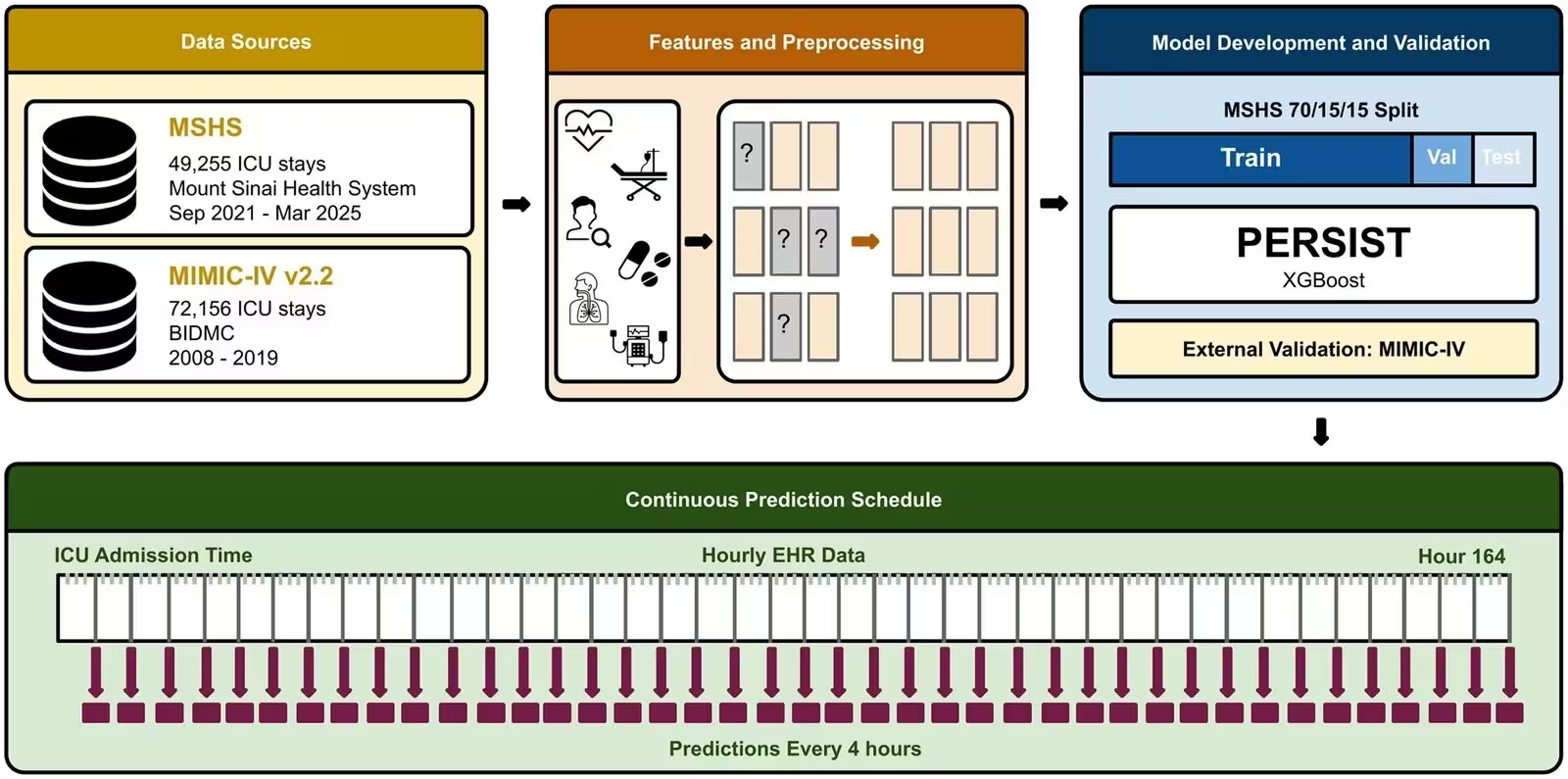
Figure 1: Study overview: data sources, preprocessing, and the PERSIST prediction schedule. Overview of the PERSIST development and validation workflow. Routinely collected hourly intensive care unit (ICU) electronic health record data from the Mount Sinai Health System (MSHS) and the Medical Information Mart for Intensive Care–IV (MIMIC-IV) are aggregated into hourly bins and preprocessed. PERSIST, an XGBoost model, trained on the MSHS 70%/15%/15% train/validation/test split, generates predictions of prolonged ICU stay (length of stay >7 days) beginning at hour 4 and every 4 h thereafter through hour 164, with each prediction using only data preceding the prediction time. PERSIST, Prognostic Estimator of RiSk for prolonged ICU STay.
Study overview: data sources, preprocessing, and the PERSIST prediction schedule. Overview of the PERSIST development and validation workflow. Routinely collected hourly intensive care unit (ICU) electronic health record data from the Mount Sinai Health System (MSHS) and the Medical Information Mart for Intensive Care–IV (MIMIC-IV) are aggregated into hourly bins and preprocessed. PERSIST, an XGBoost model, trained on the MSHS 70%/15%/15% train/validation/test split, generates predictions of prolonged ICU stay (length of stay >7 days) beginning at hour 4 and every 4 h thereafter through hour 164, with each prediction using only data preceding the prediction time. PERSIST, Prognostic Estimator of RiSk for prolonged ICU STay. Credit: Mateen Jangda et al. / JAMIA open

Instead of stopping at admission, PERSIST calculates new risk predictions every four hours starting four hours after a patient enters the unit, running through the first 164 hours of care. Each updated forecast relies strictly on data gathered up to that specific time point. The developers trained and tested the algorithm on 49,255 adult ICU admissions recorded across the Mount Sinai Health System between 2021 and 2025.

Testing Generalizability Across Separate Hospital Systems

To evaluate whether the model could adapt to different clinical environments, the investigators performed an external validation using 72,156 adult ICU stays from the Medical Information Mart for Intensive Care-IV database, which contains deidentified records from Beth Israel Deaconess Medical Center collected between 2008 and 2019. Prolonged stays exceeding seven days occurred in 16.1 percent of the Mount Sinai cohort and 11.1 percent of the validation cohort.

When measuring performance, PERSIST achieved a macroaveraged area under the receiver operating characteristic curve of 0.80 within the internal test set and 0.78 in the external validation dataset. Both figures outperformed a standard logistic regression benchmark applied under identical conditions, which scored 0.75 and 0.74, respectively. The tool also maintained stable discrimination across different age brackets, biological sexes, and racial subgroups.
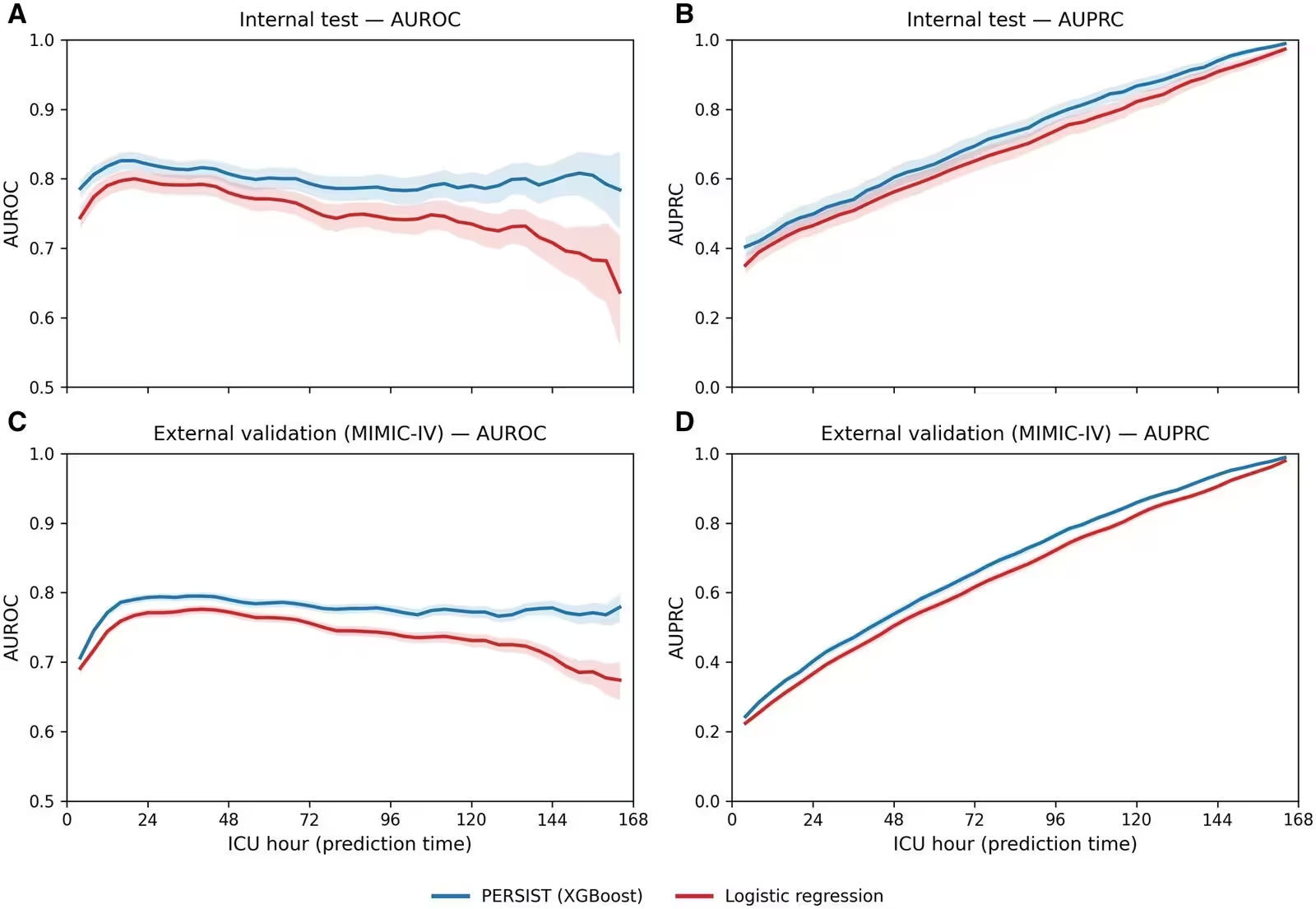
Figure 2: Discrimination of PERSIST over the intensive care unit (ICU) stay. Macroaveraged area under the receiver operating characteristic curve (AUROC) and area under the precision-recall curve (AUPRC) at each 4-h prediction time from hour 4 through hour 164, for the internal test set (top row) and the MIMIC-IV external validation cohort (bottom row), with PERSIST (XGBoost) and the logistic-regression benchmark overlaid. Shaded bands denote 95% stay-clustered bootstrap confidence intervals. PERSIST, Prognostic Estimator of RiSk for prolonged ICU STay; MIMIC-IV, Medical Information Mart for Intensive Care–IV.
Discrimination of PERSIST over the intensive care unit (ICU) stay. Macroaveraged area under the receiver operating characteristic curve (AUROC) and area under the precision-recall curve (AUPRC) at each 4-h prediction time from hour 4 through hour 164, for the internal test set (top row) and the MIMIC-IV external validation cohort (bottom row), with PERSIST (XGBoost) and the logistic-regression benchmark overlaid. Shaded bands denote 95% stay-clustered bootstrap confidence intervals. PERSIST, Prognostic Estimator of RiSk for prolonged ICU STay; MIMIC-IV, Medical Information Mart for Intensive Care–IV. Credit: Mateen Jangda et al. / JAMIA open

Interpretable Predictions and Clinical Decision Support

To help clinicians understand why the algorithm flags certain patients, the researchers utilized SHapley Additive exPlanations values to rank feature importance. The most influential factors driving the predictions aligned closely with known markers of severe critical illness. These included the requirement for invasive mechanical ventilation, high fraction of inspired oxygen levels, neurological status, blood urea nitrogen, lactate, and vasopressor dosages.

Decision curve analysis indicated that the model provided greater net benefit than treat-all or treat-none strategies across various threshold probabilities. The incremental advantage was largest during the first five days of admission, a crucial window when a patient trajectory remains uncertain and early planning can inform rehabilitation needs, bed availability, and care transitions.
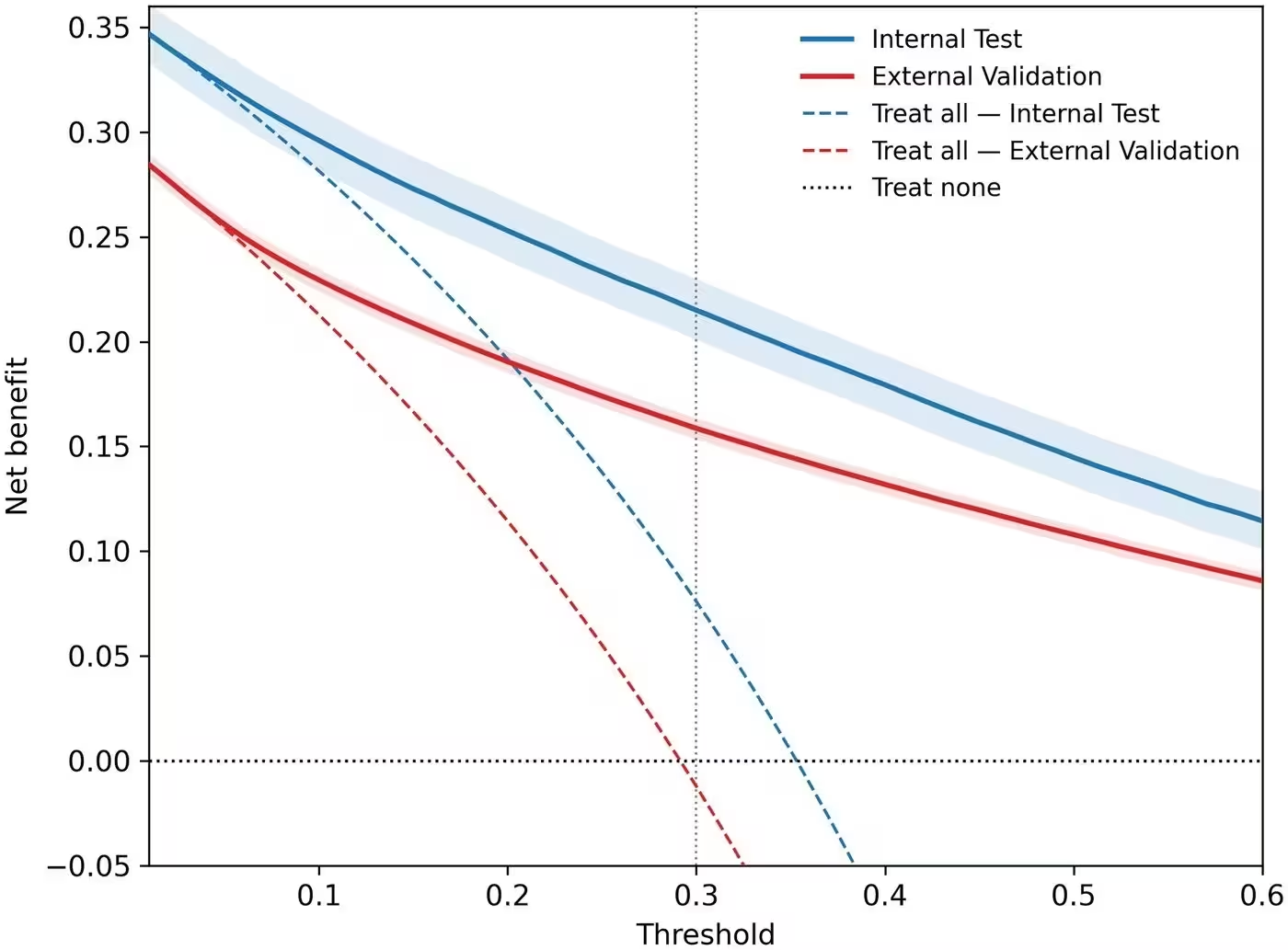
Figure 3: Decision-curve analysis of PERSIST. Net benefit of PERSIST versus the treat-all and treat-none strategies across threshold probabilities, pooled across all prediction times, for the internal test set and the MIMIC-IV external validation cohort. Each cohort’s treat-all line reflects its outcome prevalence, and treat-none corresponds to a net benefit of zero; the dotted vertical line marks the 0.30 classification threshold. Shaded bands denote 95% stay-clustered bootstrap confidence intervals. PERSIST, Prognostic Estimator of RiSk for prolonged ICU STay; MIMIC-IV, Medical Information Mart for Intensive Care–IV.
Decision-curve analysis of PERSIST. Net benefit of PERSIST versus the treat-all and treat-none strategies across threshold probabilities, pooled across all prediction times, for the internal test set and the MIMIC-IV external validation cohort. Each cohort’s treat-all line reflects its outcome prevalence, and treat-none corresponds to a net benefit of zero; the dotted vertical line marks the 0.30 classification threshold. Shaded bands denote 95% stay-clustered bootstrap confidence intervals. PERSIST, Prognostic Estimator of RiSk for prolonged ICU STay; MIMIC-IV, Medical Information Mart for Intensive Care–IV. Credit: Mateen Jangda et al. / JAMIA open

Current Limitations and Next Steps for Bedside Integration

The study authors noted several limitations to keep in mind. Because the research relied on a retrospective design, it carries inherent risks of unmeasured confounding and selection bias. Furthermore, both evaluation cohorts originated from large academic medical centers, meaning future studies must test the algorithm in community hospitals and specialized units.

Crucially, the authors emphasize that PERSIST measures length of stay rather than mortality risk, meaning a low probability of a prolonged stay does not equate to a low risk of death, especially since severely ill patients may experience short stays ending in mortality. Prospective clinical trials will be necessary to determine whether integrating these continuous risk estimates into everyday workflows actually improves hospital throughput and patient outcomes.

The research was published in JAMIA open.

Fact Checked

This article has been fact checked for accuracy, with information verified against reputable sources. Learn more about us and our editorial process.

Last reviewed on .

Article history

  • Latest version

Reference(s)

  1. Jangda, Mateen., et al. “Continuous prediction of prolonged intensive care unit stay from longitudinal electronic health record data: development and external validation.” JAMIA Open, vol. 9, no. 6, November 13, 2026 Oxford University Press (OUP), doi: 10.1093/jamiaopen/ooag216. <https://doi.org/10.1093/jamiaopen/ooag216>.

Cite this page:

Qureshi, Faisal. “New AI Tool Continuously Predicts Extended ICU Stays Using Routine Hospital Data.” BioScience. BioScience ISSN 2521-5760, 16 November 2026. <https://www.bioscience.com.pk/en/subject/genetics/continuous-prediction-of-prolonged-intensive-care-unit-stay-from-longitudinal-electronic-health-record-data-development-and-external-validation>. Qureshi, F. (2026, November 16). “New AI Tool Continuously Predicts Extended ICU Stays Using Routine Hospital Data.” BioScience. ISSN 2521-5760. Retrieved November 16, 2026 from https://www.bioscience.com.pk/en/subject/genetics/continuous-prediction-of-prolonged-intensive-care-unit-stay-from-longitudinal-electronic-health-record-data-development-and-external-validation Qureshi, Faisal. “New AI Tool Continuously Predicts Extended ICU Stays Using Routine Hospital Data.” BioScience. ISSN 2521-5760. https://www.bioscience.com.pk/en/subject/genetics/continuous-prediction-of-prolonged-intensive-care-unit-stay-from-longitudinal-electronic-health-record-data-development-and-external-validation (accessed November 16, 2026).
End of the article