Locking the Dead: 17th‑Century Polish Cemetery Reveals Anti‑Vampire Burials
A forgotten Polish cemetery unearthed sickles, padlocks and a child buried face‑down, exposing a haunting fear that lingered beyond death.
Archaeologists working near the village of Pień, close to Ostromecko in Poland, have uncovered a burial ground dating to the 1600s that contains more than a hundred interments. Over thirty of those graves feature unusual restraints—such as iron sickles, triangular padlocks, or atypical body orientations—intended to keep the deceased from rising, reflecting a local fear of revenants.
Preventing the Dead from Returning: Locking Feet and Sickle Barriers
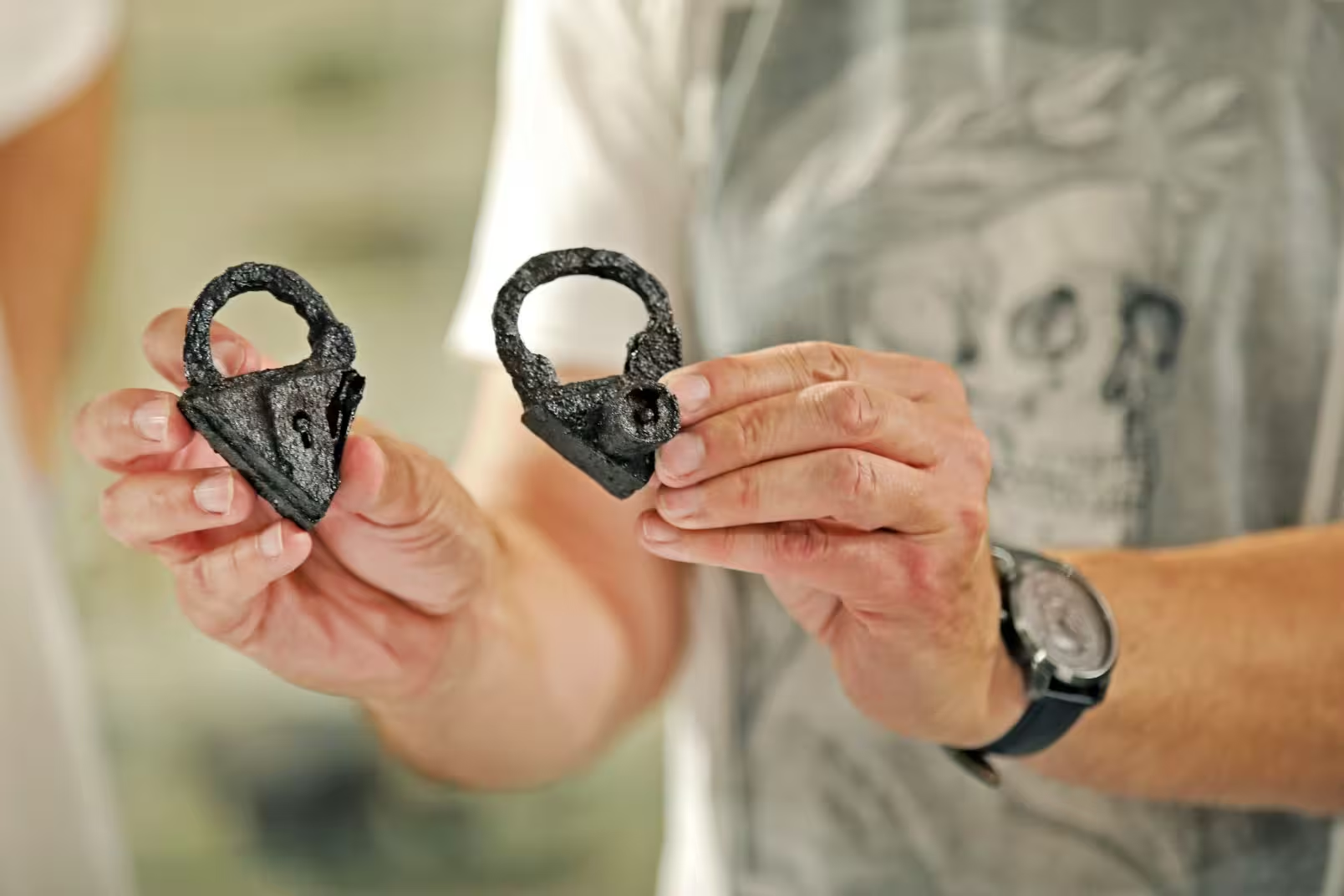
The triangular padlocks discovered at the site were deliberately fastened near the feet or toes of the buried, symbolizing a final seal on the body’s movement. Dariusz Poliński, the lead researcher from Nicolaus Copernicus University, explained that these locks were meant to stop a possible resurgence of the individual after death. Similar restraints appear in the graves of both an adult woman and a young child, indicating a repeated cultural practice rather than isolated incidents. The pattern of locked feet underscores a systematic approach to anti‑revenant burials.
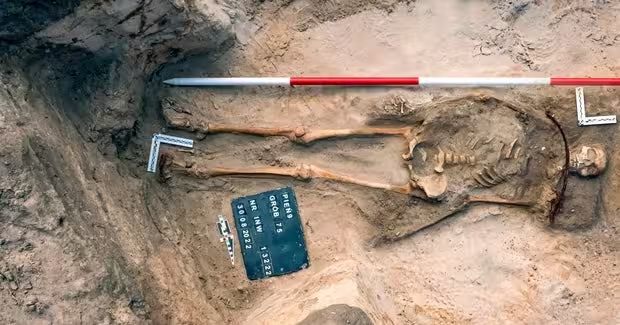
An iron sickle placed across the neck of one skeleton adds a more direct physical barrier. The curved blade would press against the throat if the body attempted to move upward, effectively serving as a lethal deterrent. In this particular grave, the sickle was accompanied by a padlock, providing two layers of restraint. Other graves feature stones positioned on the torso, removal of limbs, or face‑down burial, all aimed at limiting any post‑mortem mobility.
A High‑Status Woman Encircled by Protective Devices
Excavations in 2022 revealed a young woman whose remains bore a padlock on a toe and an iron sickle across her throat. Media outlets quickly dubbed her the “vampire woman,” though the artifacts reflect communal anxieties rather than a personal identity. Poliński suggested several possible explanations for the extreme treatment, including visible physical anomalies, mental illness, or a sudden, possibly violent death. No contemporary documentation clarifies the specific reasoning behind the restraints.
The woman’s burial also contained a silk headdress woven with precious‑metal threads, an indicator of elevated social standing. CBS News highlighted the juxtaposition of luxury attire with anti‑vampire measures, suggesting that even individuals of high rank were not exempt from these protective customs.

In 2024, Swedish archaeologist and sculptor Oscar Nilsson produced a facial reconstruction using a 3‑D replica of the woman’s skull. The process involved mapping tissue depths, shaping clay models of facial muscles, and adding silicone to simulate skin, hair, and other features. Nilsson noted that the reconstruction required between 200 and 400 hours of work, though DNA analysis would be necessary to confirm traits such as eye, hair, and skin colour.
Child Burial Mirrors Adult Restraint Practices
A second discovery, reported in 2023, involved a child aged roughly five to seven years who was interred face down with a triangular padlock positioned near the feet. The child’s grave lay a short distance from the adult woman’s burial, and additional fragmented bones of other children were found nearby, indicating that the same anti‑revenant measures were applied across age groups.
Historical research suggests that children who died before baptism, drowned, or experienced sudden death could be perceived as especially vulnerable to returning as harmful spirits. Poliński emphasized that abrupt or unexplained deaths often provoked heightened fear in communities lacking modern medical explanations. While the exact motive for the child’s restraints remains unknown, the consistent use of locks and body orientation aligns with the broader cemetery pattern.
Scientific Perspectives on the Anti‑Revenant Phenomenon
Forensic anthropologist Matteo Borrini has linked historic vampire fears to patterns of disease transmission within families. When a death was followed by illness among relatives, communities sometimes interpreted the sequence as a malicious return of the deceased. Borrini’s analysis illustrates how contagious ailments could be mythologized as supernatural attacks, providing a possible backdrop for the Pień burial customs, though no direct evidence ties an epidemic to the site.
A Concentrated Record of 17th‑Century Anti‑Vampire Burials
Overall, the Pień cemetery holds more than one hundred interments, with at least thirty displaying deliberate restraints such as iron sickles, triangular padlocks, or inverted body placements. The recurring nature of these features allows researchers to identify a cohesive cultural response to the fear of the dead rising, rather than isolated anomalies. The site thus offers a rare, tangible glimpse into how early modern Polish communities sought to safeguard the living from perceived supernatural threats.
This article has been fact checked for accuracy, with information verified against reputable sources. Learn more about us and our editorial process.
Last reviewed on .
Article history
- Latest version
Reference(s)
- <https://www.cbsnews.com/news/vampire-skeleton-poland-pure-astonishment/>.
- Guenot, Marianne. “'Vampire' skeleton with sickle discovered in Poland graveyard: photos.”, February 27, 2023 Business Insider <https://www.businessinsider.com/photos-vampire-skeleton-discovered-in-17th-century-graveyard-poland-2022-9>.
Cite this page:
- Posted by Elizabeth Taylor