Humanized Yeast Mutation Triggers Global Genomic Traffic Jams
Genetics

Humanized Yeast Mutation Triggers Global Genomic Traffic Jams

Rewiring how replication proteins bind to DNA reveals unexpected functional overlaps between gene promoters and replication origins.
By Elizabeth Taylor
Published:
Email this Article
Humanized Yeast Mutation Triggers Global Genomic Traffic Jams
Photo by Warren Umoh on Unsplash

Altering a single yeast protein complex to mimic human genetic organization triggers chaotic collisions between DNA replication and gene transcription, revealing a deep evolutionary trade-off in how genomes are organized. Researchers investigating the fundamental mechanics of cell division discovered that shifting where proteins bind on chromosomes creates widespread molecular traffic jams, but also uncovers an unexpected secondary role for DNA replication starting points.

In all eukaryotic organisms, which include everything from yeast to humans, cellular replication depends on a specialized cluster of proteins known as the Origin Recognition Complex (ORC). This complex binds to specific genomic addresses to mark where DNA copying should begin, recruiting other molecular machinery to unwind the genetic code. However, how these binding sites are selected varies wildly across species. While budding yeast rely on precise, strict DNA sequence motifs, human cells take a more flexible approach, binding sequence-agnostically to open regions near gene promoters where packaging proteins are scarce.

To understand why this difference matters, the research team previously engineered a genetically modified yeast strain carrying a humanized version of a core ORC subunit. This mutation strips the yeast protein of its sequence-specific grip, forcing it to dock instead at promoter regions just like its human counterpart. The findings were published in Nature Communications, outlining how this relocation disrupts cellular function.
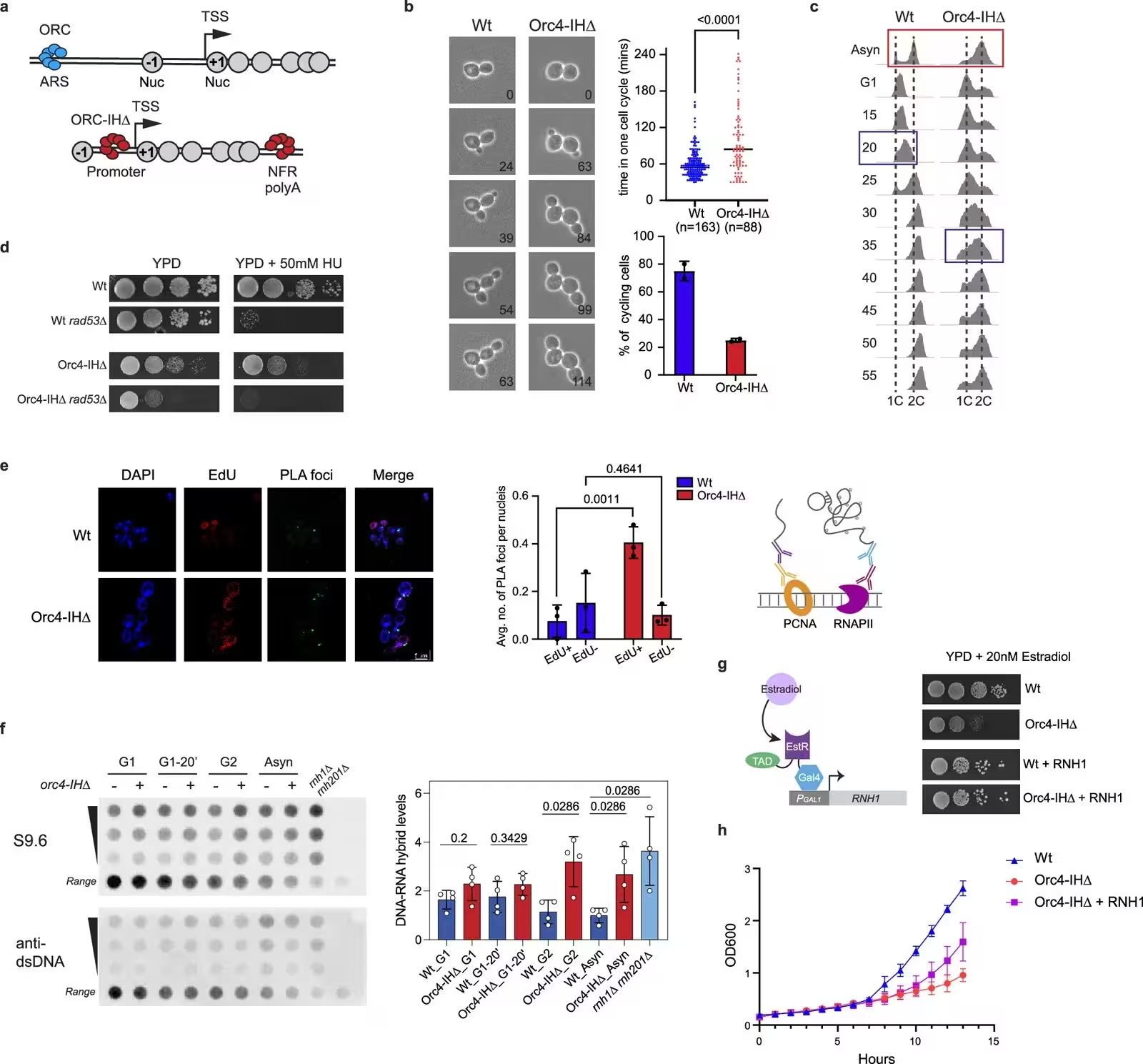
Fig. 1: Pervasive ORC-IHΔ binding at promoters in Orc4-IHΔ induces R-loop dependent replication stress and TRCs. a Cartoon showing Wt and mutant ORC-IHΔ binding patterns in the genome. b Left panel: Representative time-lapse microscopic images of single-cell tracking of Wt and Orc4-IHΔ using the Cell-ACDC platform. The number at the bottom right indicates minutes. Right panel: Quantification of time spent in one cell cycle of each tracked cell (top) and percentage of cycling cells in Wt and Orc4-IHΔ (bottom). Unpaired t-test, two-sided was performed on the quantification of time spent in one cell cycle. The percentage of cycling cells were probably underestimated in both cell types, as we stopped video recording and/or tracking errors when the fields of view were crowded with growing cells. Error bars indicate mean values with standard deviations (SD). Plots shown are representative of n  =  3 biological replicates. c FACS analysis shows Orc4-IHΔ cells exhibit a delay in cell cycle progression
Pervasive ORC-IHΔ binding at promoters in Orc4-IHΔ induces R-loop dependent replication stress and TRCs. a Cartoon showing Wt and mutant ORC-IHΔ binding patterns in the genome. b Left panel: Representative time-lapse microscopic images of single-cell tracking of Wt and Orc4-IHΔ using the Cell-ACDC platform. The number at the bottom right indicates minutes. Right panel: Quantification of time spent in one cell cycle of each tracked cell (top) and percentage of cycling cells in Wt and Orc4-IHΔ (bottom). Unpaired t-test, two-sided was performed on the quantification of time spent in one cell cycle. The percentage of cycling cells were probably underestimated in both cell types, as we stopped video recording and/or tracking errors when the fields of view were crowded with growing cells. Error bars indicate mean values with standard deviations (SD). Plots shown are representative of n  =  3 biological replicates. c FACS analysis shows Orc4-IHΔ cells exhibit a delay in cell cycle progression Credit: Clare S K Lee et al. / Nature communications

By employing high-resolution single-cell microscopy and time-course sequencing techniques, the authors tracked what happens when the protein complexes bind out of place. Instead of assembling cleanly at intergenic spacers, the misplaced ORC units loaded replication machinery directly into gene bodies. As RNA-pumping enzymes marched down the DNA strands during transcription, they physically pushed these loaded helicase proteins forward, causing major bottlenecks.

These traffic jams led to harmful transcription-replication conflicts and a significant accumulation of R-loops, which are tangled three-stranded RNA-DNA structures that destabilize the genome. Consequently, the mutant cells experienced severe cell cycle delays during the S phase and arrested in the late G2/M phase. When the investigators overexpressed an enzyme called RNase H1, which specifically clears up RNA-DNA hybrids, it successfully rescued the growth arrest phenotype and reversed the transcriptional defects.
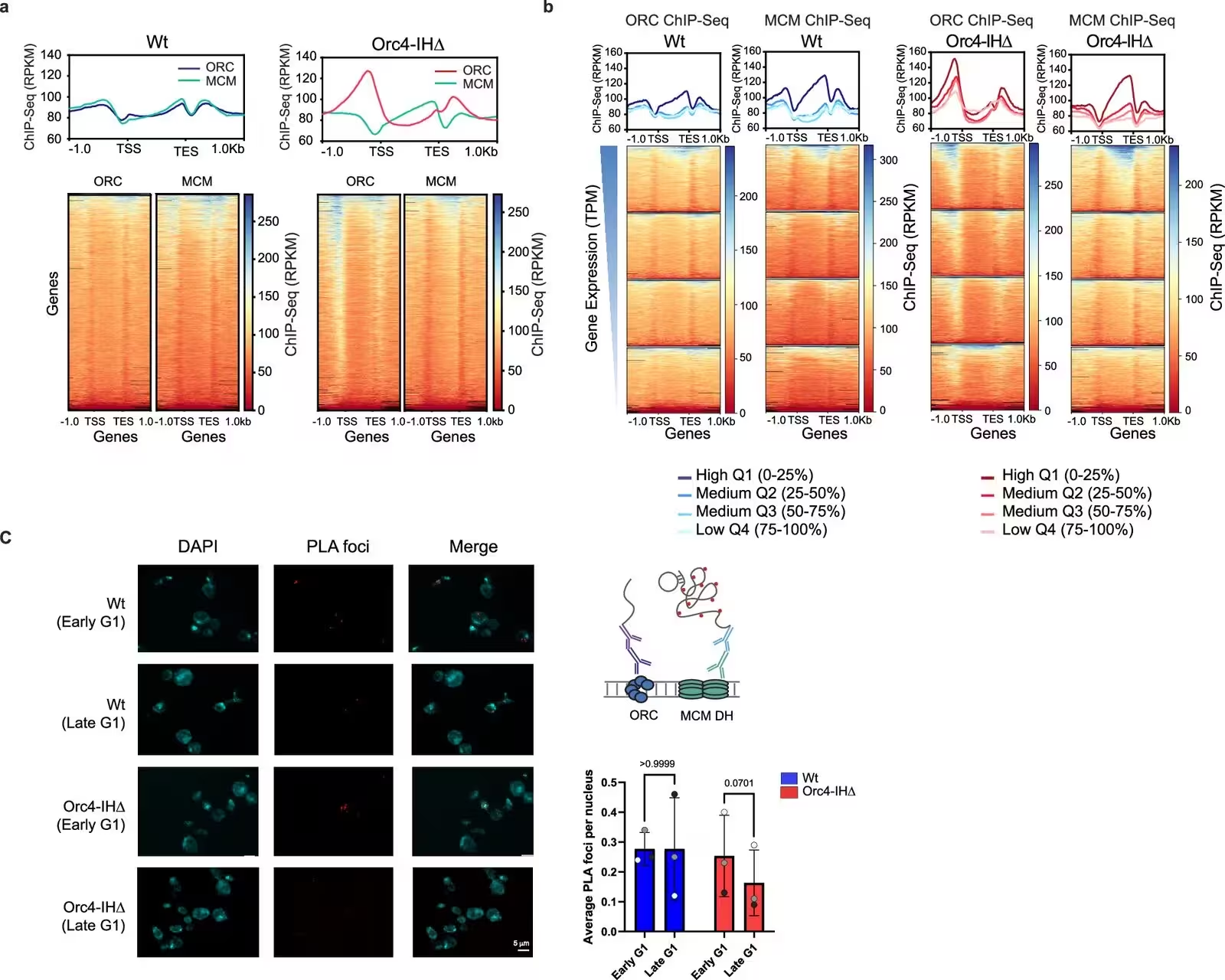
Fig. 2: MCM binding is uncoupled from ORC binding sites in Orc4-IHΔ mutant cells. a Line plots and heatmaps show the ORC and MCM enrichment patterns in Wt and Orc4-IHΔ at annotated transcripts and flanking sequences. The line plots (top) show the average ORC and MCM ChIP-seq signal (RPKM) at all annotated transcripts and the surrounding regions ( ± 1 kb) in Wt and Orc4-IHΔ. Mutant ORC-IHΔ binding (red) at the 5′ of the transcriptional start site (TSS) is significantly higher than that of wildtype (blue). MCM binding (green) in Orc4-IHΔ is uncoupled from ORC binding, with higher enrichment at the gene body, whereas in Wt, ORC and MCM binding profiles are very similar. Heatmaps (bottom) also suggest the differential enrichment of mutant ORC binding upstream of the TSS and of MCM binding in the gene body regions. b Line plots and heatmaps show the ORC and MCM enrichment patterns in Wt and Orc4-IHΔ at annotated transcripts and flanking sequences. The line plots (top) show the average ORC and MCM C
MCM binding is uncoupled from ORC binding sites in Orc4-IHΔ mutant cells. a Line plots and heatmaps show the ORC and MCM enrichment patterns in Wt and Orc4-IHΔ at annotated transcripts and flanking sequences. The line plots (top) show the average ORC and MCM ChIP-seq signal (RPKM) at all annotated transcripts and the surrounding regions ( ± 1 kb) in Wt and Orc4-IHΔ. Mutant ORC-IHΔ binding (red) at the 5′ of the transcriptional start site (TSS) is significantly higher than that of wildtype (blue). MCM binding (green) in Orc4-IHΔ is uncoupled from ORC binding, with higher enrichment at the gene body, whereas in Wt, ORC and MCM binding profiles are very similar. Heatmaps (bottom) also suggest the differential enrichment of mutant ORC binding upstream of the TSS and of MCM binding in the gene body regions. b Line plots and heatmaps show the ORC and MCM enrichment patterns in Wt and Orc4-IHΔ at annotated transcripts and flanking sequences. The line plots (top) show the average ORC and MCM C Credit: Clare S K Lee et al. / Nature communications

Beyond revealing how cells prevent genomic chaos, the experiments uncovered a surprising property of natural DNA replication origins. When the scientists replaced native gene promoters with a well-characterized yeast replication origin sequence, the loci surprisingly maintained robust transcription rather than shutting down. Base-pair resolution mapping showed that replication origins inherently possess the structural ability to form open, nucleosome-depleted regions.

This structural similarity means replication origins can double as alternative promoters, though they shift the position of nearby nucleosomes and alter where transcription begins. The work sheds light on why compact genomes like yeast require strict sequence-specific licensing to insulate gene expression from the aggressive machinery of DNA copying, while spacious mammalian genomes manage these spatial overlaps differently.

The research was published in Nature communications on November 13, 2026.

Fact Checked

This article has been fact checked for accuracy, with information verified against reputable sources. Learn more about us and our editorial process.

Last reviewed on .

Article history

  • Latest version

Reference(s)

  1. Lee, Clare S. K.., et al. “Humanized yeast ORC drives R-loop dependent transcription-replication conflicts and global gene dysregulation.” Nature Communications, vol. 17, no. 1, November 13, 2026 Springer Science and Business Media LLC, doi: 10.1038/s41467-026-79167-4. <https://doi.org/10.1038/s41467-026-79167-4>.

Cite this page:

Taylor, Elizabeth. “Humanized Yeast Mutation Triggers Global Genomic Traffic Jams.” BioScience. BioScience ISSN 2521-5760, 16 November 2026. <https://www.bioscience.com.pk/en/subject/genetics/humanized-yeast-orc-drives-r-loop-dependent-transcription-replication-conflicts-and-global-gene-dysregulation>. Taylor, E. (2026, November 16). “Humanized Yeast Mutation Triggers Global Genomic Traffic Jams.” BioScience. ISSN 2521-5760. Retrieved November 16, 2026 from https://www.bioscience.com.pk/en/subject/genetics/humanized-yeast-orc-drives-r-loop-dependent-transcription-replication-conflicts-and-global-gene-dysregulation Taylor, Elizabeth. “Humanized Yeast Mutation Triggers Global Genomic Traffic Jams.” BioScience. ISSN 2521-5760. https://www.bioscience.com.pk/en/subject/genetics/humanized-yeast-orc-drives-r-loop-dependent-transcription-replication-conflicts-and-global-gene-dysregulation (accessed November 16, 2026).
End of the article