New AI Framework Accurately Predicts Cell Responses to CRISPR Gene Edits
A novel decision-learning framework resolves gene response ambiguities and bypasses historical frequency shortcuts in single-cell screens.
A new artificial intelligence framework named S1Pert predicts how individual genes respond to CRISPR genetic interventions with unprecedented speed and accuracy. The system tackles a major blind spot in computational biology, where models often mimic historical gene trends instead of identifying true biological cause and effect.
CRISPR screens allow scientists to shut down or modify specific genes to observe the resulting ripple effects across the entire cellular transcriptome, which is the complete set of RNA transcripts produced in a cell. However, testing every possible combination of gene targets and measured readouts in the laboratory is physically impossible. Researchers rely on machine learning to fill the gaps, but standard models frequently achieve high overall scores simply by memorizing whether a gene frequently lights up or stays quiet across historical experiments, regardless of the specific intervention.
To overcome this limitation, the authors developed a system that uses statistical tests and a cached architecture to isolate true target-specific responses. The study is available on the arXiv preprint server, published in Xiaoqi Sheng, Hou wang, Yan Liang, Yutong Li, Wenhao Du, Tinghe Zhang, Jiawen Liu, Hongmin Cai. arXiv. (2026).
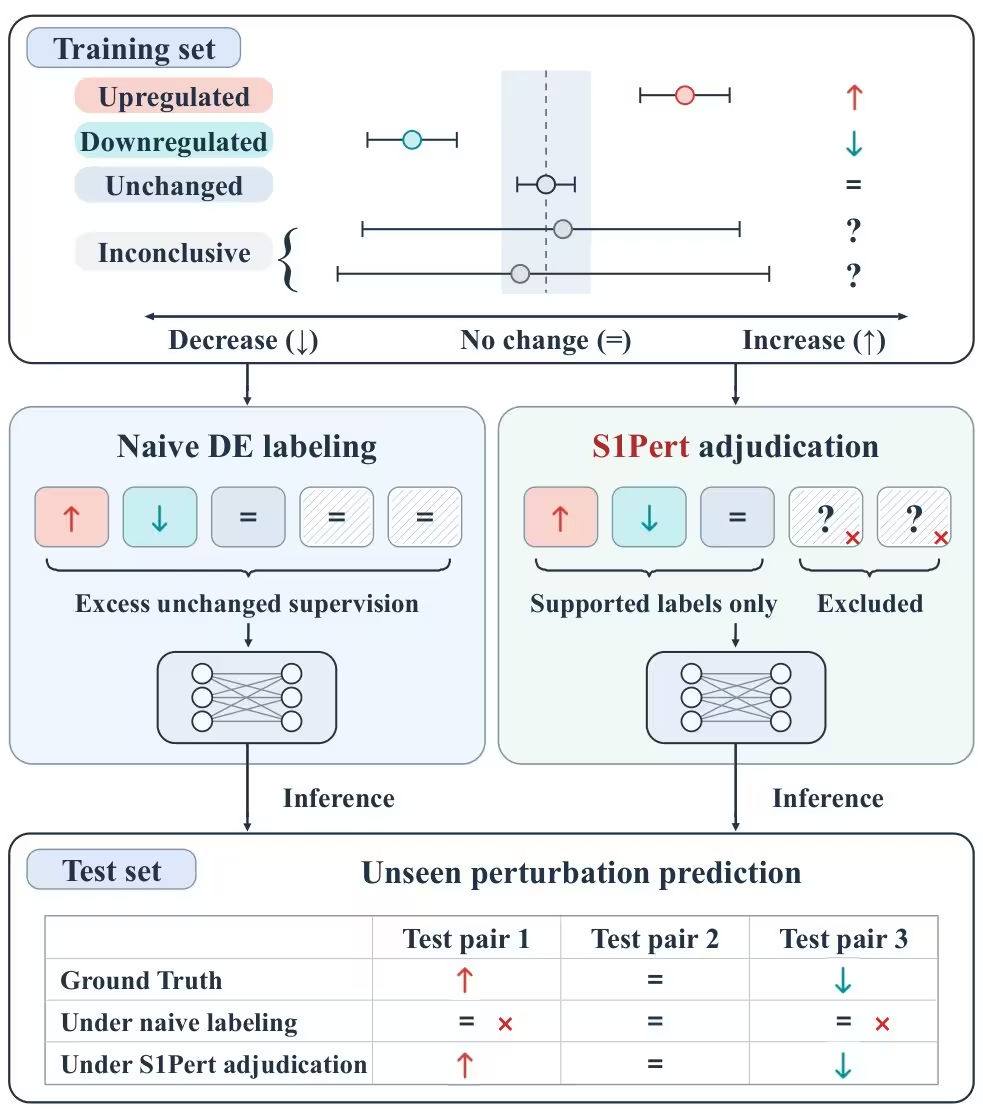
Traditional differential expression pipelines often label ambiguous or noisy data as unchanged, introducing training biases that push models to predict no change. The S1Pert framework solves this through a rigorous two-stage data adjudication protocol that combines directional Welch tests with two-one-sided equivalence testing. This approach separates genuinely invariant genes from inconclusive observations caused by low-depth single-cell sampling noise, filtering out misleading training labels.
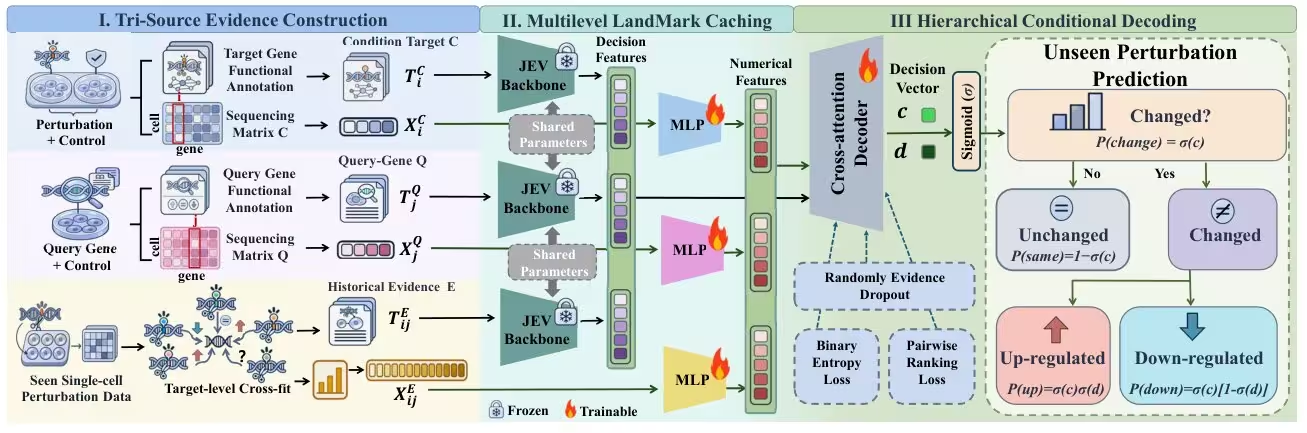
The architecture relies on a frozen foundation model backbone to process textual prompts and continuous covariates for millions of target-gene pairs without incurring massive computational penalties. By caching intermediate semantic landmarks offline, the framework avoids the quadratic bottlenecks that usually plague large language model analytics. During online inference, a lightweight hierarchical cross-attention decoder evaluates whether an expression change occurs, and then resolves the directional polarity of that change into upregulated, unchanged, or downregulated states.
Evaluated across four human cell line benchmarks covering HepG2, Jurkat, RPE1, and K562 datasets, S1Pert outperformed existing deep learning baselines and neuro-symbolic models in directional decision accuracy. The model achieved macro F-scores ranging from 0.698 to 0.850 across the cell types, while running up to 1,720 times faster than competing generative reasoning frameworks during online testing.
Overcoming Historical Shortcuts in Genomic Predictions
A key hurdle in genetic perturbation modeling is class imbalance, where unchanged gene pairs vastly outnumber minority directional shifts. Many computational tools struggle to predict downregulated responses accurately because they rely on broad gene-level averages.
The authors integrated a cross-target pairwise ranking loss alongside synchronized evidence dropout during training. This forces the neural network to compare different perturbations acting on the same query gene rather than falling back on frequency shortcuts. Ablation tests revealed that removing these components or stripping away the semantic landmark caching significantly dropped performance, particularly for minority downregulated outcomes.
Furthermore, testing the model against random target shuffles confirmed that S1Pert relies heavily on the actual identity of the perturbed target. When target identities were randomized during inference, the macro F-score dropped by more than 6 percentage points, proving that the system genuinely distinguishes target-specific regulatory shifts.
Potential Applications for High-Throughput Screening
The ability to accurately forecast transcriptomic responses at scale provides a powerful computational screening tool for biomedical research. By narrowing down candidate genetic interventions prior to wet-lab validation, the framework can streamline target discovery for complex cellular pathways.
While the current implementation focuses on single-gene perturbations within specific cell lines, the methodology opens pathways toward modeling combinatorial multi-gene interventions and multimodal cellular signals. Future developments will also explore boundary failure cases and broader tissue contexts to maintain statistical rigor across increasingly diverse biological landscapes.
The study was posted to the arXiv preprint server on November 13, 2026.
This article has been fact checked for accuracy, with information verified against reputable sources. Learn more about us and our editorial process.
Last reviewed on .
Article history
- Latest version
Reference(s)
- Sheng, Xiaoqi. “S1Pert: Scalable Target-Specific Gene Response Prediction with System-One Intelligence.” arXiv.org <http://arxiv.org/abs/2611.17705v1>.
Cite this page:
- Posted by Elizabeth Taylor