Dead Stars Reveal Younger Exoplanets Packed Larger Iron Cores Across Galactic History
By studying planetary debris swallowed by 70 white dwarf stars, astronomers trace how galactic chemical evolution alters exoplanet core sizes over billions of years.
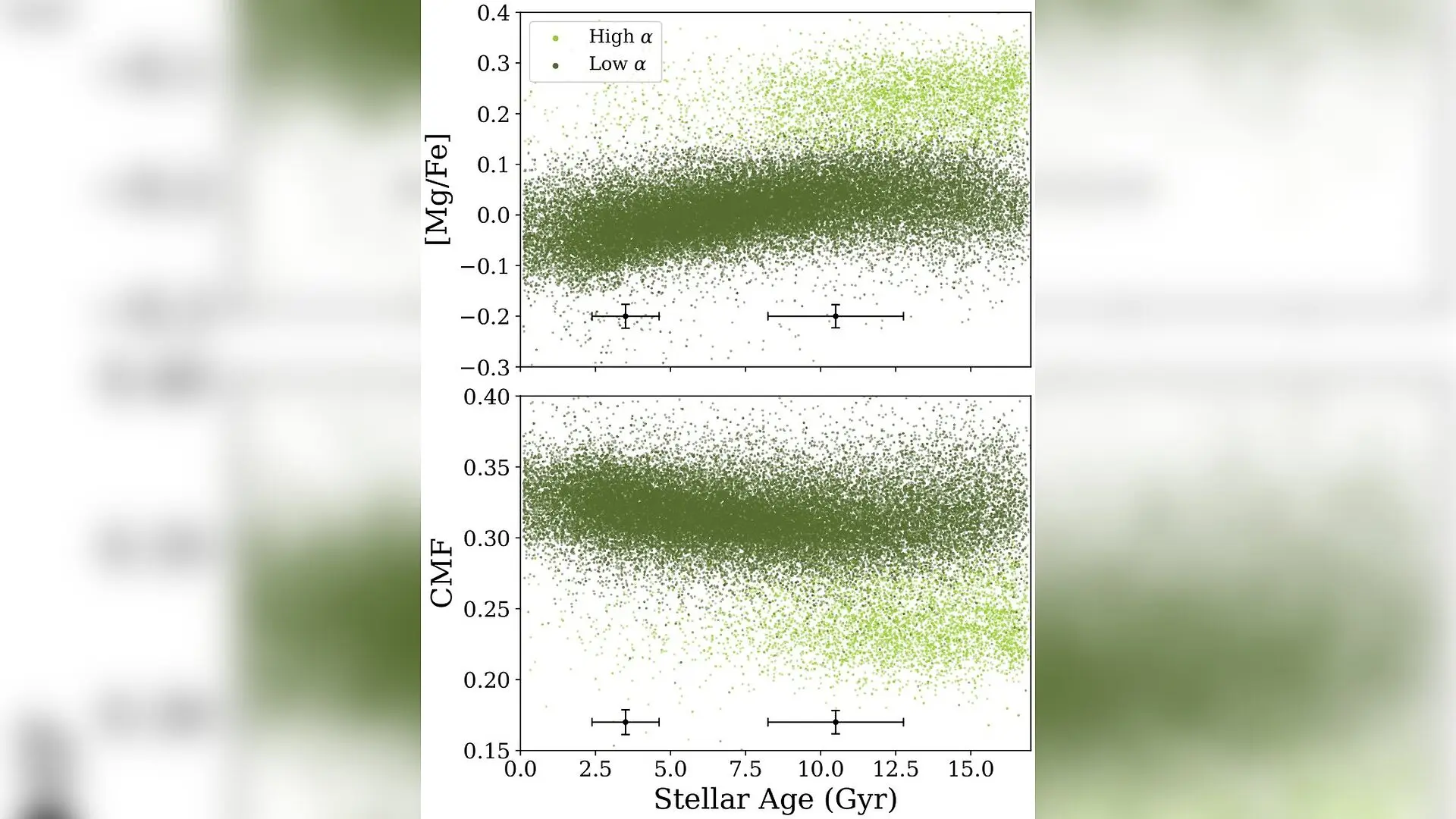
Dead star remnants have revealed that rocky exoplanets forming around younger stars in the Milky Way tend to pack significantly larger iron cores than their older cosmic counterparts. An international team of astronomers has investigated 70 polluted white dwarfs, which act as cosmic recycling bins by consuming nearby planetary debris, to reconstruct the deep chemical history of planetary building blocks across the galaxy.
As stars age, generations of stellar explosions and galactic recycling alter the raw chemical ingredients available in interstellar space. To trace how these shifts affect planet composition, the researchers calculated the iron mass fractions, serving as a proxy for core mass fractions, of planetary material devoured by white dwarfs. They paired these debris measurements with total stellar ages derived from cooling times and main sequence lifetimes, alongside galactic kinematic data from the Gaia space observatory.
The analysis, available on the arXiv preprint server, demonstrates that younger white dwarf systems generally host planetary debris with higher iron mass fractions. This pattern matches theoretical expectations from galactic chemical evolution, where early core-collapse supernovae enrich the galaxy differently than later Type Ia supernovae. The trend appears much clearer in white dwarfs featuring hydrogen-dominated atmospheres compared to those dominated by helium, a difference likely tied to complex atmospheric settling times and accretion physics.
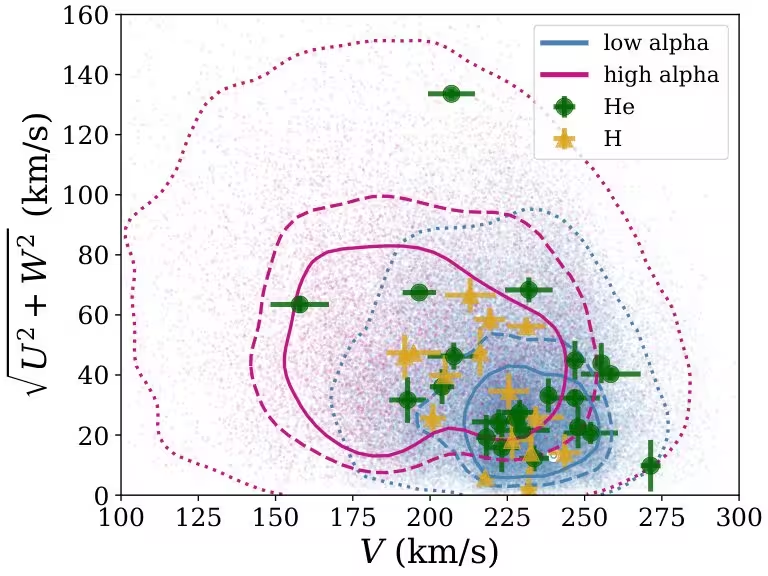
How Polluted White Dwarfs Act As Cosmic Scrap Heaps
White dwarfs are the dense, cooling remnants left behind when stars like our Sun exhaust their nuclear fuel. When these dead stars swallow surviving rocky asteroids or planets that venture too close, the swallowed elements leave distinct spectral signatures in the stellar atmosphere. This unique pollution allows astronomers to measure bulk elemental abundances, including iron, silicon, and magnesium, revealing the interior architecture of exoplanetary bodies.
To ensure robust comparisons, the team evaluated 70 polluted white dwarfs and benchmarked their results against a massive sample of about 200,000 normal main sequence stars drawn from the APOGEE survey. Main sequence stars show a clear decline in alpha-element ratios relative to iron over cosmic time. When translated into core mass fractions, this shift suggests that planets born around ancient stars should possess smaller metallic cores than planets formed in recent epochs.
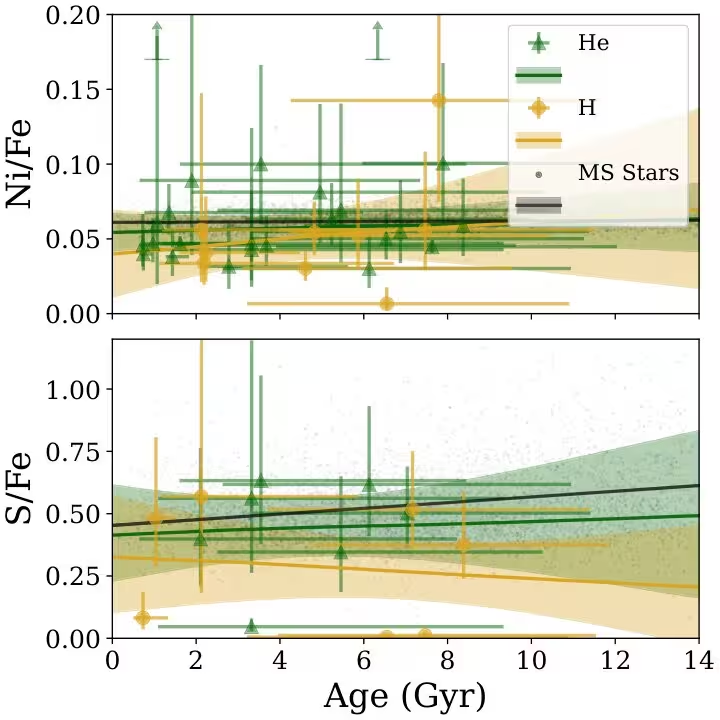
Uncertainties And The Road To Larger Stellar Samples
While the overall data points toward the expected negative trend between planetary iron fractions and system age, the researchers note significant hurdles in the analysis. Age determinations for white dwarfs carry substantial uncertainties that can span up to 4 billion years for the oldest objects. Furthermore, helium-dominated white dwarfs present wider spreads in iron fractions due to the intricate timescales involved in element settling and accretion phases.
Population synthesis modeling conducted by the authors indicates that confirming these subtle trends with high statistical certainty will require observing on the order of a thousand polluted white dwarf systems. Upcoming high-resolution spectrographs on extremely large telescopes, alongside massive spectroscopic surveys, are expected to expand the census of studied white dwarfs by an order of magnitude. This future growth should help astronomers firmly separate galactic-scale chemical evolution from local planet formation processes.
The study was posted to the arXiv preprint server on November 16, 2026.
This article has been fact checked for accuracy, with information verified against reputable sources. Learn more about us and our editorial process.
Last reviewed on .
Article history
- Latest version
Reference(s)
- Trierweiler, Isabella. “Compositions of Exoplanetary Debris Shaped by Milky Way Stellar Abundance Patterns.” arXiv.org <http://arxiv.org/abs/2611.21583v1>.
Cite this page:
- Posted by Nida Rehman