Math Equations Reveal Brain Wiring From Electrical Activity
New theoretical physics calculations show how high-frequency neural firing patterns can expose hidden synaptic connections.

A recurrent network of 1,000 spiking neurons can reveal its hidden web of synaptic connections entirely from the statistical patterns of its high-frequency electrical chatter. Researchers have derived a closed-form set of mathematical equations that links how individual cells fire in time to the underlying matrix of connections spanning the entire circuit.
Neuroscientists have long struggled to reconstruct precise wiring diagrams from recorded brain activity because of the sheer complexity of nonlinear biological networks. Every neuron processes incoming electrical currents through unique, nonlinear filters, making it difficult to trace which cell talks directly to another. The new theoretical framework, published in arXiv, demonstrates that neural cross-correlations at rapid time scales depend almost entirely on two quantities: single-cell auto-correlations and an effective connectivity matrix.
Decoding the Language of Brain Waves
To untangle the web of signals, the authors used a diagrammatic expansion of path integrals to track how electrical activity travels across the system. The analysis shows that neural correlations naturally decompose into distinct path lengths. Direct monosynaptic connections produce sharp, fast peaks in the data, whereas polysynaptic pathways involving multiple intermediary steps create slower, broader waves.
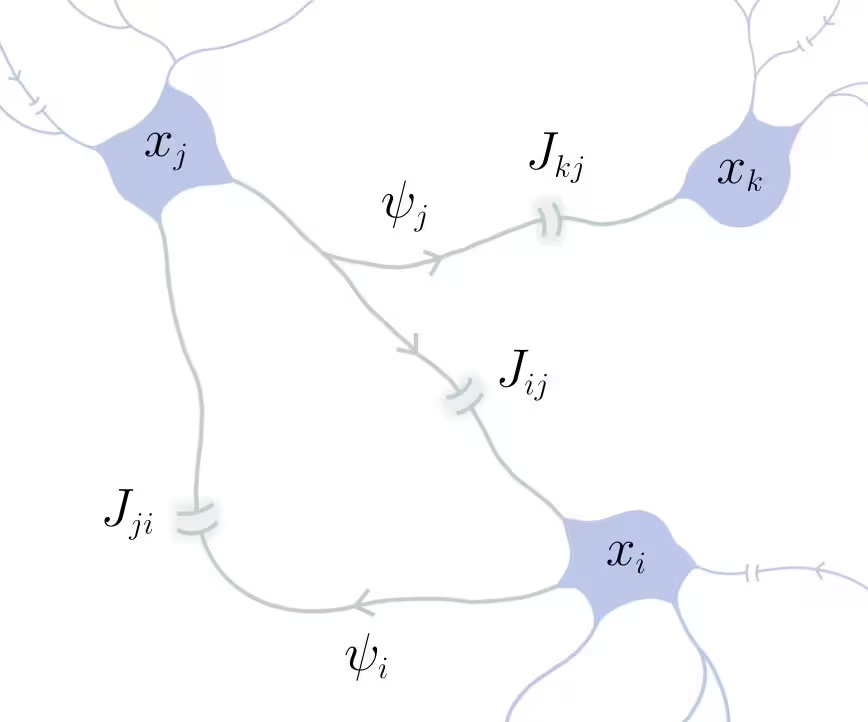
By focusing specifically on high-frequency bands, the team found that the influence of complex network details fades away, leaving a simplified equation where effective connections can be directly isolated. The investigators tested this approach using simulations of excitatory and inhibitory leaky-integrate-and-fire neurons, a standard computational model for cortical tissue. By recording simulated activity over a period of 5.6 hours across a 200-neuron subset, the algorithm reconstructed synaptic strengths with high statistical accuracy.
Next Steps for Experimental Neurophysiology
While the initial validation relies on computer simulations under stationary and asynchronous conditions, the underlying mathematics offers a principled foundation for analyzing real biological tissue. The authors note that upcoming extensions of the work will incorporate models for unrecorded neurons to handle extracellular recordings from living brains.
The study was posted to the arXiv preprint server on November 16, 2026.
This article has been fact checked for accuracy, with information verified against reputable sources. Learn more about us and our editorial process.
Last reviewed on .
Article history
- Latest version
Reference(s)
- Wakhloo, Albert. “Connectivity from activity in spiking neural networks.” arXiv.org <http://arxiv.org/abs/2611.21592v1>.
Cite this page:
- Posted by Priya Sharma