Forget the Roars: This Exceptional Fossil Reveals Dinosaurs Communicated More Like Birds Than Movie Monsters
Researchers have uncovered compelling evidence indicating that certain dinosaurs may have interacted vocally, much like today’s avian species.
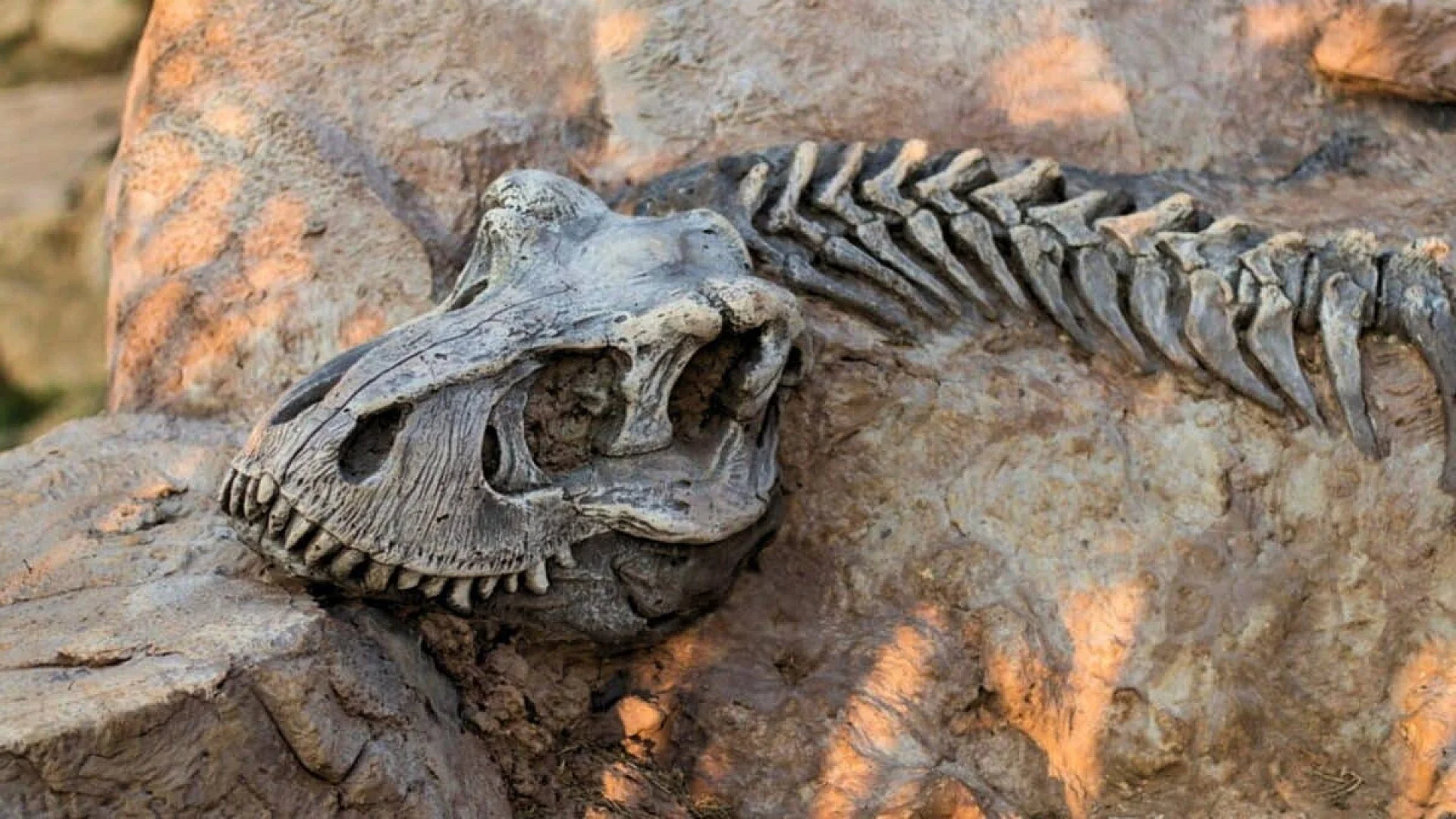
Imagine a dinosaur opening its mouth. For decades, films and television shows responded with a deep, guttural roar, a sound borrowed from lions and amplified for monsters. A remarkable fossil discovery in northern China tells a quieter story, one etched into the throat bones of a creature smaller than a finger joint.
The animal was no giant. Pulaosaurus qinglong measured about 72 centimeters from snout to tail, a two-legged herbivore that scurried through Jurassic forests 163 million years ago. Yet, inside its throat, scientists found something remarkable: an ossified larynx, the bony framework of a voice box, preserved clearly enough to reveal how the creature made sound.
When researchers at the Chinese Academy of Sciences examined those bones, they found a structure built for modulation, not brute noise. The dinosaur likely chirped, cooed, and produced complex calls. It sounded more like a bird than a beast.
The Forgotten Fossils
Voice boxes rarely survive. In most backboned animals, cartilage forms the larynx, and cartilage decays long before minerals can replace it. Preserving one demands an exceptional chain of burial conditions: rapid sediment coverage, low oxygen, and enough geochemical luck to harden soft tissue into stone.
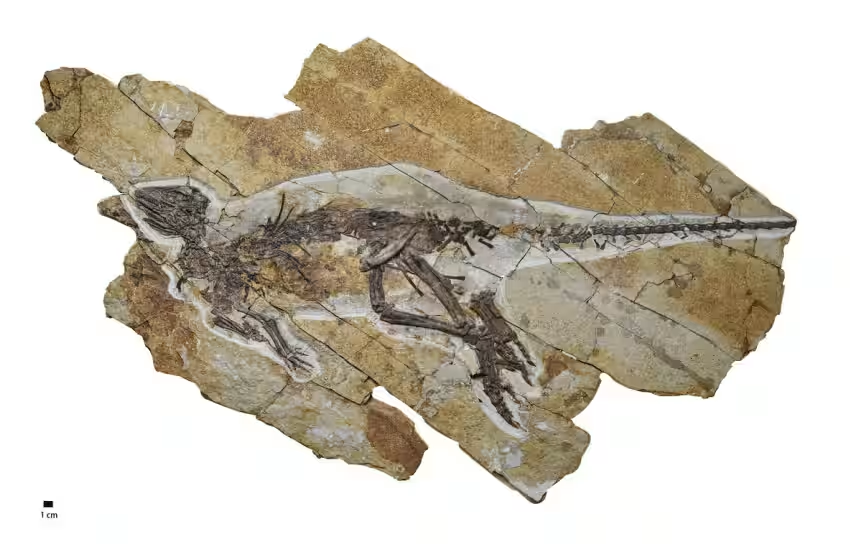
That is why the Pulaosaurus specimen, published in July 2025 in the journal PeerJ, marks only the second reported fossil voice box from a non-avian dinosaur. The first came in 2023, when Junki Yoshida and colleagues described in Communications Biology the larynx of Pinacosaurus grangeri, a squat, armored ankylosaur that lived roughly 75 to 81 million years ago in what is now Mongolia.
The two discoveries sit on opposite branches of the dinosaur family tree, separated by about 90 million years. Yet both animals share laryngeal features with modern birds: long arytenoid bones, enlarged cricoid elements, and firm joints capable of opening and closing the airway with precision.
A Sound Modifier, Not a Noisemaker
Understanding that anatomy requires a look at how living animals produce sound. In crocodilians and most reptiles, the larynx acts as the sound source. Tissue around the glottis vibrates as air pushes through, generating the call.
Birds work differently. A dinosaur larynx in modern avians serves as a sound modifier. The actual vocal source sits deeper in the chest, where an organ called the syrinx vibrates at the junction of the trachea and lungs. The larynx higher in the throat then shapes that raw sound, adjusting pitch, volume, and texture by changing the size of the airway opening.
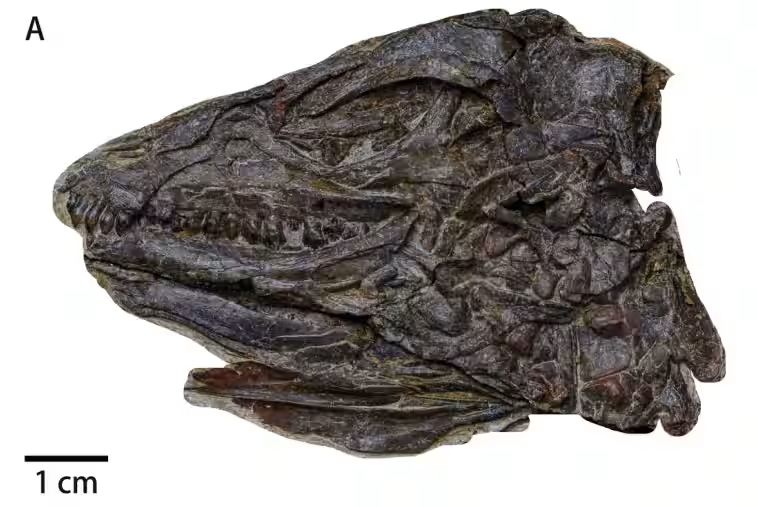
The arytenoid bones preserved in Pulaosaurus are long and leaf-shaped. They offer a large attachment surface and an extended lever arm for the muscles that dilate the glottis. The researchers identify this configuration as a modifier architecture, not a source generator. The authors said that the specimen “represents the second known dinosaur to preserve ossified laryngeal elements, thus suggesting that a bird-like vocalization evolved early in non-avian dinosaur evolution.”
A Juvenile with a Story to Tell
The fossil came from the Tiaojishan Formation in Qinglong County, Hebei Province. It now resides at the Institute of Vertebrate Paleontology and Paleoanthropology in Beijing under specimen number IVPP V30936. The slab holds a near-complete skeleton: skull elements, both forelimbs, most of the hindlimbs, and rare hyoid bones that supported the tongue. Gut contents sit preserved in the abdominal cavity, a snapshot of the animal’s last meal.
Researchers named the species after Qinglong County and after Pulao, a dragon from Chinese mythology known for its thunderous voice. The choice fits with quiet irony. A creature named for deafening sound probably made none. Instead, it called through the forest in frequencies that might have carried between individuals without broadcasting danger to every predator within earshot.
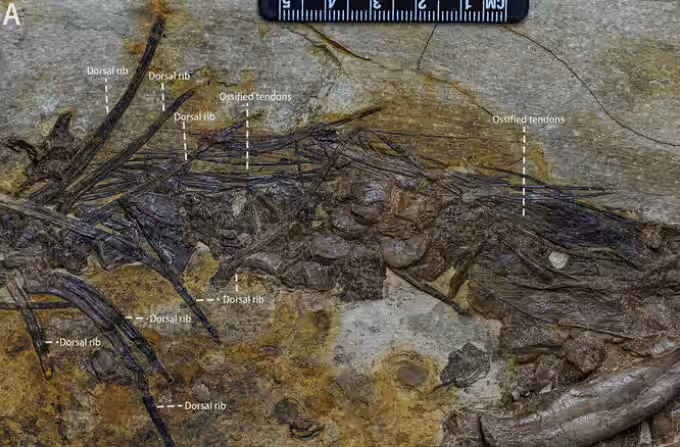
Unfused vertebral sutures and the large proportional size of the eye socket suggest the specimen was a juvenile. Young animals of many species vocalize frequently, calling to parents, siblings, or group members. If Pulaosaurus lived in social groups, as some small ornithischians appear to have done, bird-like vocal communication would have served practical ends: staying in contact, warning of threats, coordinating movement.
Two Fossils Rewrite the Timeline
Pinacosaurus and Pulaosaurus could hardly differ more in body plan. Pinacosaurus was a broad, armored tank of an animal, part of the ankylosaur lineage known from Late Cretaceous deposits in China and Mongolia. Pulaosaurus was a lithe, early-diverging neornithischian, a member of the group that would eventually give rise to duck-billed hadrosaurs and horned ceratopsians. That both possessed a kinetic, bird-type larynx hints that the vocal hardware did not appear once in a specialized offshoot. It was present early, in a common ancestor, and inherited across the dinosaur radiation.
The Pulaosaurus paper classifies the animal as one of the earliest-diverging neornithischians yet described. Phylogenetic analysis places it near Agilisaurus and Hexinlusaurus, two small bipedal herbivores from roughly contemporaneous deposits in southwestern China. Diagnostic traits include five premaxillary teeth, a small boss on the jugal bone, and three unfused distal tarsals in the ankle. Each feature separates the genus from its closest relatives.
James Napoli, a vertebrate paleontologist at Stony Brook University, told Smithsonian Magazine that fossilized vocal organs remain “one of those persistent unknowns” in dinosaur science. “Without fossilized vocal organs, which are extremely rare,” Napoli said, “it’s really hard to even begin to estimate the limits of dinosaur vocal behavior, much less what they really sounded like.”
What the Sandstone Still Holds
The Tiaojishan Formation belongs to the Yanliao Biota, a Middle-to-Late Jurassic fossil assemblage that has yielded feathered theropods, early mammals, and pterosaurs. Neornithischian dinosaurs were conspicuously scarce in these deposits until now. Pulaosaurus helps close that gap and adds vocal anatomy to the list of traits paleontologists can study in the formation’s exceptionally preserved specimens.
Local fossil hunter Yong Wang collected the slab before scientists prepared and CT-scanned it. The scans revealed internal details of the pelvic girdle hidden by overlapping bones and confirmed the specimen’s authenticity. The ossified laryngeal elements rest ventrally adjacent to the displaced mandible, exactly where they would have sat in life.
This article has been fact checked for accuracy, with information verified against reputable sources. Learn more about us and our editorial process.
Last reviewed on .
Article history
- Latest version
Reference(s)
- Yang, Yunfeng. “A new neornithischian dinosaur from the Upper Jurassic Tiaojishan Formation of northern China.”, vol. 13, pp. e19664 PeerJ, doi: 10.7717/peerj.19664. <https://peerj.com/articles/19664/>.
- Yoshida, Junki. “An ankylosaur larynx provides insights for bird-like vocalization in non-avian dinosaurs - Communications Biology.”, vol. 6, no. 1, February 15, 2023, pp. 152 Nature, doi: 10.1038/s42003-023-04513-x. <https://www.nature.com/articles/s42003-023-04513-x>.
- “Pulao | Dragons of Fame | The Circle of the Dragon.” <https://www.blackdrago.com/fame/pulao.htm>.
- “Pinacosaurus | Natural History Museum.” <https://www.nhm.ac.uk/discover/dino-directory/pinacosaurus.html>.
- Bassi, Margherita. “Rare Fossil Suggests Some Dinosaurs May Have Sounded Like Birds and Shared Similar Vocal Anatomy.”, July 30, 2025 Smithsonian Magazine <https://www.smithsonianmag.com/smart-news/rare-fossil-suggests-some-dinosaurs-may-have-sounded-like-birds-and-shared-similar-vocal-anatomy-180987071/>.
Cite this page:
- Posted by Hassan Raza