Hidden Math Flaw Proves Disease Memory Models May Be Entirely Wrong
New mathematical proofs reveal that early epidemic data cannot reliably identify fractional orders, exposing widespread false memory artifacts.
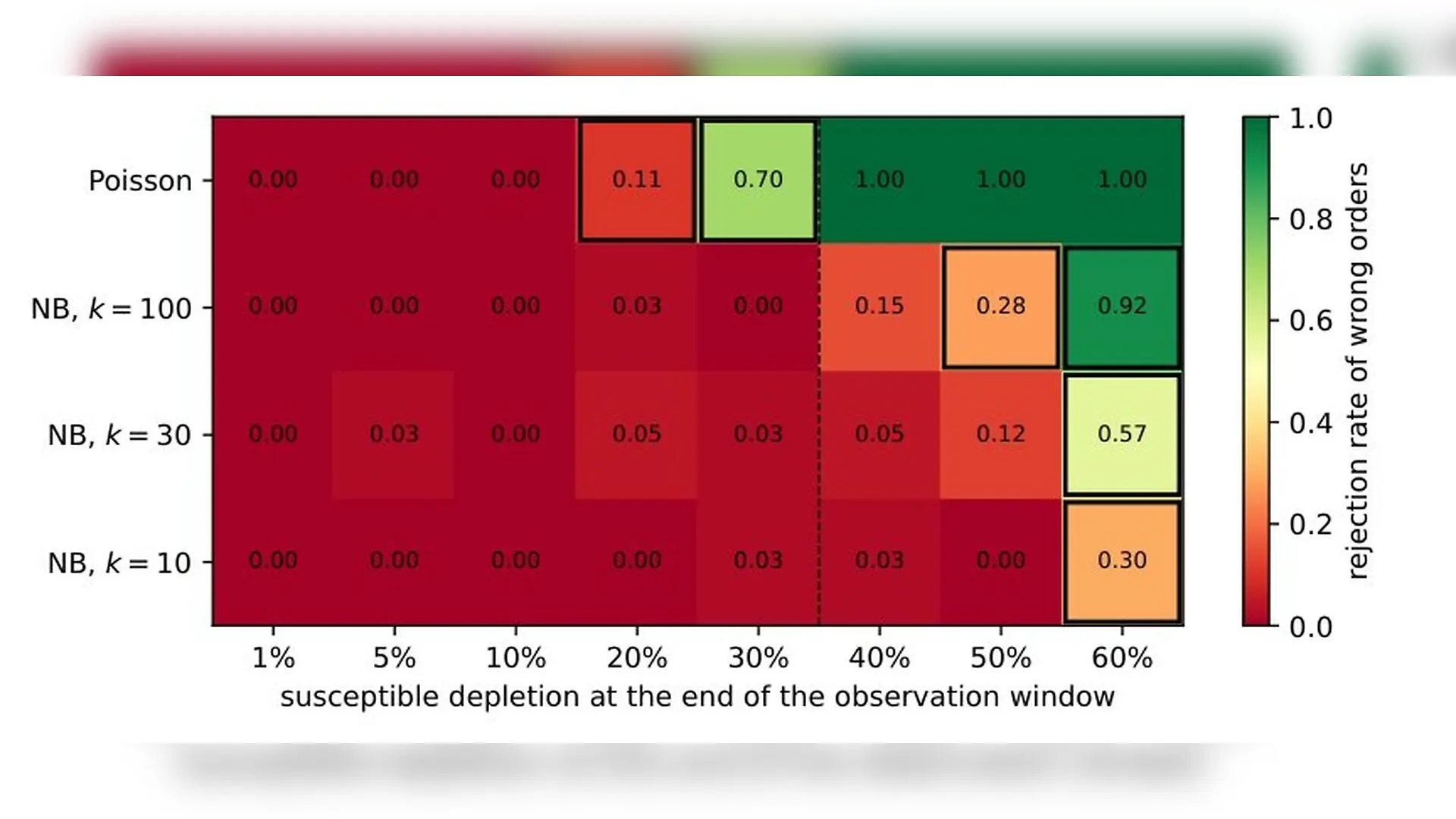
When mathematicians model outbreaks using fractional calculus, a special fractional order parameter is often assumed to capture historical infection memory, but new research shows that early pandemic data cannot reliably identify this value.
Epidemiologists frequently use fractional compartmental models, such as the fractional Caputo susceptible-infectious-removed or SIR model, to study how past exposures and reporting delays shape current transmission. Although these models often achieve closer statistical fits to reported cases than classical integer-order models, researchers Md Babul Hossain and Mohammad Shah Alam recently investigated whether the data actually determine the fractional order or if other factors are at play. Their findings are available on the arXiv preprint server in a study published in the arXiv preprint server.
Why Early Outbreak Data Masks the True Order
The authors demonstrated mathematically that when transmission rates vary freely over time, every admissible fractional order and removal rate reproduces the exact same incidence data. Even when transmission remains constant, the dominant term of early linearized growth depends entirely on only two combined parameters, specifically the growth rate and the amplitude. Any remaining transient information is strictly bounded, meaning different parameter sets can yield nearly identical infection curves during the initial weeks of an epidemic.
Through a series of simulations and mathematical proofs, the authors established that standard incidence counts in the early phase of an outbreak contain insufficient information to separate competing fractional orders. In fact, wrong orders were rejected in at most 5 percent of simulation replicates when data collection stopped two weeks or more before the epidemic peak.
Can Real Surges and Interventions Create False Memory?
The research also explored whether estimated fractional orders below one genuinely indicate biological memory or simply reflect model misspecification and numerical artifacts. When the team tested noise-free data generated from standard integer-order mechanisms, they discovered two distinct sources of spurious memory.
First, daily discretization methods used to solve fractional models introduce numerical errors that the fractional order readily absorbs, masquerading as memory. Second, when infection transmission drops mid-outbreak due to public health interventions or behavioral shifts, the model fits lower fractional orders to mimic the slowed progression of the disease.
What Happens to Infection Forecasts When Parameters Trade Off
Because multiple parameter combinations can produce nearly identical early trajectories, standard plug-in forecasts that fix a single fractional order tend to be dangerously overconfident. In the authors test scenarios, competing models that were indistinguishable during the first 60 days predicted epidemic peaks that differed by as much as 75 percent.
When the researchers analyzed early COVID-19 case records from Bangladesh and the United States, they observed the same mathematical ambiguity. The estimated fractional orders hovered below one, but the removal rates pressed against numerical boundaries, indicating that the fits were driven by algorithmic constraints rather than true historical memory in the populations.
The study was posted to the arXiv preprint server on November 19, 2026.
This article has been fact checked for accuracy, with information verified against reputable sources. Learn more about us and our editorial process.
Last reviewed on .
Article history
- Latest version
Reference(s)
- Hossain, Md. “Fractional Order or False Memory: Identifiability of Caputo SIR Models from Incidence Data.” arXiv.org <http://arxiv.org/abs/2611.25440v1>.
Cite this page:
- Posted by Linda Wilson