AI Agent Uncovers Why Wind Turbines Collapse During Extreme Typhoons And Earthquakes
A new artificial intelligence framework called Iwind automates complex simulations to reveal hidden failure patterns and parked-state survival strategies in wind energy towers.
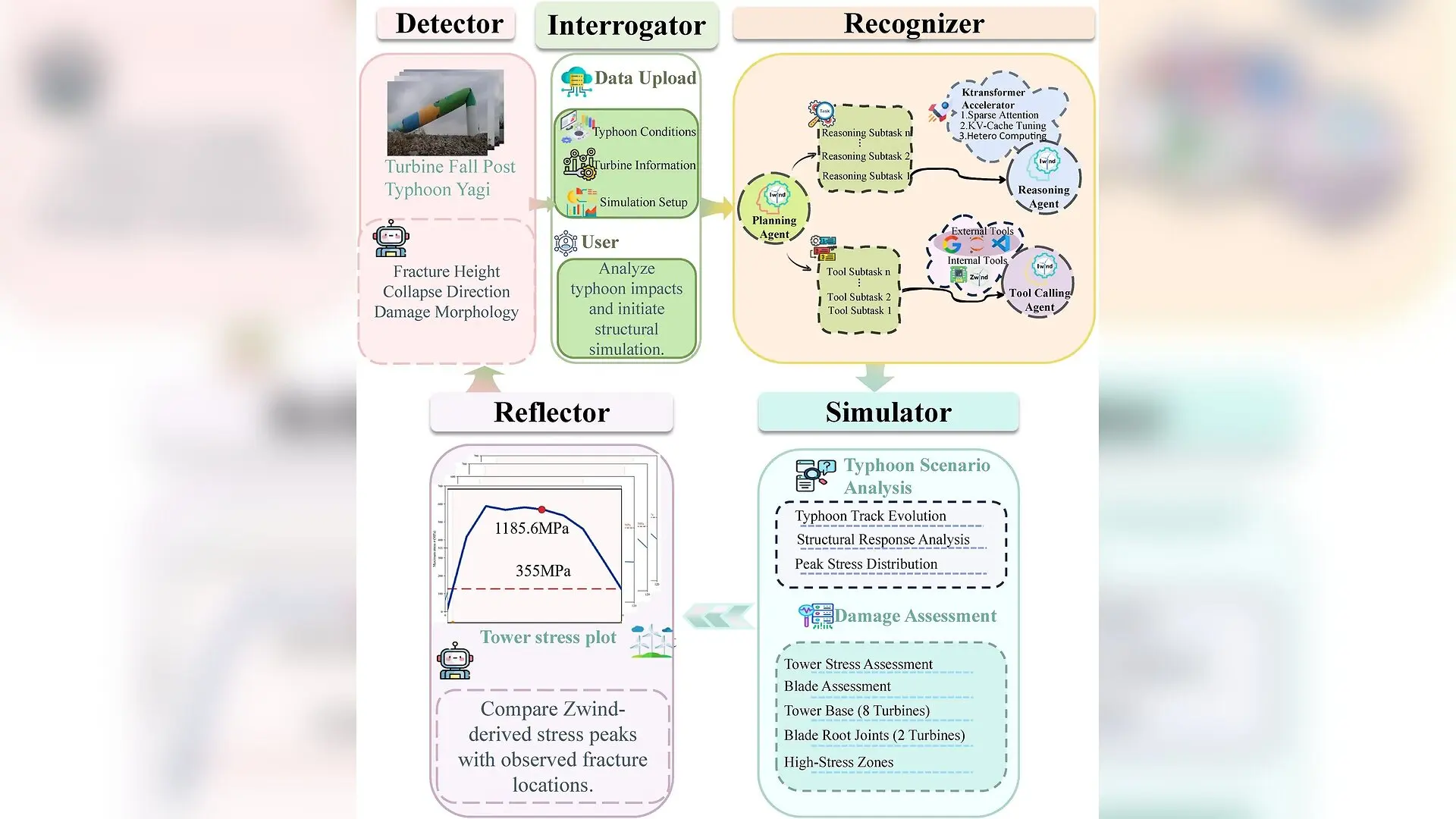
A new artificial intelligence agent named Iwind can translate everyday language instructions into complex structural engineering simulations for wind turbines facing extreme natural hazards. Researchers developed this physics-informed framework to help engineers quickly analyze how 100-meter-tall energy towers respond to violent forces such as typhoons and earthquakes.
Wind power is rapidly expanding into challenging offshore and onshore regions worldwide, but extreme weather events continue to cause catastrophic structural failures. For instance, when Super Typhoon Yagi struck coastal areas in 2024, it destroyed numerous wind turbines, leaving behind severe blade fractures, buckled steel towers, and total structural collapses. Investigating these disasters traditionally requires months of tedious manual field surveys and isolated computer modeling, creating a major bottleneck in disaster response and structural safety design.
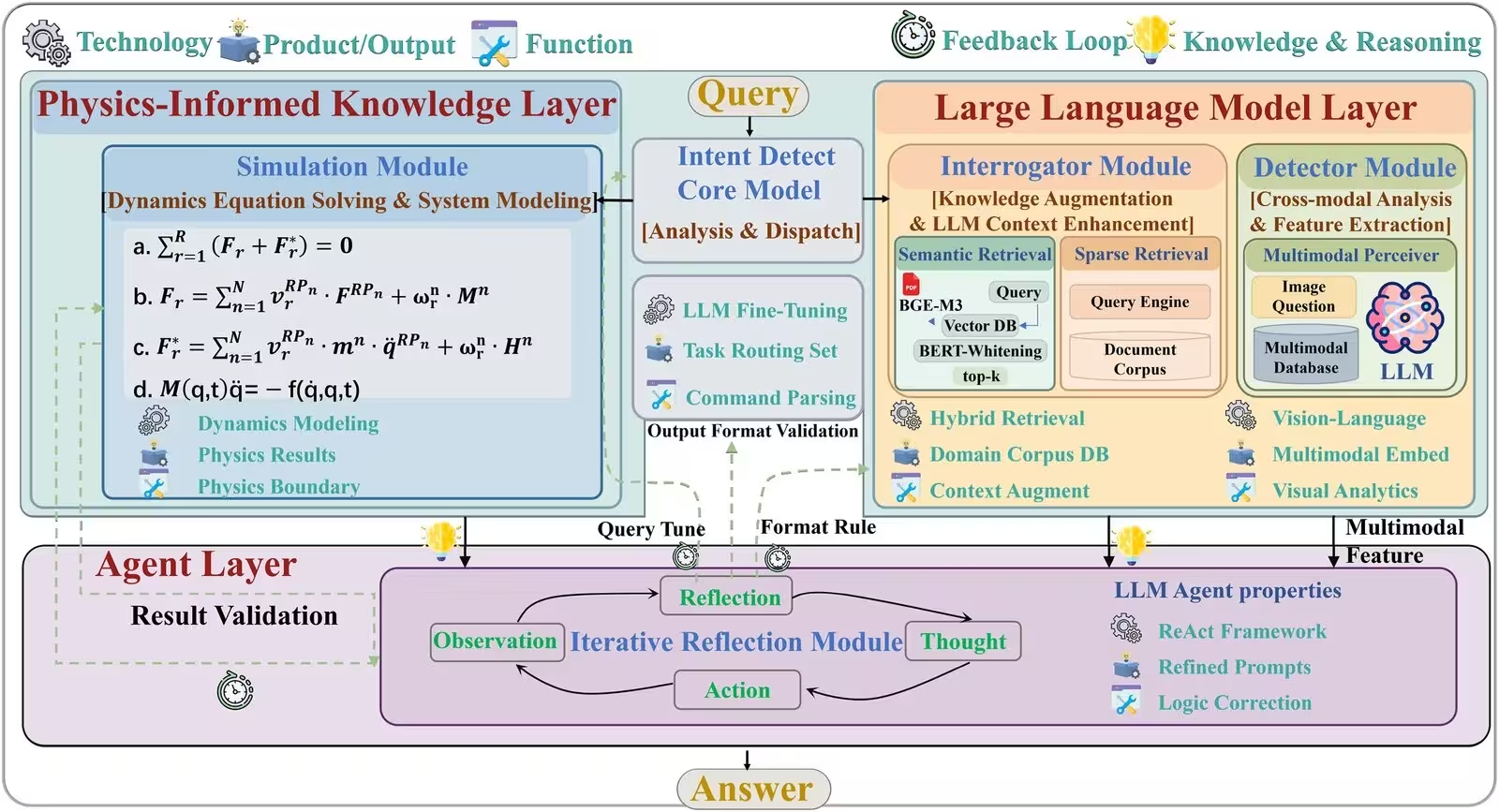
To overcome these hurdles, a team of scientists created the Iwind agent, which operates as a bridge between human engineering requests and advanced numerical solvers. As published in iScience, the framework uses a specialized large language model combined with retrieval-augmented generation and the model context protocol to standardize solver communication. Rather than performing the underlying physics calculations itself, the agent interprets user instructions, checks parameters, generates input files for an in-house multi-body dynamics solver called Zwind, and orchestrates post-processing scripts.
How Artificial Intelligence Automates Engineering Simulations
The Iwind agent organizes its operations through five distinct functional modules that handle intent recognition, iterative reflection, knowledge retrieval, simulation execution, and visual perception. When evaluated on a Chinese benchmark containing 15,000 professional questions across 15 technical categories, the full model configuration achieved high scores for domain-specific knowledge retrieval and task execution. Controlled tests showed that supervised fine-tuning, reinforcement learning, and retrieval augmentation provided complementary benefits, raising simulation input generation rates to 86.7 percent and end-to-end task completion to 83.3 percent.
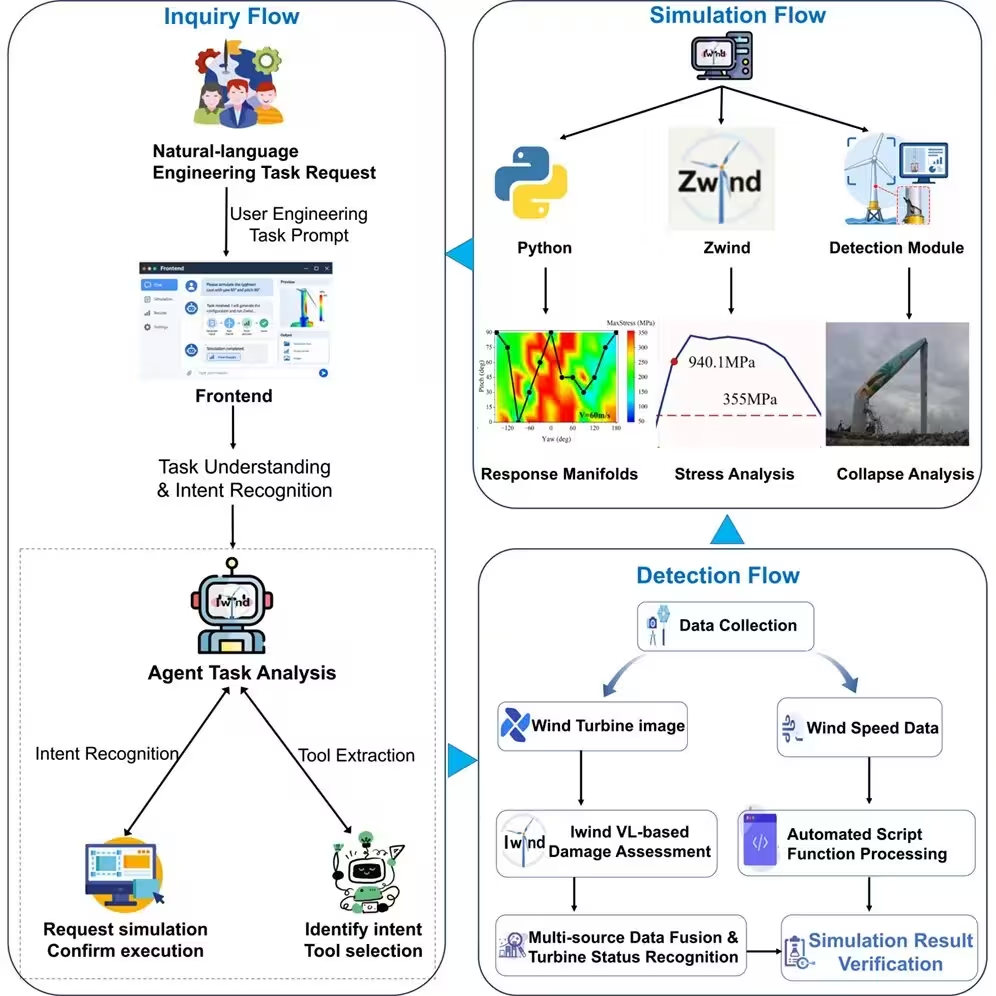
In addition to text processing, the system incorporates a computer vision module powered by a YOLO-based detector to screen turbine damage from photographs. This visual pipeline identifies seven visible surface defects, including cracks, burns, deformations, and rust, helping engineers locate fault zones across damaged structures. By pairing these visual observations with Zwind simulations, the agent generates structured assessment reports that map out stress distributions and yield-exceedance regions along the tower height.
Distinct Failure Patterns Caused by Typhoons and Earthquakes
When analyzing historical disaster events such as Typhoon Yagi, the research team found that turbine collapses followed distinct spatial patterns. Among 15 examined turbines, eight suffered tower buckling or complete collapse, with fracture heights concentrated primarily between 15 and 65 meters above the ground. Computer simulations driven by reconstructed wind fields revealed that computed linear-elastic stresses at these estimated fracture heights exceeded the 355 megapascal yield threshold of standard S355 tower steel.
The study also highlighted fundamental differences between wind and seismic loading mechanisms. While typhoons apply distributed aerodynamic thrust from above that often leads to blade fractures and upper tower buckling, earthquakes introduce violent inertial excitation through the foundation. Consequently, earthquake-damaged turbines frequently displayed more severe structural distress in their lower foundations and supporting base structures while upper towers remained relatively intact.
Why Yaw and Pitch Angles Shape Parked Turbine Survival
To investigate how parked turbines survive extreme loads when power grids fail, the researchers simulated various fixed blade pitch and rotor yaw combinations. By sweeping through complete 360-degree orientation cycles and blade feathering angles, the Zwind software mapped out structural response manifolds that resembled letter shapes. Under typhoon wind conditions, the analysis produced W-shaped response curves indicating that crosswind orientations require specific pitch adjustments to minimize bending stress.
Conversely, seismic simulations generated mirror-image M-shaped response manifolds due to the inverted-pendulum dynamics of the heavy rotor-nacelle assembly shaking from the base. These offline state maps provide valuable reference points for pre-storm parked-state planning and hazard-region identification. The authors note that while the framework significantly accelerates structural analysis, practical field deployment still requires careful expert validation, dedicated backup power systems, and rapid actuator responses to ensure structural safety.
The research was published in iScience on October 30, 2026.
This article has been fact checked for accuracy, with information verified against reputable sources. Learn more about us and our editorial process.
Last reviewed on .
Article history
- Latest version
Reference(s)
- Fu, Linjun., et al. “A physics-informed LLM agent for uncovering typhoon- and earthquake-induced turbine failures and offline yaw-pitch countermeasures.” iScience, vol. 29, no. 11, November 1, 2026, pp. 118076 Elsevier BV, doi: 10.1016/j.isci.2026.118076. <https://doi.org/10.1016/j.isci.2026.118076>.
Cite this page:
- Posted by Vikram Desai