Ethiopian Study Reveals 2024 Malaria Resurgence and Parasite Shift
A five-year analysis of health center records uncovers changing parasite species dominance and seasonal transmission peaks in East Gojjam.
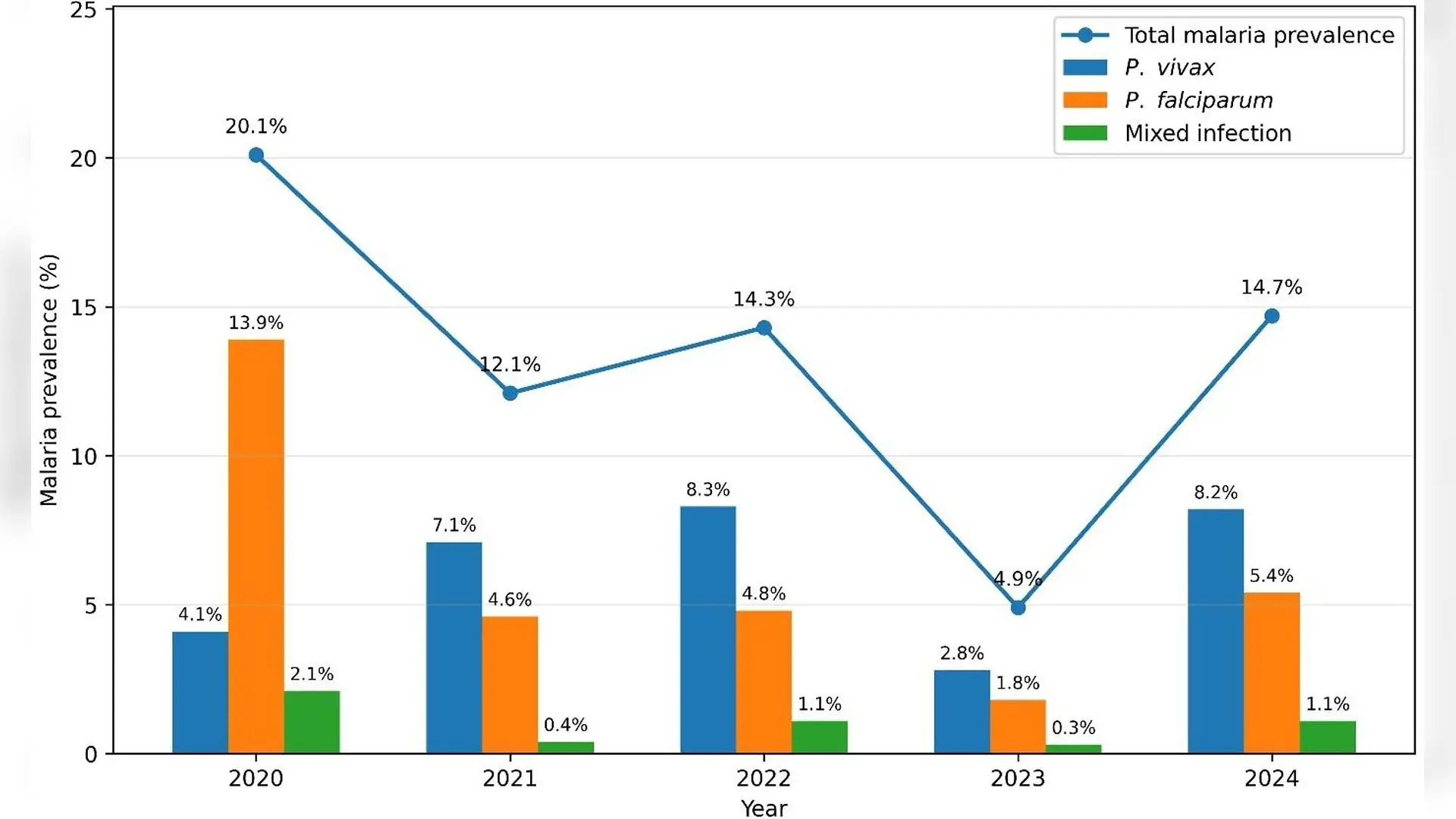
A five-year analysis of patient records from a health center in northwestern Ethiopia reveals shifting malaria trends, including a sharp resurgence in 2024 after years of steady decline. The study, published in PLOS One, examined 7,806 blood film examinations conducted between January 2020 and December 2024 at the Yejube Health Center in the Baso Liben District.
Fluctuating Infections and a 2024 Resurgence
Researchers evaluated medical records to track how malaria prevalence and parasite species distribution changed over time in the East Gojjam Zone. Out of all tested febrile patients, 1,066 tested positive for malaria, yielding an overall five-year test positivity rate of 13.65 percent. The infection rate started high at 20.08 percent in 2020 before dropping to a low of 4.95 percent in 2023. However, that downward trend reversed abruptly in 2024, when the positivity rate jumped to 14.66 percent.
The authors note that this local spike mirrors broader national trends across Ethiopia, where millions of cases have strained healthcare resources. Factors such as weather variability, potential disruptions in vector control programs, and challenges in maintaining prevention efforts may have contributed to the sudden increase in disease transmission.
Shifting Parasite Species Behind the Infections
The study tracked two primary parasite species responsible for the illness: Plasmodium falciparum and Plasmodium vivax. Across the entire five-year window, Plasmodium falciparum accounted for 49.62 percent of cases, while Plasmodium vivax made up 43.34 percent, alongside a small percentage of mixed infections. However, a closer look at the yearly breakdown shows a notable shift in dominance.
While Plasmodium falciparum was the most common parasite in 2020, Plasmodium vivax took over as the leading species from 2021 through 2024. This transition presents distinct medical challenges because Plasmodium vivax can form dormant liver-stage hypnozoites, which are parasites that can reactivate weeks or months later to cause relapses without a new mosquito bite. Treating this species requires specialized medications that clear dormant liver stages, though deploying these treatments safely is often complicated by a lack of point-of-care enzyme deficiency testing.
Demographic Patterns and Seasonal Peaks
Statistical analysis identified strong links between malaria positivity and specific patient characteristics. Males faced significantly higher odds of contracting the infection than females, with a positivity rate of 16.7 percent compared to 10.1 percent, likely due to greater outdoor occupational exposure and mobility.
Age also played a major role in vulnerability. Children under five years old and working-age adults between 15 and 59 years old experienced much higher odds of testing positive compared to adults aged 60 and older. On a seasonal level, infections followed a predictable pattern tied to local rainfall. The highest positivity rates occurred in autumn, peaking in October at 21.5 percent following the main rainy season, with a smaller secondary bump observed in May during regional weather shifts.
Study Limitations and Next Steps
Because the investigation relied entirely on retrospective hospital logbooks, it reflects facility-based test positivity rather than total community-wide prevalence. The authors acknowledge that the data lacked details on patient travel history, socioeconomic status, or exact insecticide-treated net usage. They recommend that public health officials strengthen local surveillance, target high-risk demographic groups, and ensure proper species-specific diagnostics and treatments to support ongoing elimination goals.
The research was published in PLOS One on November 19, 2026.
This article has been fact checked for accuracy, with information verified against reputable sources. Learn more about us and our editorial process.
Last reviewed on .
Article history
- Latest version
Reference(s)
- Fenta, Abebe., et al. “Five-year trends in Malaria prevalence, Plasmodium species distribution, demographic patterns, and seasonal variation at Yejube health center, Baso Liben district, East Gojjam zone, Ethiopia, 2020–2024: Implications for Malaria elimination.” PLOS One, vol. 21, no. 11, November 19, 2026, pp. e0363165 Public Library of Science (PLoS), doi: 10.1371/journal.pone.0363165. <https://doi.org/10.1371/journal.pone.0363165>.
Cite this page:
- Posted by Michael Ellison