Hidden Energy Cascade Reveals Why Tropical Clouds Form Massive Clusters
A novel theoretical framework demonstrates how atmospheric energy flows across spatial scales to drive convective self-aggregation over tropical oceans.
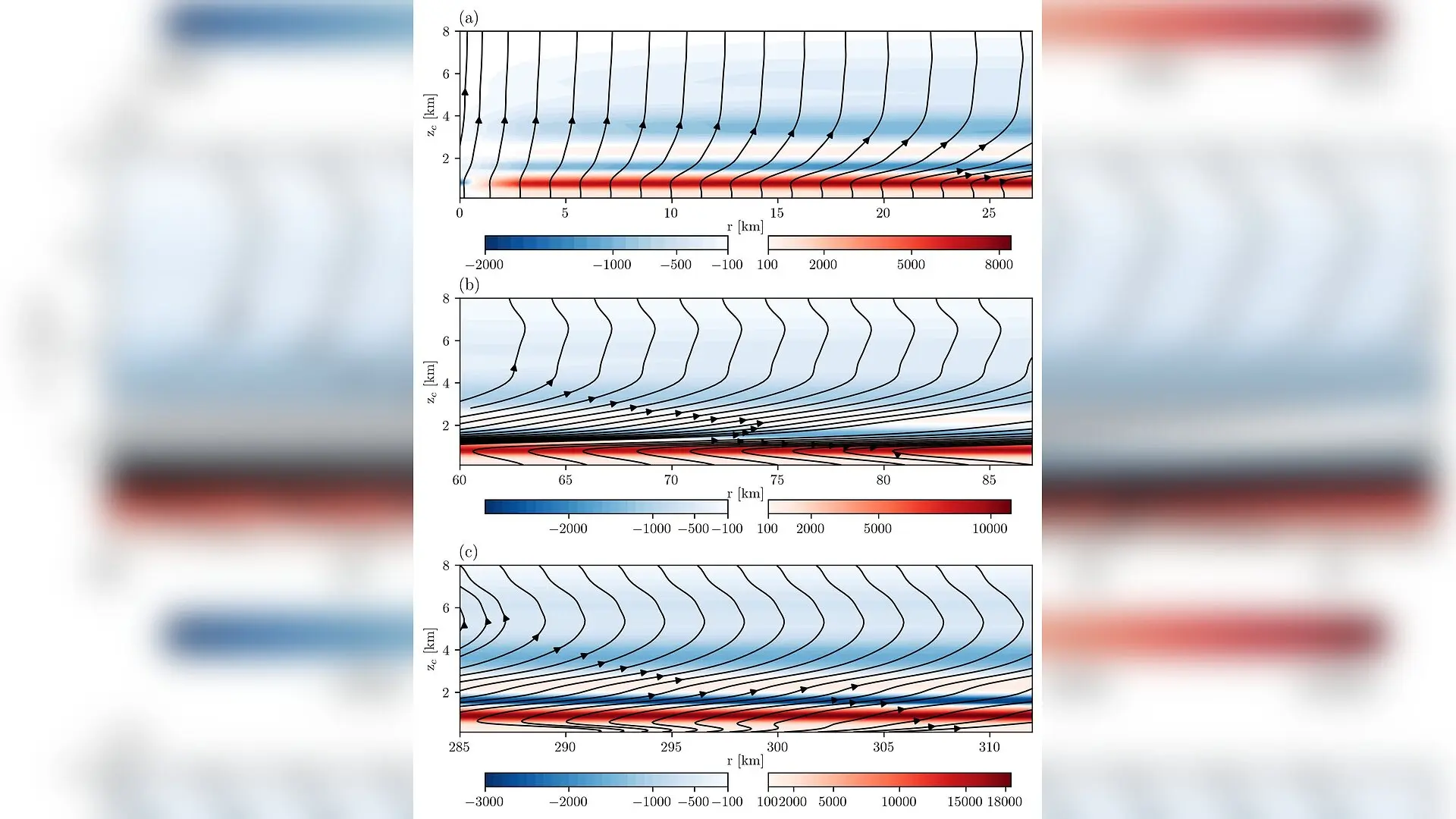
When atmospheric energy flows upward and outward across spatial scales, scattered clouds spontaneously organize into massive regional clusters over tropical oceans. Atmospheric scientists have long debated the exact mechanics driving this process, known as convective self-aggregation, where randomized storms consolidate into localized moist patches surrounded by dry air. New research reveals that this self-organization is sustained by an inverse energy cascade, where atmospheric energy flows from smaller local weather disturbances up to larger mesoscale circulations spanning roughly 100 to 250 kilometers.
The study, published in the arXiv preprint server, was conducted by Lorenzo Silvestri, Paolina Bongioannini Cerlini, and Andrea Cimarelli. The authors developed a scale-by-scale theoretical framework by deriving a generalized Yaglom equation to track second-order structure functions of frozen moist static energy, which measures the scale-dependent variance of atmospheric energy per unit volume across simulated tropical environments.
How Energy Cascades Across Atmospheric Scales
To understand how individual clouds cluster into massive weather systems, the researchers analyzed idealized numerical simulations spanning 768 by 768 kilometers with a horizontal grid resolution of 3 kilometers. Their multi-dimensional budget analysis demonstrates that the lower atmospheric levels, extending from the surface up to the boundary layer top around 1,150 meters, act as the primary engine for moist energy variance production. Here, intense temperature and moisture gradients generate scale-energy anomalies that are subsequently transported upward and outward.
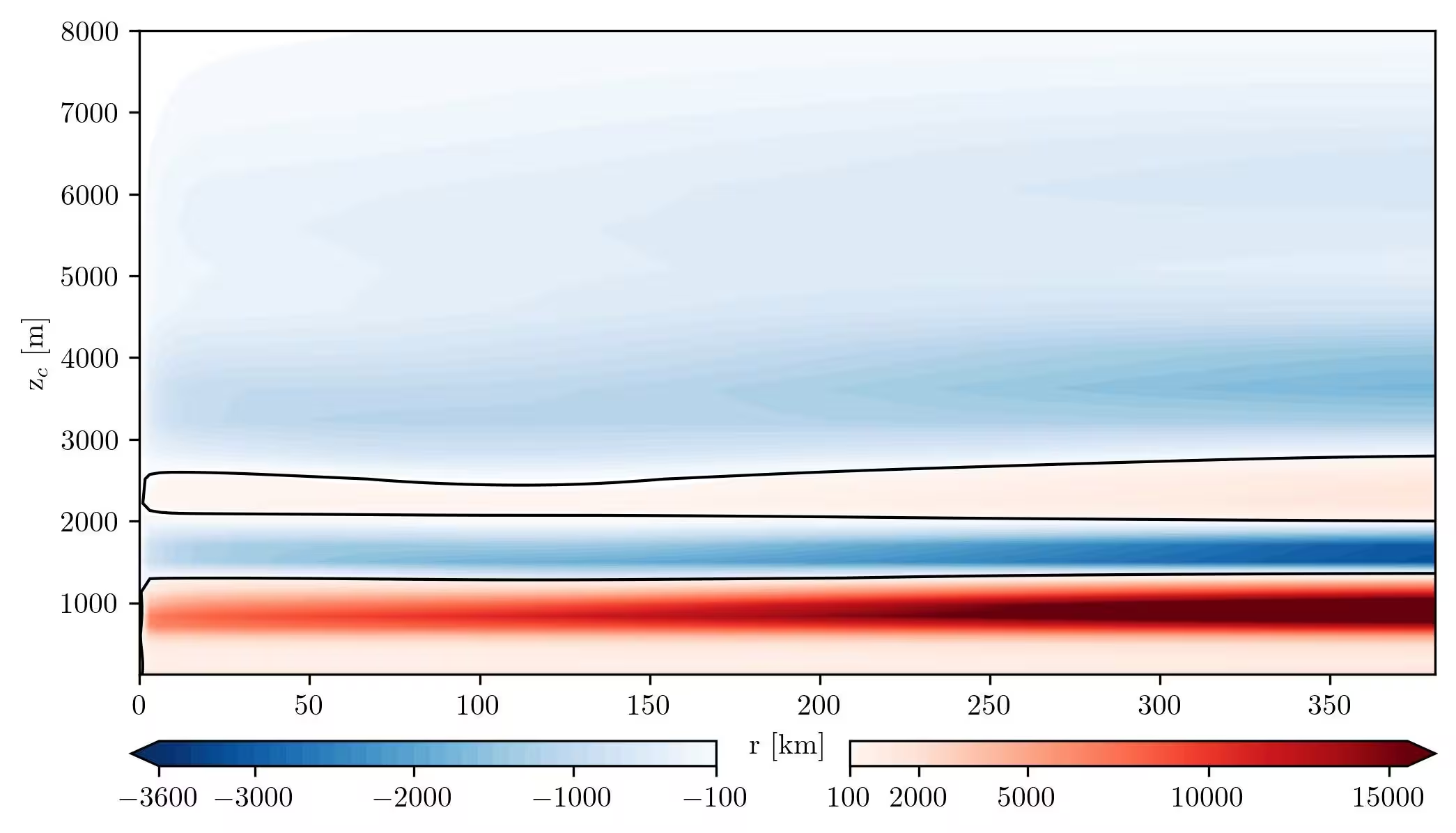
The team found that scale-energy variance exhibits an extraordinary collapse across all atmospheric layers onto a robust self-similar power law, scaling as $r^{6/5}$ in the mesoscale range between 100 and 250 kilometers. In contrast, horizontal velocity increments follow a $r^{2/5}$ power law while retaining residual height dependence, and vertical velocity fluctuations saturate rapidly for horizontal scales larger than 30 kilometers. These scaling laws allowed the researchers to explicitly quantify the moisture-convection feedback through scale-dependent correlation coefficients.
The Boundary Layer Top as a Thermal and Dynamic Filter
A critical finding of the analysis is that the boundary layer top acts as a scale-dependent dividing layer. At small local scales below 100 kilometers, strong thermal and energy stratification filters interactions between the surface and the free troposphere, successfully decoupling low-level and high-level dynamics. However, large-scale mesoscale circulations possess enough energy to overcome this stratification, connecting the boundary layer directly to the free troposphere.
Above 1,200 meters in the shallow cloud layer, the energy budget transitions into a sink region where scale-energy variance is consumed rather than locally produced. The authors observed that spatial energy fluxes are strictly ascending throughout the column, carrying energy generated near the surface upward into the troposphere. Within the mesoscale range, this ascending transport combines with an inverse energy cascade, moving energy from larger surface structures toward smaller boundary layer features like cold pools, while larger cluster scales undergo a reverse cascade.
Theoretical Limits of Tropical Cloud Clusters
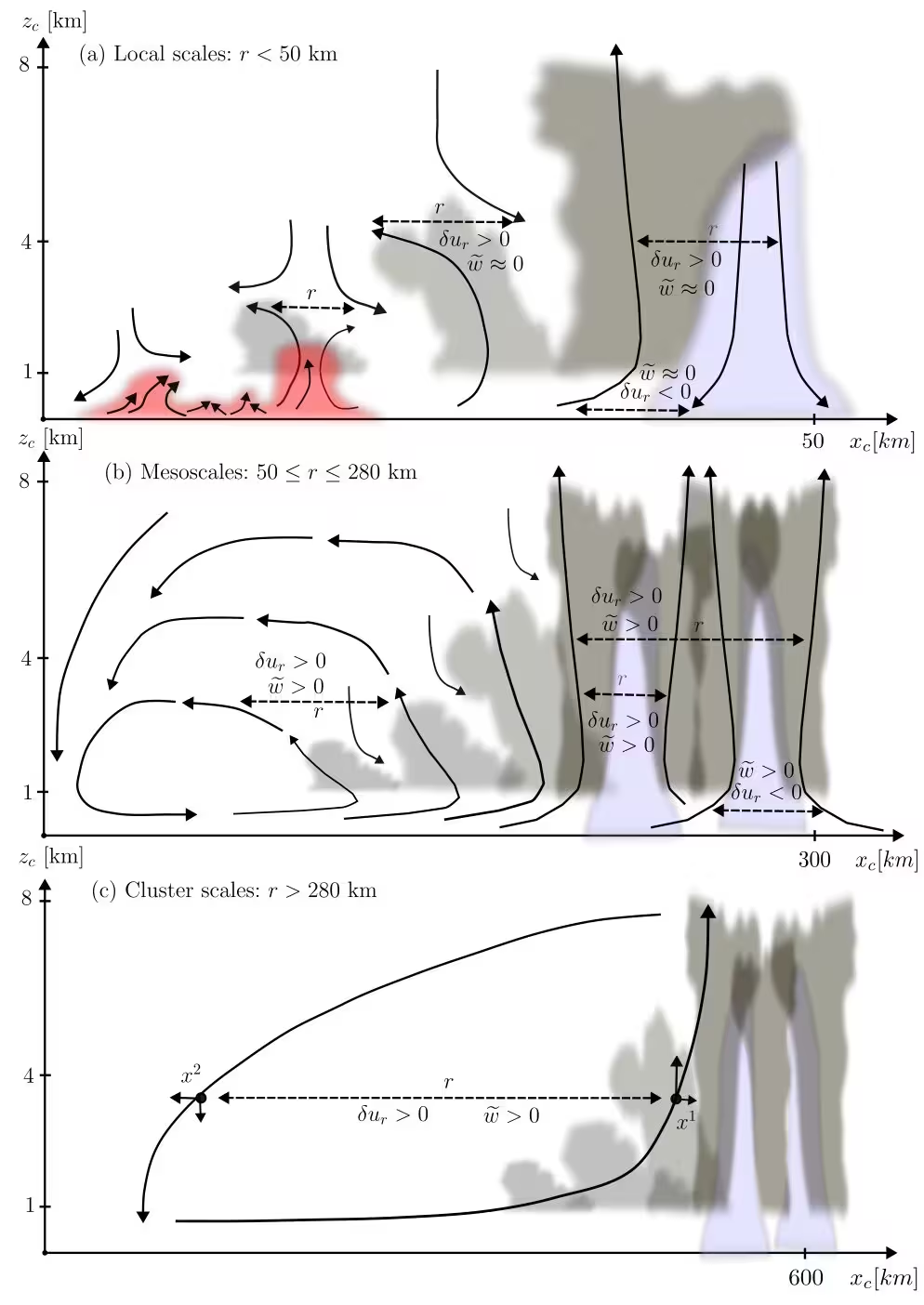
By framing their findings within a convective quasi-equilibrium state, the researchers derived theoretical limits for the natural size of mesoscale convective units. The lower bound of roughly 50 kilometers is set by the point where gravity wave propagation time scales match convective turnover times. Below this threshold, individual cloud systems dominate without coherent self-similarity.
The upper limit is governed by two competing constraints. In the Tropics, a geometrical limit tied to the tropopause height of roughly 17,000 meters restricts single mesoscale circulations to a maximum horizontal width of about 260 kilometers, closely matching the cluster sizes observed in simulations. Poleward of 20 degrees latitude, however, a stricter dynamical limit imposed by the Coriolis force takes over, shrinking the maximum scale of self-similar aggregation and offering new insight into the observed widths of tropical convergence zones and weather systems.
The study was posted to the arXiv preprint server on November 19, 2026.
This article has been fact checked for accuracy, with information verified against reputable sources. Learn more about us and our editorial process.
Last reviewed on .
Article history
- Latest version
Reference(s)
- Silvestri, Lorenzo. “Multi-scale dynamics of deep convective self-aggregation. Part II: scale-by-scale budget and mesoscale self-similarity.” arXiv.org <http://arxiv.org/abs/2611.25829v1>.
Cite this page:
- Posted by Michael Ellison