Frozen Mountain Soils Hide a Seven-Month Drought Lag
Satellite data from the Qilian Mountains reveal how thawing permafrost and seasonally frozen ground alter plant water use efficiency over a twenty-year timeline.
When mountain ice and frozen ground begin to warm up under global climate change, the water efficiency of local plant life does not respond immediately, instead keeping a hidden schedule that researchers have only recently untangled across a massive 20-year timeline.
Vegetation across the remote mountain slopes analyzed in a study published in iScience showed that over half of all plant-covered areas experience a delayed reaction to drought, waiting nearly seven months on average before feeling the hydrological strain.
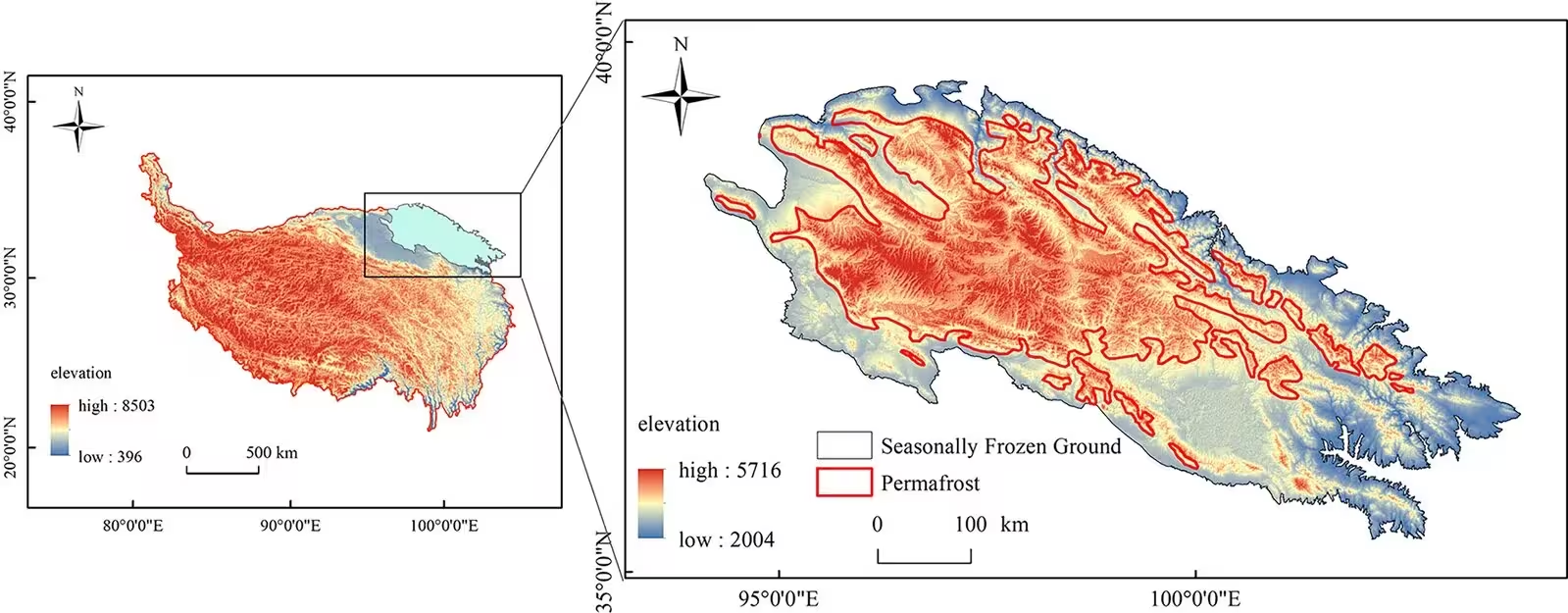
An international research team led by scientists from institutions including the Chinese Academy of Sciences and West Yunnan University examined how frozen ground landscapes handle changing water and carbon cycles. Their investigation focused on the rugged terrain of the Qilian Mountains in Northwest China, spanning a massive 16.90 times ten to the fourth square kilometers of high-altitude ecosystems that act as vital natural water towers and ecological barriers for inland river basins.
A Sharp Boundary Separates Two Distinct Frozen Soil Zones
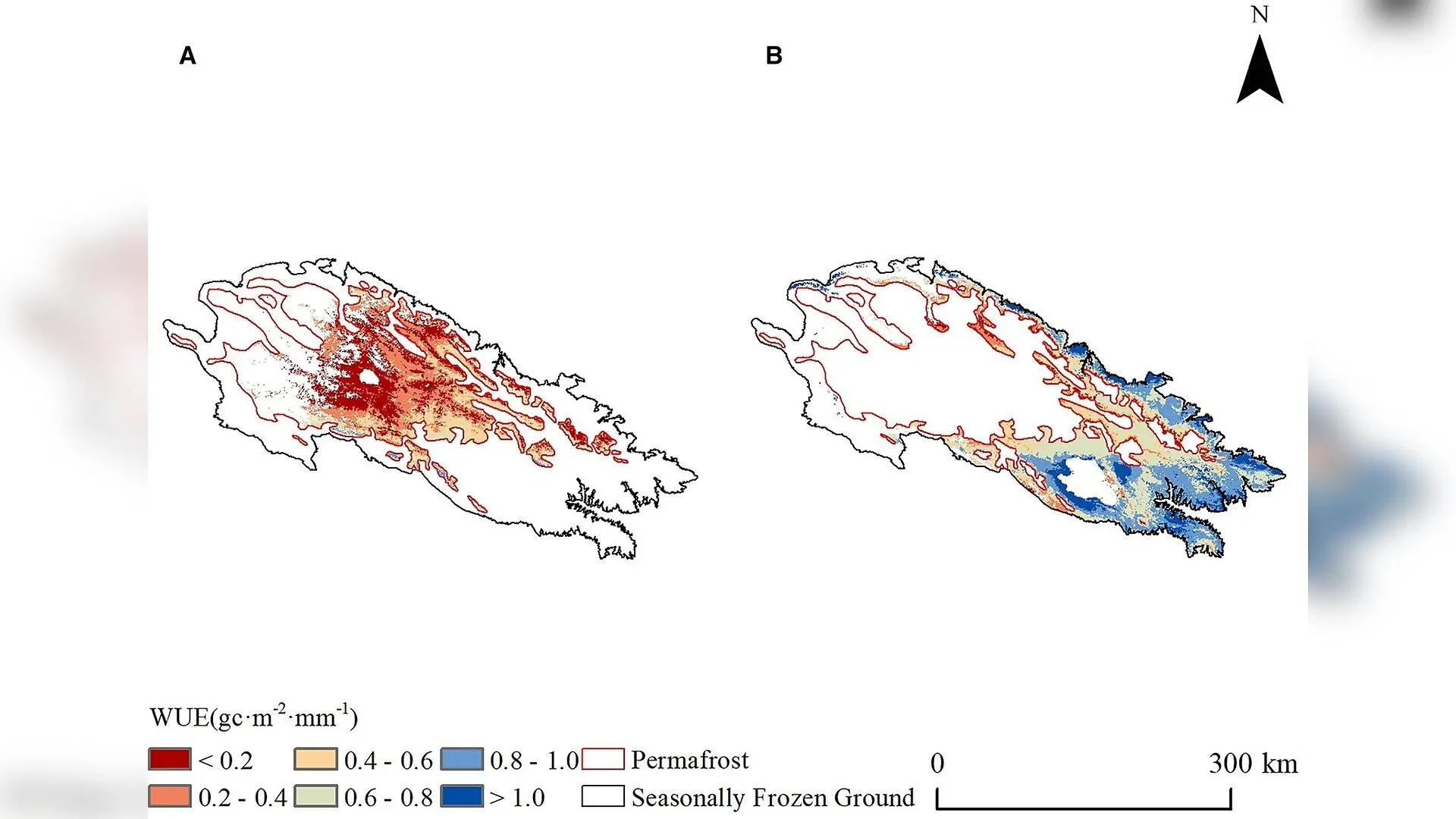
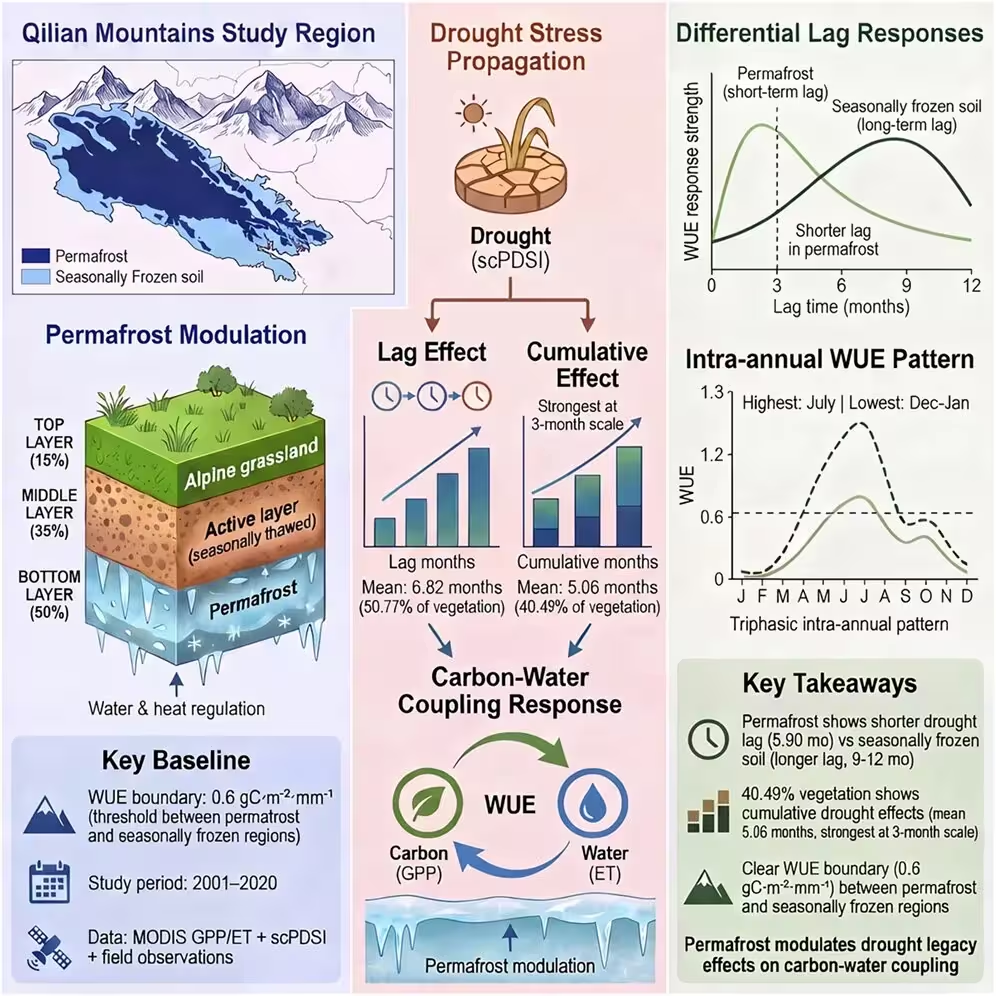
The study mapped how the landscape is split almost evenly between two major underground thermal states, with permafrost covering 47.51 percent of the region and seasonally frozen soil making up the remaining 52.49 percent. The authors found a distinct statistical tipping point at 0.6 grams of carbon per square meter per millimeter of water, which acts as a clear threshold separating these two contrasting soil environments.
In the permafrost regions, vegetation is dominated by alpine meadows and sparse alpine wastelands enduring thin active soil layers and low temperatures. Meanwhile, the seasonally frozen soil zones feature denser ecosystems including evergreen coniferous forests, mixed forests, and croplands that support more robust carbon sequestration and water transpiration.
Why Vegetation Takes Nearly Seven Months to Feel the Pinch of Drought
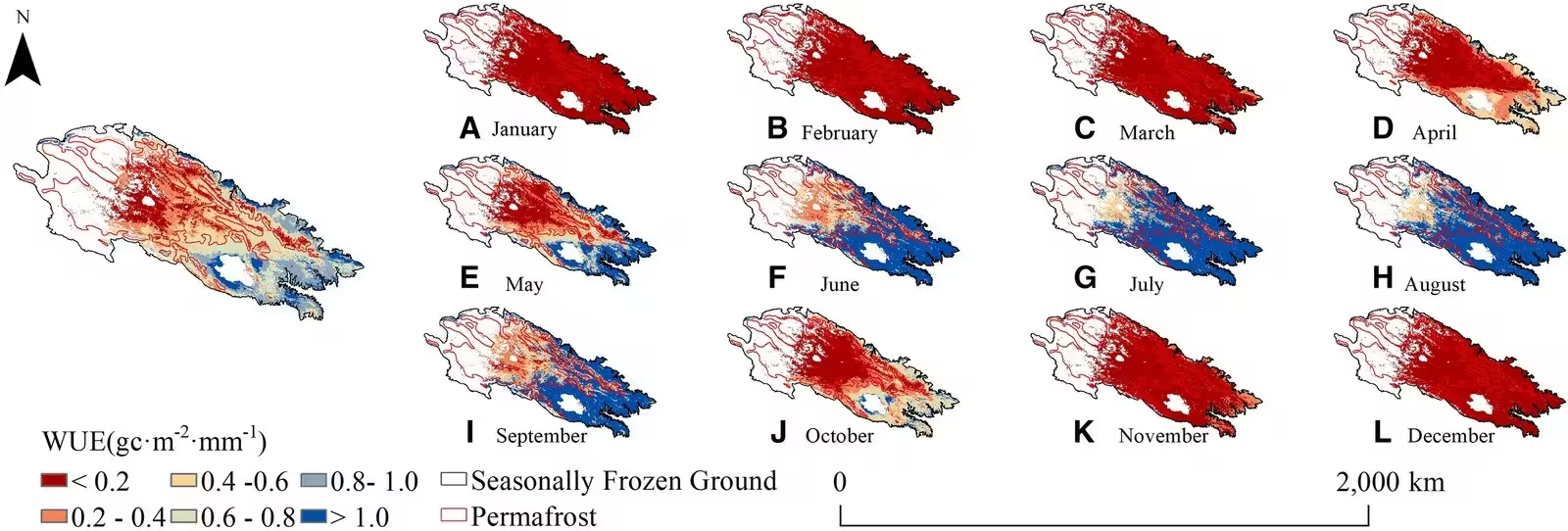
By pairing satellite observations from NASA MODIS instruments with the self-calibrated Palmer Drought Severity Index covering the years from 2001 to 2020, the team tracked ecosystem water use efficiency, defined as the ratio of carbon uptake through photosynthesis to water lost through evapotranspiration. Across the entire mountain range, plant water efficiency showed a slow overall decline during the twenty-year study window.
The analysis revealed that 50.77 percent of the vegetation exhibits a lagged response to drought events, with a mean delay of 6.82 months. However, the two soil types behave very differently when water supplies fluctuate.
- Seasonally frozen soils display longer average response lags of 7.24 months, leaning toward non-lagged and long-term recovery patterns.
- Permafrost zones show shorter average lags of 5.90 months, characterized mainly by non-lagged and short-term drought impacts.
The researchers note that seasonally frozen soils possess higher soil temperatures and more active water cycling, allowing plants to adapt better and tolerate dry spells longer. In contrast, permafrost zones experience brief pulses of meltwater when temperatures rise, but this temporary relief is quickly canceled out by rapid soil moisture loss and shallow root systems that cannot tap deep water reserves.
Cumulative Strains Add Up Across Months of Growth
Beyond simple time lags, the team investigated how prolonged dry periods accumulate over time to stress alpine ecosystems. The data showed that 40.49 percent of the vegetation suffers from cumulative drought effects lasting an average of 5.06 months, meaning that dry conditions in preceding months heavily dictate current plant performance.
Cumulative dry stress hit seasonally frozen forest areas over longer timescales, often stretching past eight months thanks to dense root networks that hold soil moisture longer. In high-altitude permafrost meadows, cumulative effects lasted just 3.88 months on average because shallow alpine roots rely on a fragile supply of surface meltwater that vanishes quickly under warming temperatures.
The authors acknowledge certain limitations in their work, noting that field validation relied on reference evapotranspiration equations rather than direct eddy covariance flux measurements of actual water vapor loss in every zone. Nevertheless, the findings highlight how thawing mountain permafrost alters the hidden clocks governing how fragile highland ecosystems survive shifting climate extremes.
The research was published in iScience on October 29, 2026.
This article has been fact checked for accuracy, with information verified against reputable sources. Learn more about us and our editorial process.
Last reviewed on .
Article history
- Latest version
Reference(s)
- Li, Lili., et al. “The lagged and cumulative effects of permafrost and seasonally frozen soil on water use efficiency in the Qilian Mountains, Northwest China.” iScience, vol. 29, no. 11, November 1, 2026, pp. 117973 Elsevier BV, doi: 10.1016/j.isci.2026.117973. <https://doi.org/10.1016/j.isci.2026.117973>.
Cite this page:
- Posted by Michael Ellison