New Software Pipeline Simplifies Complex Microbiome Data Analysis
Researchers validate a graphical tool using Amazonian mangrove sediments, revealing a remarkably stable core microbial backbone.

Mangrove sediment ecosystems in the Amazon region harbor surprisingly stable microbial communities that remain resilient across varying environmental conditions, according to a recent validation study. Researchers investigating the hidden microscopic life within these coastal wetlands turned to 34 paired-end FASTQ files originating from a previously published study to test a newly developed computational tool designed to make complex microbiome data analysis accessible to scientists without advanced programming backgrounds.
The study, published in Genetics and Molecular Biology in late 2026, details the creation and testing of a graphical software pipeline called Metadoon. Developed by Adan Rodrigues de Oliveira and colleagues at the Federal University of Pará in Brazil, the software addresses a major bottleneck in microbial ecology research, where powerful bioinformatic tools typically demand extensive command-line proficiency.
How the New Software Pipeline Streamlines Genomic Analysis
Amplicon sequencing, specifically targeting the V3 and V4 hypervariable regions of the 16S rRNA gene, serves as a cornerstone for profiling microbial populations in soils, waters, and host-associated environments. However, traditional pipelines such as QIIME2 and mothur require researchers to navigate complex Unix-based terminal environments, handle intricate dependency installations, and manually configure multi-step scripts. These technical barriers often prevent experimental biologists and ecologists from independently analyzing their high-throughput sequencing runs.
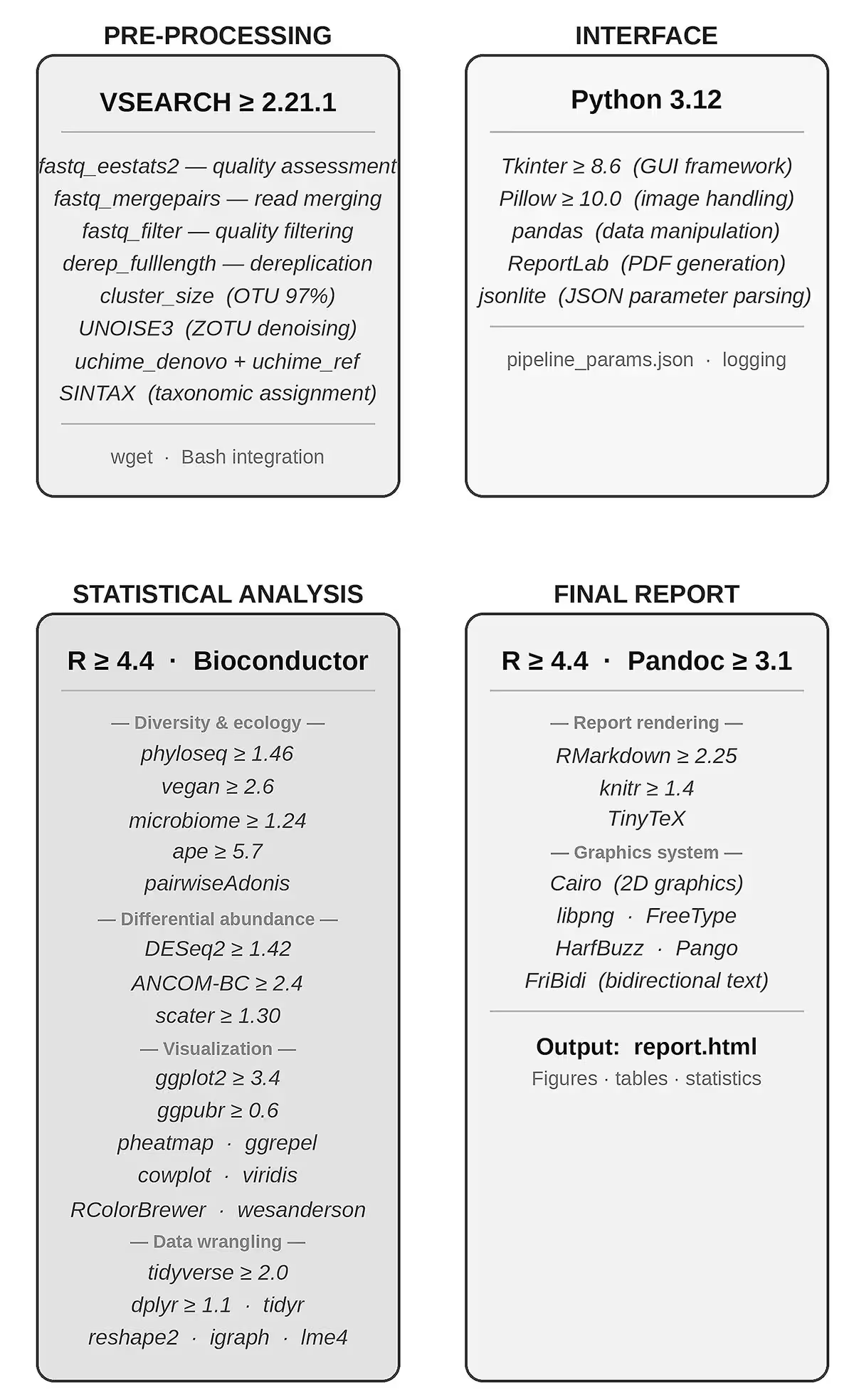
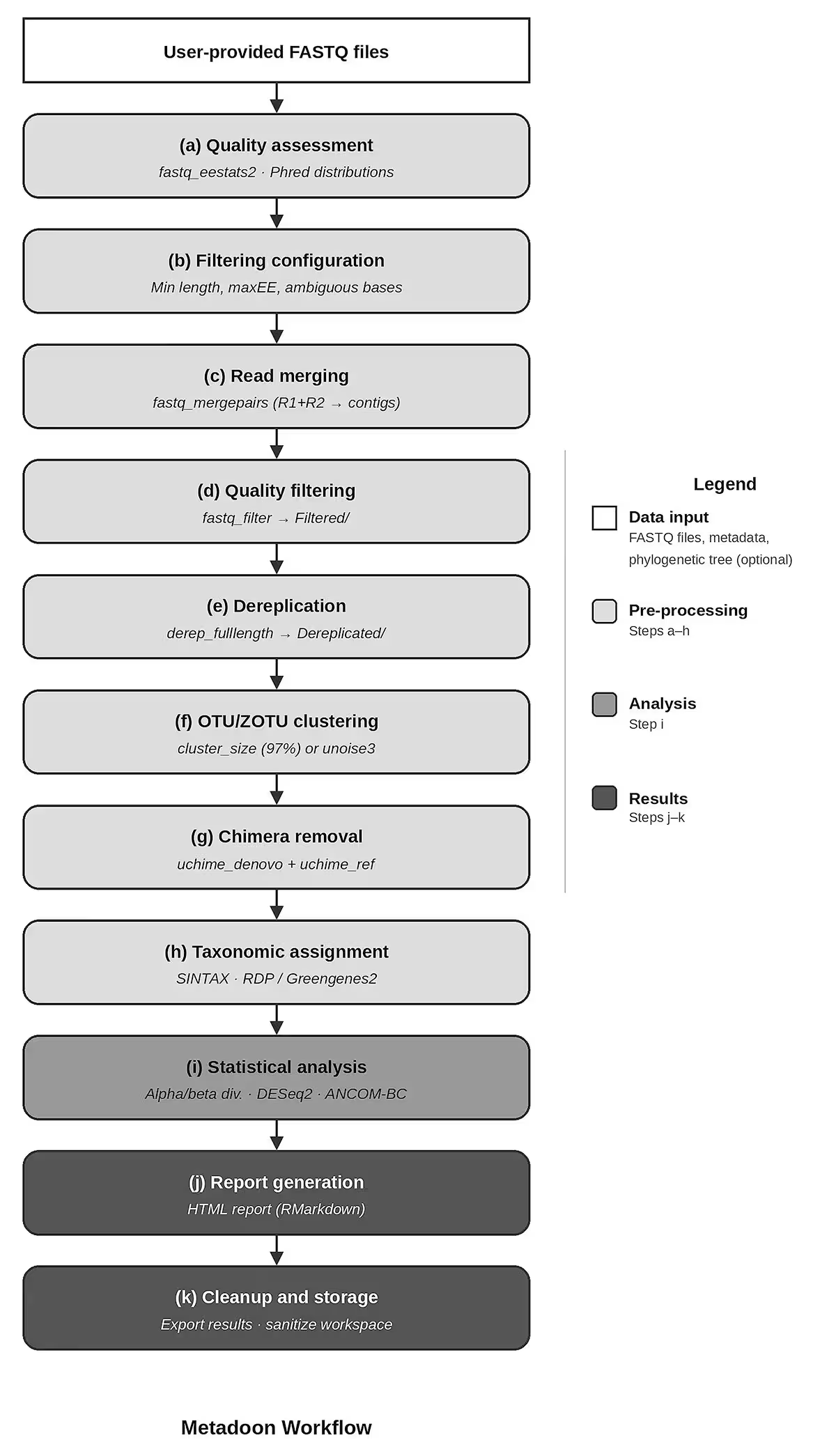
To overcome these hurdles, the research team built Metadoon using Python for the graphical user interface, while integrating robust engines like VSEARCH for sequence processing and R for advanced statistical computations. The software operates entirely on local hardware, ensuring complete data privacy and removing the file size restrictions or external server upload requirements typical of web-based analysis platforms. Users interact with an intuitive point-and-click window to manage everything from quality filtering and read merging to operational taxonomic unit clustering and chimera removal.
What the Mangrove Sediment Analysis Revealed About Microbial Communities
To validate the performance and scalability of their software, the authors tested the complete pipeline on 34 Amazonian mangrove sediment samples representing three distinct environmental categories labeled as recovery, degraded, and preserved. Across all analyzed samples, taxonomic profiling revealed that Proteobacteria dominated the microbial populations, followed consistently by Firmicutes and Bacteroidetes. This high-level phylum dominance extended down through finer taxonomic resolutions into specific families and genera.
Alpha diversity metrics, including the Shannon and Simpson indices, indicated a balanced mix of species richness and evenness within individual samples. Furthermore, richness estimators such as Chao1 and ACE pointed to a substantial presence of rare taxa, highlighting the intricate ecological complexity of the mangrove sediments. When examining beta diversity through Principal Coordinates Analysis and Non-Metric Multidimensional Scaling based on Bray-Curtis dissimilarity, the researchers found a remarkably homogeneous community structure across the different sample types, supported by a PERMANOVA p-value of 0.267.
Why a Conserved Core Microbiome Matters for Coastal Ecosystems
The lack of significant statistical differentiation across the varying environmental conditions suggested that a robust core microbiome is conserved throughout these mangrove ecosystems. The team identified specific bacterial genera present across all samples regardless of their environmental classification, pointing to a stable microbial backbone dedicated to essential ecological functions like nutrient cycling and organic matter decomposition.
While the study demonstrates that Metadoon can successfully process complex environmental datasets and generate publication-ready HTML reports complete with diversity charts and differential abundance outputs, the authors note certain limitations. The current version is optimized primarily for V3-V4 region data and offers fewer parameter adjustments for advanced users compared to highly scriptable command-line frameworks. Nevertheless, the open-source tool provides a practical solution for research groups looking to perform rigorous microbiome analyses on standard laboratory computers without needing dedicated computational support.
The research was published in Genetics and molecular biology on November 16, 2026.
This article has been fact checked for accuracy, with information verified against reputable sources. Learn more about us and our editorial process.
Last reviewed on .
Article history
- Latest version
Reference(s)
- Oliveira, Adan Rodrigues de., et al. “Metadoon: A user-friendly GUI for amplicon analysis.” Genetics and Molecular Biology, vol. 49, no. suppl 4, January 1, 2026 FapUNIFESP (SciELO), doi: 10.1590/1678-4685-GMB-2025-0097. <https://doi.org/10.1590/1678-4685-GMB-2025-0097>.
Cite this page:
- Posted by Linda Wilson