Massive Ice Landslides Discovered on Pluto Reveal Unexpected Geological Activity
Six massive landslides discovered on Pluto by New Horizons data show the dwarf planet’s icy surface is far more active than previously thought.

For decades, scientists imagined Pluto as a remote, icy sphere whose dramatic scenery appeared frozen in time. A recent study appearing in Icarus overturns that notion, delivering the first definitive proof of colossal landslides on the dwarf planet. By scrutinizing images taken by NASA’s New Horizons probe, researchers demonstrate that gravity has shaped Pluto’s icy crust far more vigorously than earlier models suggested.
New Horizons Archive Yields Fresh Clues About Pluto’s Active Surface
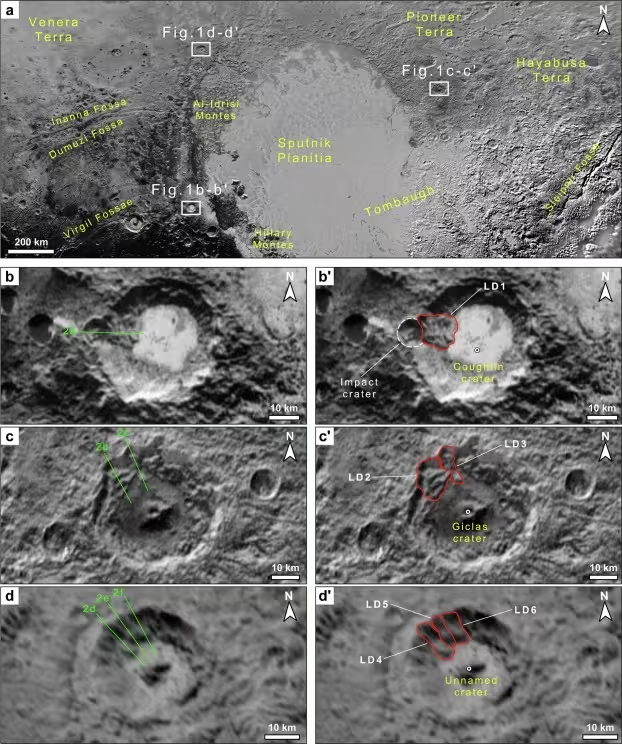
Almost a decade after New Horizons swept past Pluto in July 2015, scientists are still mining its treasure trove of data. By re‑examining high‑resolution pictures captured with the spacecraft’s Long‑Range Reconnaissance Imager (LORRI) and pairing them with topographic elevation models, an international team pinpointed six gigantic landslides distributed across three impact craters. The results, detailed in Icarus, display unmistakable geological patterns that echo landslides documented on Earth and other planetary bodies.
Researchers identified crescent‑shaped collapse scars along crater rims, massive blocks of displaced ice, and broad fields of debris that blanket crater floors. These hallmarks leave little doubt that huge volumes of frozen material once detached and surged downhill under Pluto’s weak gravitational pull. As the authors note,
“These observations have enabled, for the first time, landslides to be recognized on one of the most prominent icy bodies in the Kuiper Belt,” marking a milestone in the geological exploration of the distant dwarf planet.
Gigantic Ice Flows Reshaped Pluto’s Craters
The newly documented landslides are noteworthy not only for being Pluto’s first confirmed instances, but also for their extraordinary dimensions. Each event appears to have descended between roughly 1.5 and 2.2 kilometers before traveling as far as 14.5 kilometers across crater interiors. The biggest slide spanned nearly 130 square kilometers—an area comparable to a small city.
Scientists infer that the flows involved massive amounts of water ice blended with rocky debris, collapsing from steep crater walls that have persisted for billions of years. Although Pluto’s gravity is only a fraction of Earth’s, these steep slopes generated enough force to trigger dramatic mass movements. Similar mechanisms have been observed on Mars, Ceres, and other bodies, but Pluto had long stood out as an exception despite its rugged topography. The new findings close a critical gap in our understanding of how frozen surfaces evolve over geological time.

Pluto Proves It Is Not Geologically Dormant
The discovery adds weight to a growing consensus that Pluto’s interior remains far more active than many researchers anticipated before the New Horizons encounter. Rather than isolated incidents, the landslides imply that gravitational collapse may be a common process continually reshaping portions of the dwarf planet’s surface. The study’s authors contend that such slope failures have likely played a substantial role in sculpting Pluto’s impact craters and mountainous regions. They state,
“The identification of landslides on the surface of Pluto indicates that gravitational slope instabilities are widespread and previously undisclosed processes that may have contributed to shaping the dwarf planet’s surface.”
This insight builds on an already dynamic geological record that includes nitrogen‑ice glaciers, towering water‑ice peaks, ancient tectonic features, and expansive frozen plains unlike any seen elsewhere in the solar system.
Upcoming Missions Could Unveil More Hidden Activity
The six confirmed slides likely represent only a fraction of Pluto’s true geological vigor. While investigating the data, the team noted additional surface markings that resemble landslides but could not be verified due to limited image resolution. Because New Horizons performed a single flyby, large sections of the far side remain sparsely imaged.
Future spacecraft equipped with higher‑resolution cameras and advanced topographic instruments may uncover numerous additional ice‑mass failures, offering fresh perspectives on how Pluto’s crust evolves across immense timescales. Ongoing re‑analysis of the New Horizons archive continues to reveal that even the most distant worlds can harbor surprising and active geological processes.
This article has been fact checked for accuracy, with information verified against reputable sources. Learn more about us and our editorial process.
Last reviewed on .
Article history
- Latest version
Reference(s)
- Discenza, Marco Emanuele., et al. “First geomorphological evidence of landslides on Pluto.” Icarus, vol. 459, November 1, 2026, pp. 117210 Elsevier BV, doi: 10.1016/j.icarus.2026.117210. <https://www.sciencedirect.com/science/article/pii/S0019103526002769?via%3Dihub>.
Cite this page:
- Posted by Karan Das