New Math Reveals How Spacecraft Jitter Scrambles Telescope Light Data
An advanced mathematical framework explains why traditional steady-state models miss critical errors in solar telescope polarization measurements.
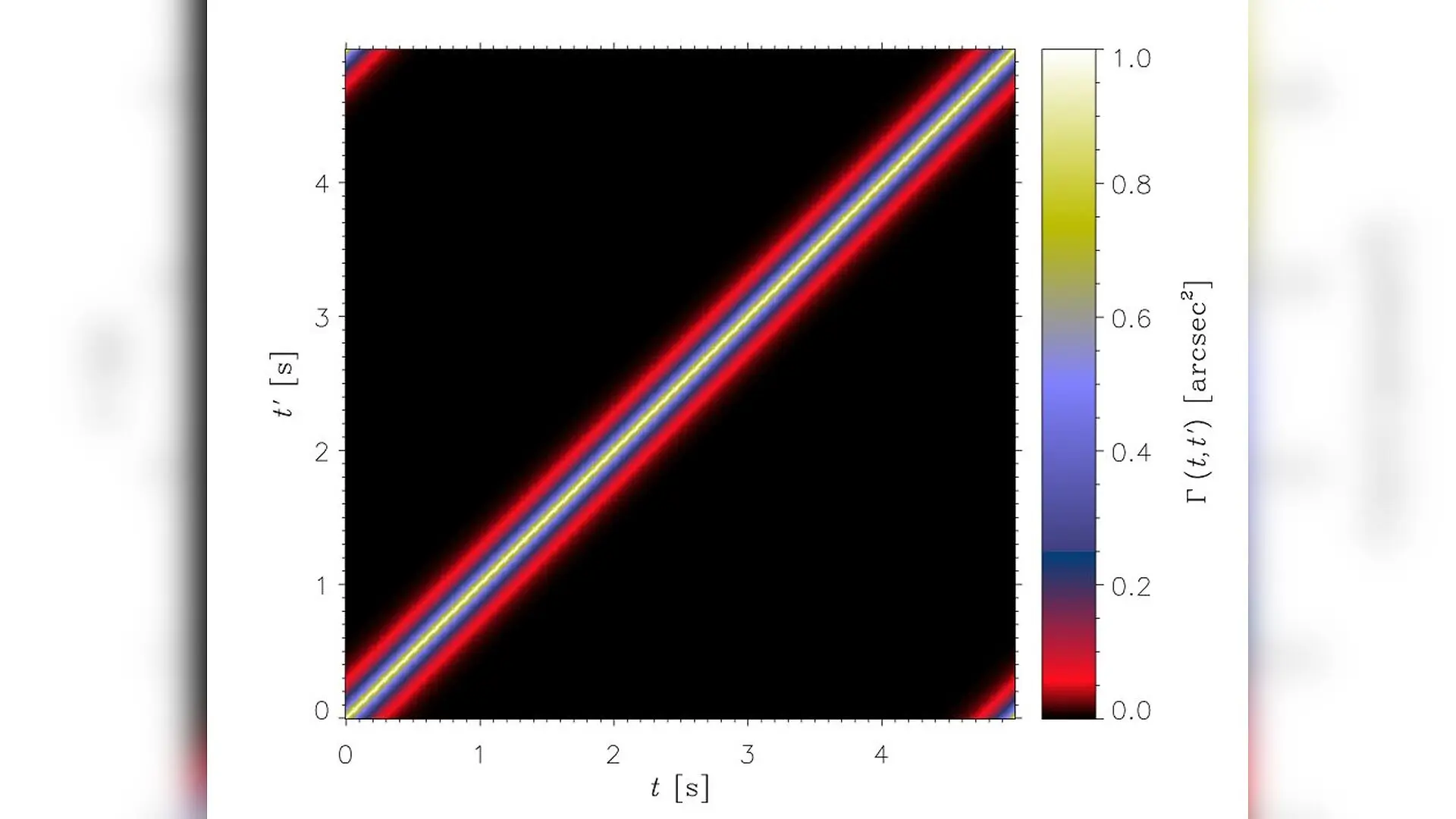
Telescopes observing the Sun face a persistent enemy in the form of tiny, unwanted camera vibrations that distort scientific measurements. Researchers have now developed a mathematical framework that expands our understanding of how this image jitter scrambles light polarization data, moving beyond traditional models that assumed random motions were uniform over time.
Light carries vital clues about solar magnetic fields through a property called polarization, where light waves vibrate in specific directions. When space telescopes or ground-based observatories experience jitter, image blurring creates systematic errors known as polarimetric cross-talk, where different components of the light signal bleed into one another. In a study published in arXiv, astrophysicists R. Casini and A. G. de Wijn from the High Altitude Observatory in Boulder, Colorado, addressed how non-stationary and non-isotropic movements corrupt these delicate observations.
Why Traditional Steady-State Models Fall Short for Spacecraft Jitter
For decades, scientists relied on statistical models that treated image motion as a stationary process, much like standard atmospheric seeing where random phases average out smoothly over long periods. However, modern instruments mounted on spacecraft often suffer from non-stationary disturbances, such as pointing drifts, thermal transients, or mechanical vibrations like electronic hums that synchronize with a telescope observation sequence. Under these conditions, standard single-frequency power spectra fail to capture the true nature of the jitter because the statistical properties change depending on the exact timing of the observation.
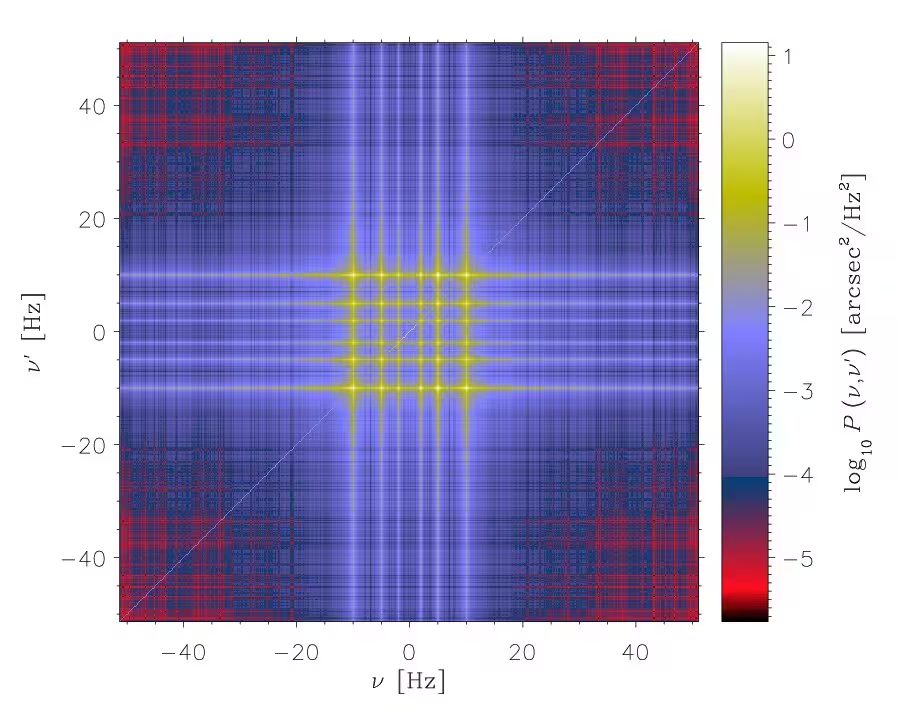
To solve this, the authors generalized an older formalism to account for two-time auto-correlation functions and a two-frequency power-spectral density. This mathematical upgrade allows scientists to calculate the exact mean-square error of Stokes parameters, which describe the polarization state of light, for specific realizations of image motion rather than relying on long-term averages.
How Off-Diagonal Power Features Create Unexpected Cross-Talk Resonances
When the researchers tested their new formalism using numerical examples, they discovered significant differences compared to traditional methods. When jitter contains narrow power structures at specific frequencies, such as 2, 5, or 10 hertz, these features generate off-diagonal power signatures in a two-frequency power spectrum. Standard one-dimensional models completely miss these off-diagonal contributions, leading to miscalculations of cross-talk.
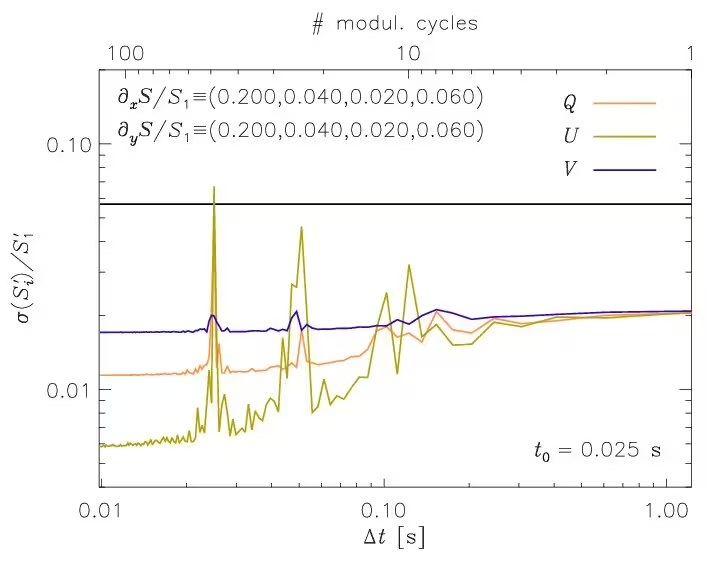
The severity of these resonance peaks depends heavily on the exact starting time of a polarimetric sequence relative to the jitter time series. If an observation begins at 25 milliseconds versus 75 milliseconds into a vibration cycle, the resulting cross-talk amplitude changes significantly. However, the study demonstrates that if scientists average their measurements over a large number of random starting times, the off-diagonal contributions cancel out through phase averaging, causing the new non-stationary model to converge gracefully back to the simpler stationary framework.
What These Findings Mean for Future Solar Telescope Design
The authors conclude that traditional one-dimensional power spectra do not carry enough information to reconstruct the non-stationary character of complex spacecraft jitter. Because an infinite set of two-time auto-correlation functions can share the exact same time average, instrument designers must rely on either direct time-series data or realistic physical models of spacecraft attitude control systems to predict data corruption accurately.
While the traditional stationary model can still serve as a useful tool for a quick qualitative assessment, ignoring non-stationary jitter components risks misrepresenting polarimetric cross-talk at crucial exposure times. This research gives astronomers a precise mathematical lens to account for mechanical instabilities, ensuring that future observations of solar magnetic fields remain sharp and reliable.
The study was posted to the arXiv preprint server on November 5, 2026.
This article has been fact checked for accuracy, with information verified against reputable sources. Learn more about us and our editorial process.
Last reviewed on .
Article history
- Latest version
Reference(s)
- Casini, R.. “Polarization cross-talk from non-stationary sources of image jitter.” arXiv.org <http://arxiv.org/abs/2611.08300v1>.
Cite this page:
- Posted by Nida Rehman