Webb Telescope Discovers Surprising Recurring Weather Patterns on a Distant Brown Dwarf
The James Webb Space Telescope has detected unexpected, ever-changing atmospheric patterns on a distant exoplanet located twenty light-years away.
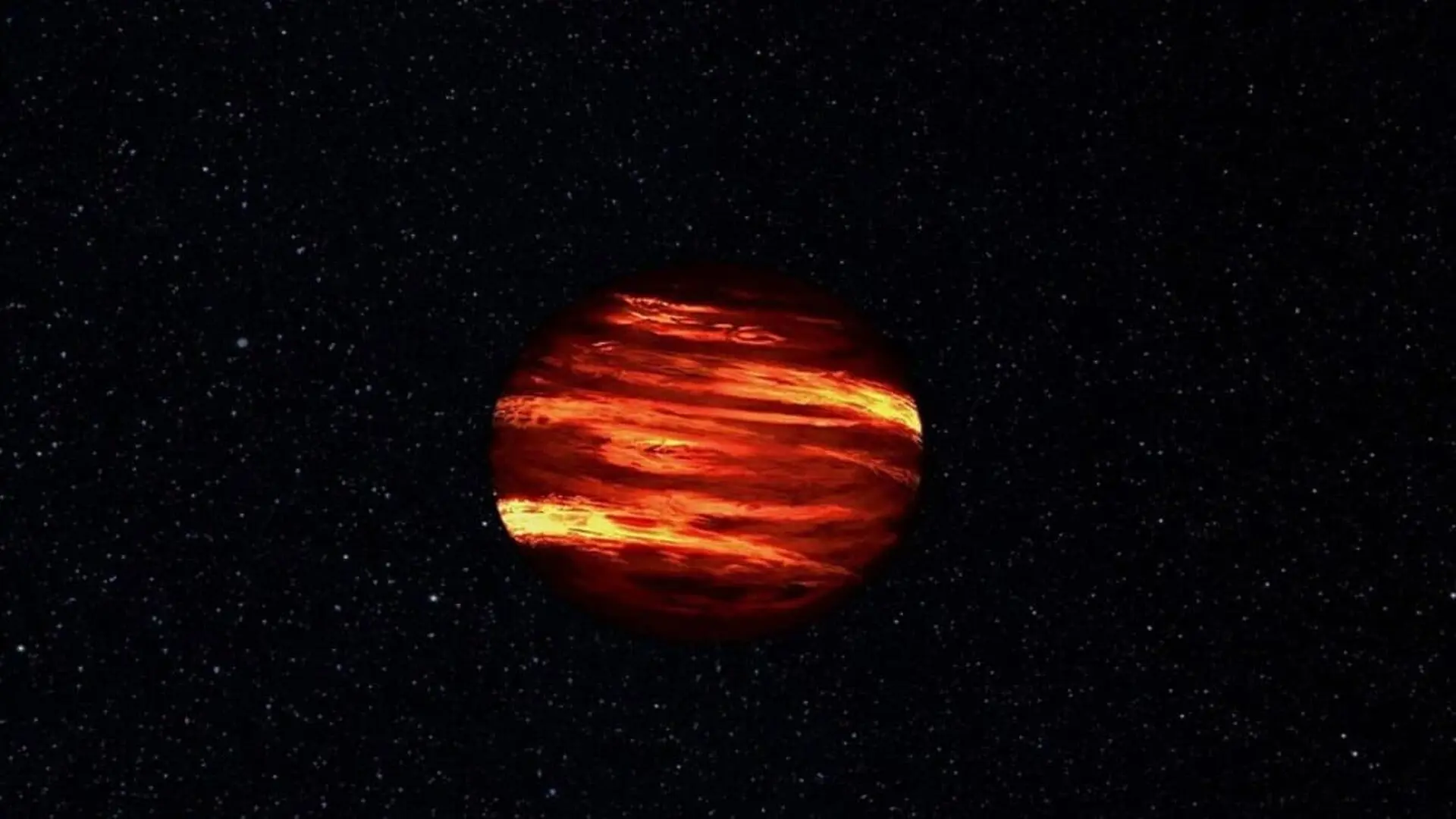
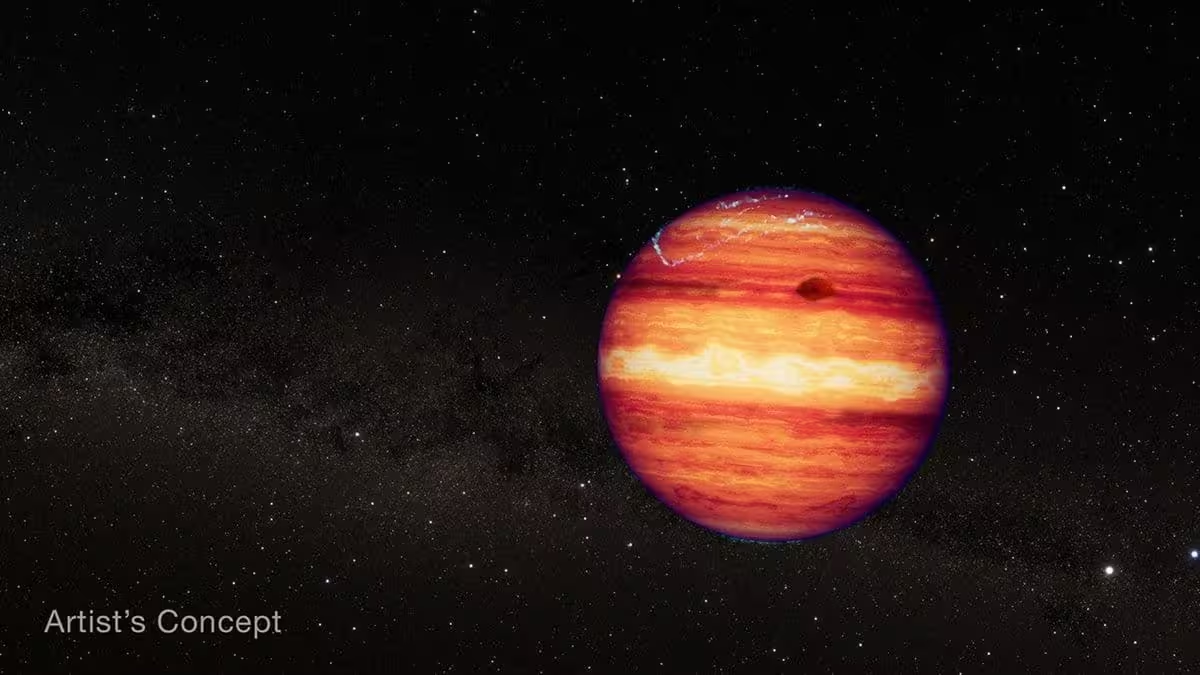
Astronomers using the James Webb Space Telescope (JWST) have uncovered a surprising degree of atmospheric order on a distant, isolated world located 20 light-years from Earth. The object, known as SIMP 0136, is a brown dwarf—an entity larger and hotter than a gas giant but lacking the necessary mass to ignite hydrogen fusion like a true star. While its environment appears turbulent, new research indicates that its weather follows distinct, repeatable cycles.
Because direct imaging of clouds at such a distance is currently impossible, researchers analyzed the object by tracking minute fluctuations in its brightness as it rotates. These light signals, captured by the JWST, act as a diagnostic tool for the complex weather systems swirling deep within the brown dwarf’s atmosphere.
Consistency in a Chaotic Atmosphere
Despite the inherently volatile nature of its atmosphere, SIMP 0136 exhibits three primary weather patterns that recur with remarkable regularity. These states are defined by specific shifts in cloud density and temperature. As the object spins, regions characterized by higher temperatures and thinner cloud cover alternate with cooler zones where thicker, more expansive cloud decks prevail.
The study, published in Astronomy & Astrophysics, highlights that these underlying weather drivers remain stable over extended periods. Researchers observed these patterns persisting across more than a dozen full rotations, suggesting that while individual cloud formations are transient, the fundamental atmospheric processes powering them are consistent.
“We also discovered that these drivers of the weather patterns on SIMP-0136 persist over time, even as the detailed appearance of the atmosphere evolves over more than a dozen rotations,” said Merle Schrader, a PhD candidate at Trinity College Dublin and the study’s lead author.
Decoding Atmospheric Data
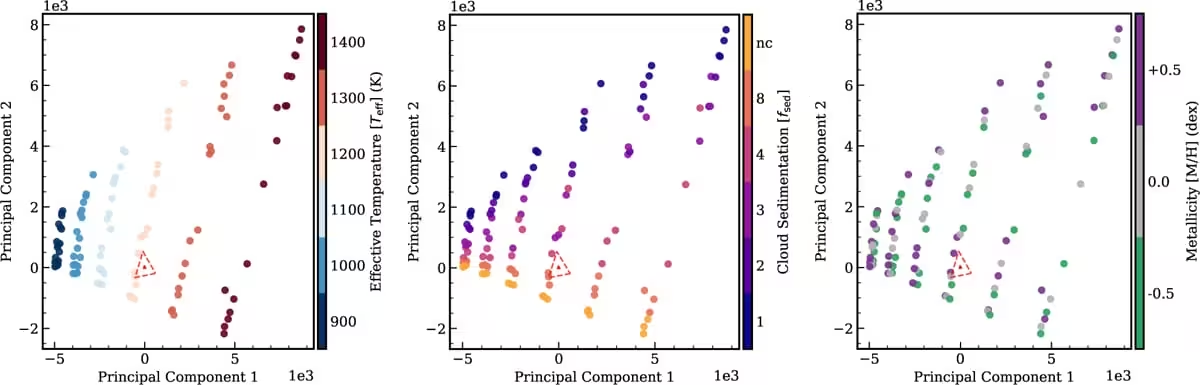
To distill these patterns from the complex data stream, the team employed principal component analysis (PCA). This statistical technique allowed them to filter out random background noise and isolate the dominant factors influencing the light spectrum. The analysis revealed that the atmospheric variability is primarily driven by two phenomena: localized temperature fluctuations and variations in the vertical structure of cloud sedimentation.
This data-driven approach marks a shift in how researchers study exoplanetary atmospheres. Instead of starting with an exhaustive computational model, the team extracted the core atmospheric drivers directly from the raw observational data. This methodology allowed them to categorize the complex interplay of clouds and temperature without needing to simulate every micro-process simultaneously.
Observing from Two Decades Away
The light captured by the telescope in 2023 began its journey 20 years prior, providing a window into the past of this celestial body. Despite the vast distance, the ability to resolve these weather cycles on an object that appears as little more than a single pixel underscores the precision of modern astronomical instrumentation.
Professor Johanna Vos, an associate professor at Trinity College Dublin, noted the broader implications of this work for future missions. By enabling a rapid, effective analysis of dominant atmospheric components, this method provides an essential, time-saving step before scientists initiate more intensive, computationally demanding atmospheric modeling.
This article has been fact checked for accuracy, with information verified against reputable sources. Learn more about us and our editorial process.
Last reviewed on .
Article history
- Latest version
Cite this page:
- Posted by Aisha Ahmed