Scientists Just Recreated the Mysterious Flow Found Deep Inside Rapidly Rotating Planets
Scientists have reproduced a long-predicted turbulent flow state, revealing new insights into the heat and motion hidden deep inside rotating stars and planets.
Researchers have successfully recreated a turbulent, high-speed convection regime within a laboratory setting that has long been theorized to dominate the interiors of rapidly spinning stars and planets. By utilizing a specialized tank filled with liquid gallium, an international team led by scientists at the University of California, Los Angeles has bridged the gap between abstract theoretical physics and the realities of fluid dynamics in celestial bodies.
The findings, detailed in the journal Physical Review Letters, provide a rare instance where experimental measurements, theoretical models, and numerical simulations align with high precision. This “diffusivity-free” turbulent state has remained elusive in conventional labs for decades, largely because the physical walls of experimental containers often interfere with the natural flow patterns of the fluid.
Decoding the Mechanics of Celestial Interiors
Convection serves as the engine for many planetary and stellar processes, transporting heat and fueling the dynamos that generate magnetic fields. When a body rotates rapidly, however, the physics becomes significantly more complex. Theory suggests that in these extreme environments, turbulence becomes so intense that the transport of momentum and heat ceases to depend on the microscopic properties of the fluid, such as its thermal diffusivity or viscosity. Instead, the motion is dictated primarily by inertia, buoyancy, and rotation.
Until now, verifying this “diffusivity-free” regime was nearly impossible because standard experimental setups—where fluid is heated from below and cooled from above—inevitably create thermal boundary layers along the tank walls. These layers mask the true behavior of the fluid in the center. The UCLA-led team circumvented this by focusing on an oscillating thermal-inertial mode, a specific instability that is driven by internal temperature gradients rather than being hindered by the container’s boundaries.
Advanced Liquid-Metal Benchmarking
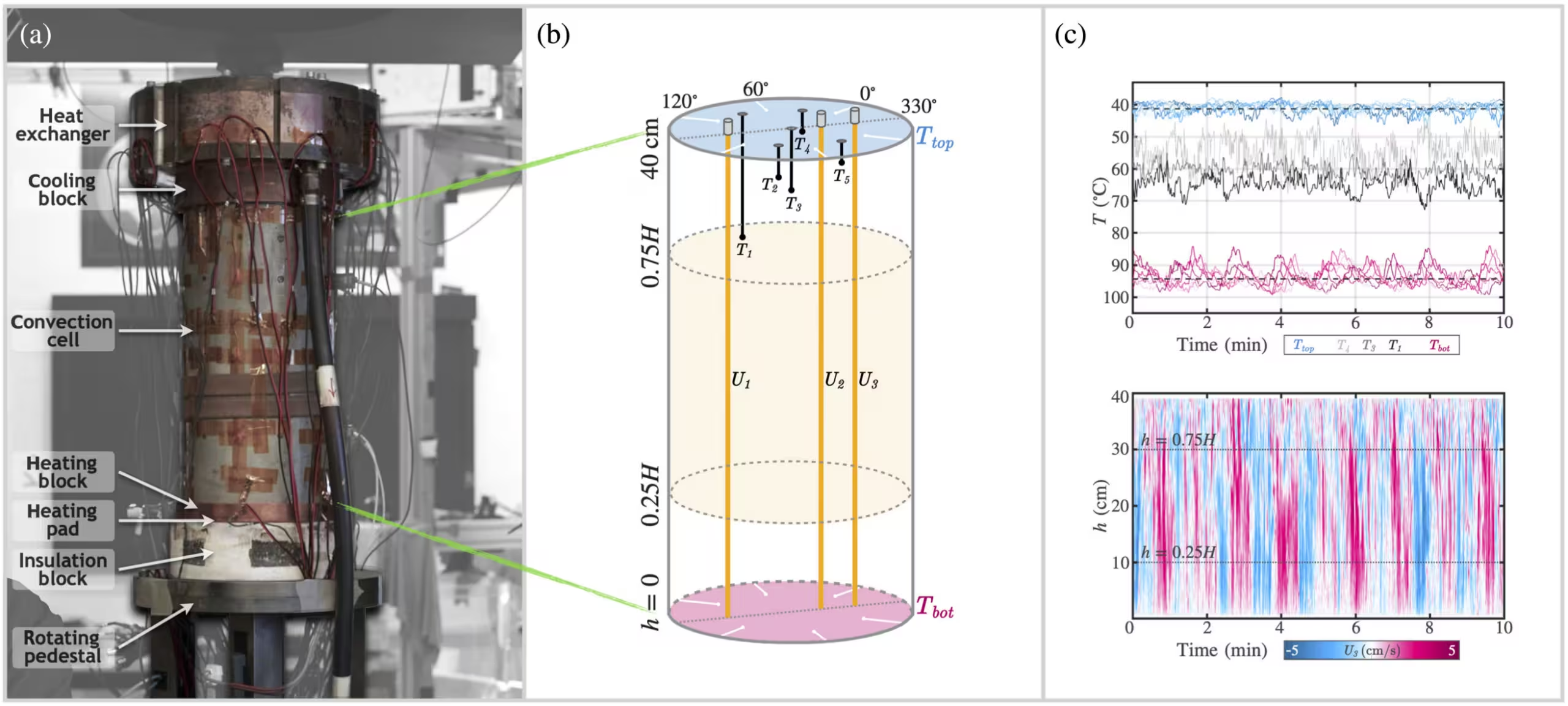
The experiment relied on the RoMag device, which houses liquid gallium between two copper blocks. By heating the base and cooling the top while rotating the entire apparatus, the researchers were able to simulate the extreme conditions found in stellar convection zones and planetary cores. They employed ultrasonic Doppler velocimetry to track flow, using tiny natural impurities within the metal as reflective markers to measure velocity.
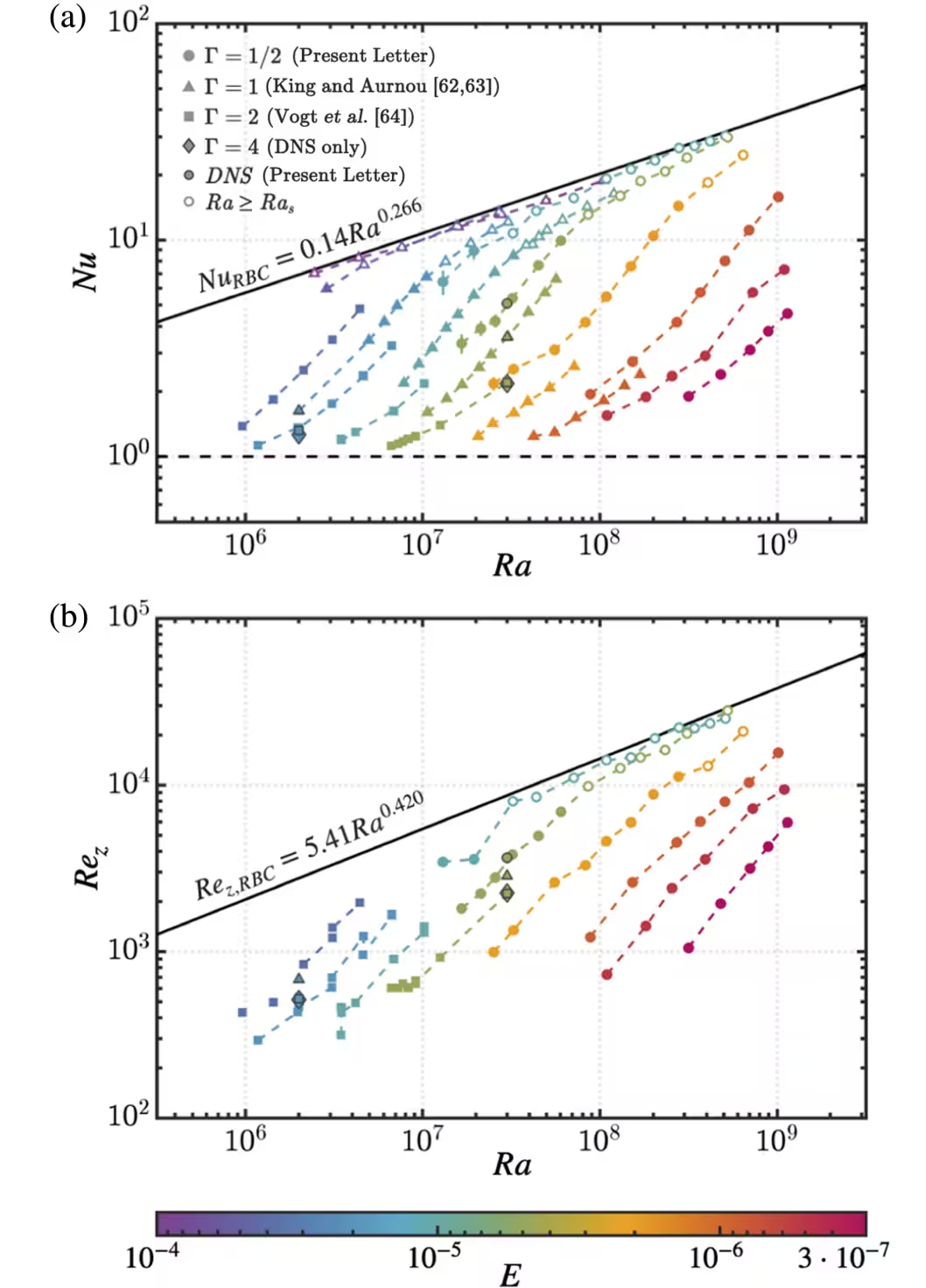
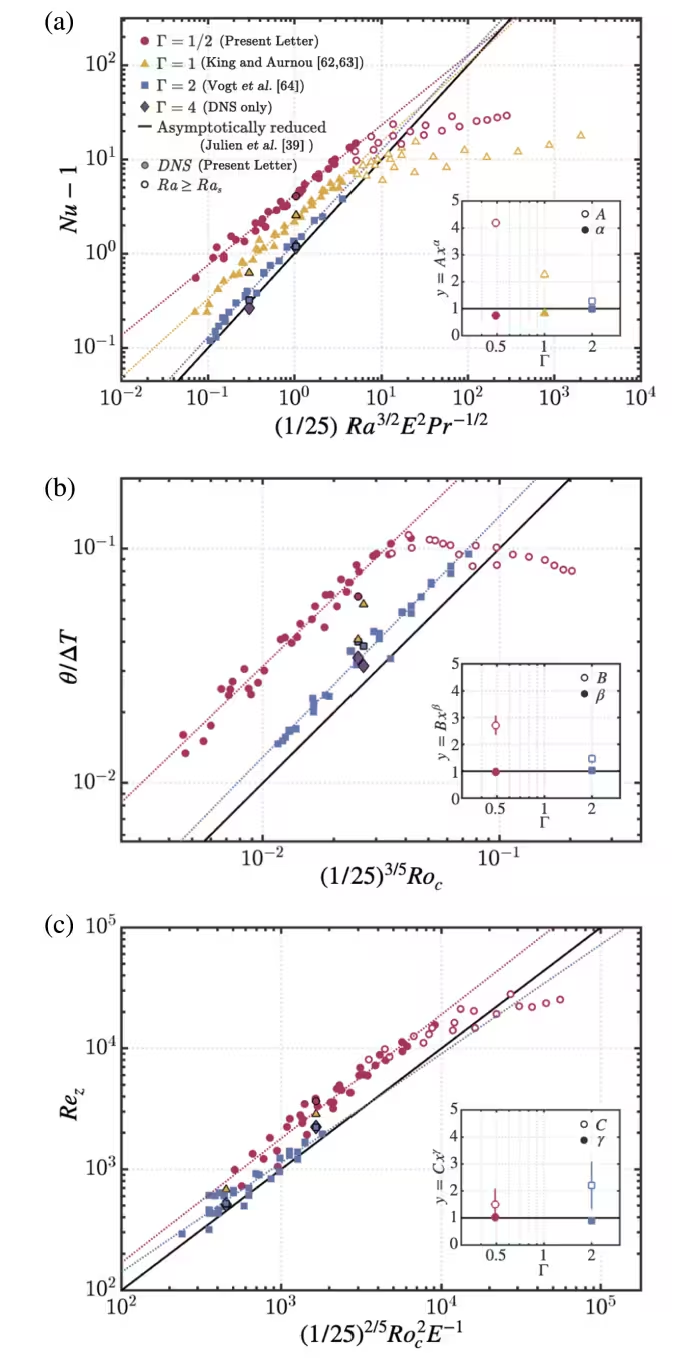
The team validated their model using three independent metrics: global heat transport, internal temperature fluctuations, and vertical flow velocity. The fact that all three converged on the predicted scaling laws provides a robust validation of the underlying physics. “This gives us far greater confidence to apply these models to the interiors of planets and stars,” noted Tobias Vogt of the Helmholtz-Zentrum Dresden-Rossendorf, a co-author who contributed to the study during his time at UCLA.
Implications for Future Planetary Research
This study demonstrates that small-scale laboratory experiments can effectively act as a proxy for processes happening at a planetary scale. While the experiment does not replicate an entire planet, it successfully validates the foundational scaling relationships that dictate internal dynamics. By overcoming the constraints of boundary-layer interference, the researchers have provided a clearer view into the turbulent heart of unreachable celestial objects.
![Nondimensional parameter definitions. Variables are 𝜈 (viscosity, m2/s), 𝜅 (thermal diffusivity, m2/s), 𝛼 (thermal expansivity, 1/K), 𝑔 (gravitational acceleration, m/s2), Δ𝑇 (vertical temperature drop, K), 𝐻 (layer height, m), Ω (rotation rate, rad/s), 𝑞 (total heat flux, W/m2), 𝑘 [thermal conductivity, W/(mK)], 𝑢 (flow velocity, m/s).](https://www.bioscience.com.pk/images/9dddfe3ee5.avif)
Looking ahead, the team suggests that future iterations could use different container geometries or other low-Prandtl-number fluids, such as liquid sodium, to further refine these observations. For now, the successful demonstration of this turbulent flow state marks a significant milestone in geophysical and astrophysical fluid dynamics.
Further Scientific Context
- Geostrophic to magnetically-damped turbulence in liquid metal rotating magnetoconvection – Physics of the Earth and Planetary Interiors (2026).
- Beyond Nusselt number: assessing Reynolds and length scalings in rotating convection – Journal of Fluid Mechanics (2025).
- Ultimate Rayleigh-Bénard turbulence – Reviews of Modern Physics (2024).
- Shadowgraph Measurements of Rotating Convective Planetary Core-Style Flows – Journal of Geophysical Research: Planets (2024).
- Diffusion-Free Scaling in Rotating Spherical Rayleigh-Bénard Convection – Geophysical Research Letters (2021).
This article has been fact checked for accuracy, with information verified against reputable sources. Learn more about us and our editorial process.
Last reviewed on .
Article history
- Latest version
Reference(s)
- “UCLA.” <https://www.ucla.edu/>.
- Abbate, Jewel A.., et al. “Diffusivity-Free Turbulence in Liquid Metal Rotating Rayleigh-Bénard Convection Experiments.” Physical Review Letters, vol. 137, no. 9, August 24, 2026 American Physical Society (APS), doi: 10.1103/pc8y-j7g8. <https://journals.aps.org/prl/abstract/10.1103/pc8y-j7g8>.
- “HZDR – Helmholtz-Zentrum Dresden-Rossendorf.”, August 31, 2026 <https://www.hzdr.de/db/Cms?pOid=74004&pNid=0&pLang=en>.
- Liu, Tao., et al. “Geostrophic to magnetically-damped turbulence in liquid metal rotating magnetoconvection.” Physics of the Earth and Planetary Interiors, vol. 374, May 1, 2026, pp. 107535 Elsevier BV, doi: 10.1016/j.pepi.2026.107535. <https://www.sciencedirect.com/science/article/pii/S0031920126000452>.
- Kannan, Veeraraghavan. “Beyond Nusselt number: assessing Reynolds and length scalings in rotating convection under stress-free boundary conditions | Journal of Fluid Mechanics | Cambridge Core.”, vol. 1016, pp. A3 Cambridge Core, doi: 10.1017/jfm.2025.10384. <https://www.cambridge.org/core/journals/journal-of-fluid-mechanics/article/beyond-nusselt-number-assessing-reynolds-and-length-scalings-in-rotating-convection-under-stressfree-boundary-conditions/DB643C6826DB21F054B4BD21BF26BE01>.
- Lohse, Detlef., et al. “Ultimate Rayleigh-Bénard turbulence.” Reviews of Modern Physics, vol. 96, no. 3, August 6, 2024 American Physical Society (APS), doi: 10.1103/RevModPhys.96.035001. <https://journals.aps.org/rmp/abstract/10.1103/RevModPhys.96.035001>.
- Abbate, Jewel A.., et al. “Shadowgraph Measurements of Rotating Convective Planetary Core‐Style Flows.” Journal of Geophysical Research: Planets, vol. 129, no. 9, September 3, 2024 American Geophysical Union (AGU), doi: 10.1029/2024JE008471. <https://agupubs.onlinelibrary.wiley.com/doi/10.1029/2024JE008471>.
- Wang, Guiquan., et al. “Diffusion‐Free Scaling in Rotating Spherical Rayleigh‐Bénard Convection.” Geophysical Research Letters, vol. 48, no. 20, October 21, 2021 American Geophysical Union (AGU), doi: 10.1029/2021GL095017. <https://agupubs.onlinelibrary.wiley.com/doi/full/10.1029/2021GL095017>.
Cite this page:
- Posted by Aisha Ahmed