Astronomers May Have Just Found a Massive Galaxy With Absolutely No Stars
Astronomers have identified a potential dark galaxy, a rare cosmic object composed entirely of gas with no visible stars, offering a new mystery for space.
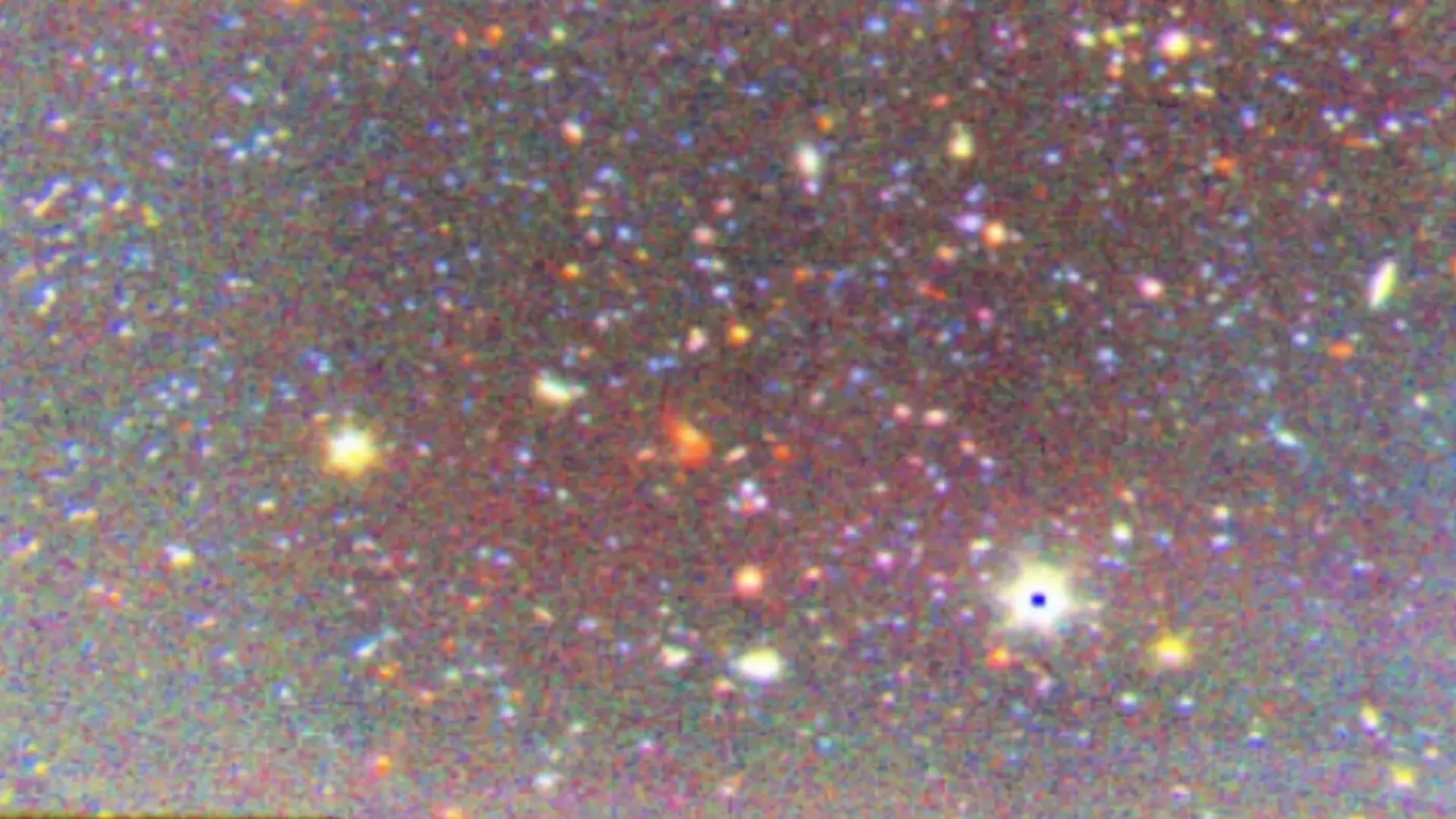
Astronomers have identified a compelling candidate for a long-theorized but rarely observed cosmic phenomenon: a galaxy entirely devoid of stars. Dubbed Cloud 9, the mysterious object consists of a significant concentration of neutral hydrogen gas that lacks any detectable stellar light, potentially reshaping our understanding of how galaxies originate and evolve.
An Enigma of Gas Without Light
The discovery, detailed in a study published on arXiv, identifies a massive structure that defies the conventional definition of a galaxy. While most galaxies are identified by the brilliant light of billions of stars, Cloud 9 was pinpointed solely through its neutral hydrogen emissions. This suggests the existence of galactic structures that remain effectively invisible to standard optical surveys, challenging the assumption that dense gas reservoirs inevitably trigger star formation.
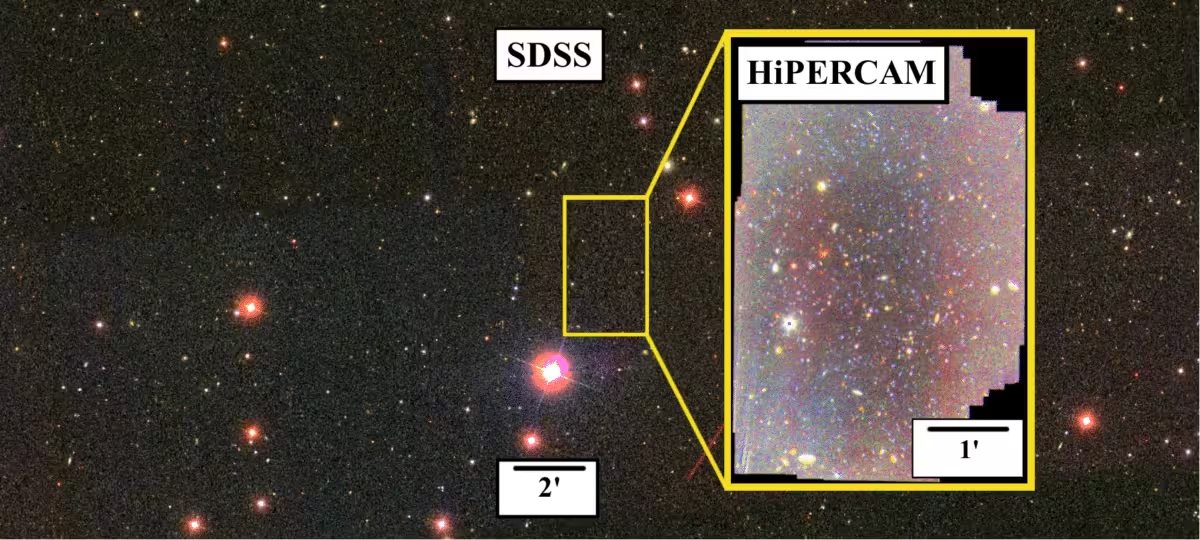
To confirm the object’s unique nature, researchers utilized ultra-deep optical imaging to search for even the most faint or ancient stellar populations. The results were stark. Lead researcher Ignacio Trujillo of the Instituto de Astrofísica de Canarias noted that the complete absence of light at the site of such a massive gas cloud was a striking observation.
“But the most striking aspect of our research was the absolute emptiness of the image at the location of Cloud 9. When you look at an image reaching those depths and see nothing where a structure containing a million solar masses of gas should be, it is genuinely remarkable,” Trujillo told Space.com. “Most objects in the universe leave some trace of light. Cloud 9 does not. That silence is, in its own way, the most compelling result we could have obtained.”
Testing Theoretical Limits
The existence of “dark galaxies”—structures composed of dark matter and gas that fail to transition into star-forming galaxies—has been a cornerstone of astrophysical theory for decades. However, verifying these objects is notoriously difficult because any lingering, low-luminosity stars could easily be mistaken for a standard, dim galaxy. By combining radio telescope data with high-sensitivity optical observations, the team was able to place strict constraints on the object’s mass.
Even when modeling for the most difficult-to-detect stellar populations, such as old, metal-poor stars, the data showed no evidence of stellar presence. The researchers established an upper limit of just 16,000 solar masses for any potential stellar material within the structure. Given that typical galaxies contain millions to trillions of solar masses of stars, this figure is effectively negligible.
“The result was clear: we detected absolutely no stellar emission within the region corresponding to the location of Cloud 9,” Trujillo explained. “Assuming an old, metal-poor stellar population—which would be the hardest kind to detect—we can set an upper limit on the total stellar mass of just 16,000 solar masses.”
While future, more advanced instrumentation may one day detect trace signals currently beyond our reach, Cloud 9 stands as one of the most rigorous candidates yet for a truly starless, dark galaxy. It offers a rare glimpse into a hidden phase of cosmic evolution, where massive reservoirs of matter exist in a state of suspended formation.
This article has been fact checked for accuracy, with information verified against reputable sources. Learn more about us and our editorial process.
Last reviewed on .
Article history
- Latest version
Reference(s)
- “Ultra-Deep imaging of the starless galaxy candidate Cloud-9.” <https://arxiv.org/html/2608.20911v1>.
- Lea, Robert. “On Cloud 9: Have astronomers discovered the first starless galaxy?.”, August 28, 2026 Space <https://www.space.com/astronomy/galaxies/on-cloud-9-have-astronomers-discovered-the-first-starless-galaxy>.
Cite this page:
- Posted by Aisha Ahmed