James Webb Telescope Finally Solves a Two-Decade Old Cosmic Explosion Mystery
James Webb Space Telescope observations may have finally identified the mysterious galaxy behind a 20-year-old gamma-ray burst puzzle.
A nearly two-decade-old astronomical enigma surrounding the gamma-ray burst known as GRB 061201 appears to be nearing a resolution, thanks to the sensitivity of the James Webb Space Telescope (JWST). The findings, published in the Astrophysical Journal, indicate that the explosive event was not a peculiar, nearby anomaly but rather a standard, distant cosmic explosion consistent with current models of short gamma-ray bursts.
Resolving a Long-Standing Cosmic Puzzle
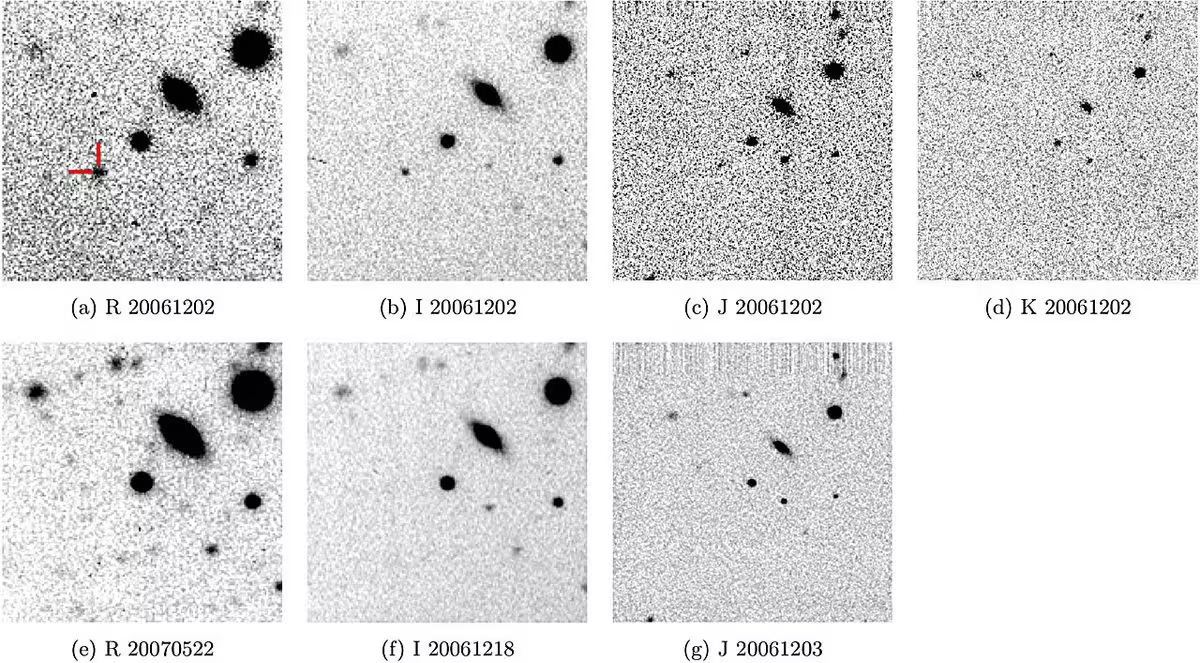
When GRB 061201 first flared into view in 2006, it was immediately classified as a high-energy event. Short gamma-ray bursts are typically triggered by the catastrophic collision of compact stellar remnants, such as neutron stars or a neutron star and a black hole. However, this specific burst baffled researchers because, once the initial brilliant afterglow faded, no host galaxy could be identified at the coordinates of the explosion.
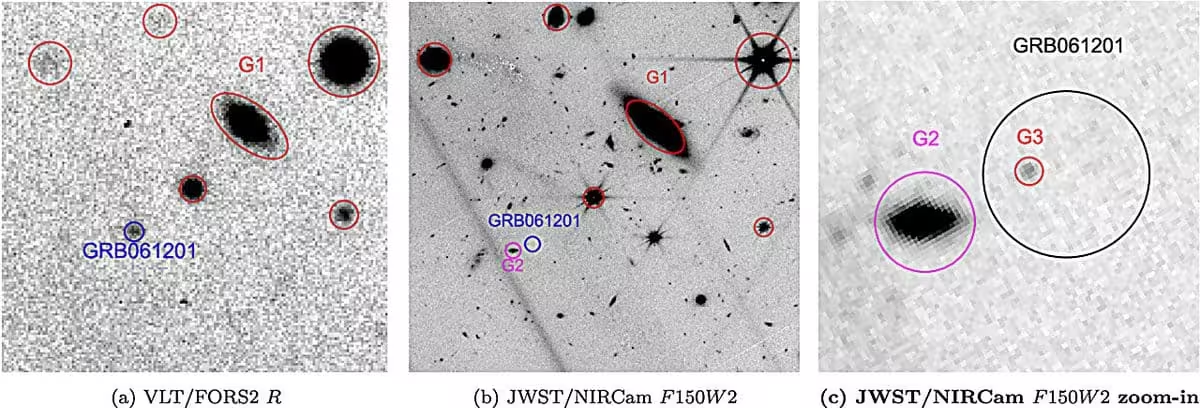
Without a visible host to provide a distance, astronomers were left with two competing theories. One suggested the event occurred in a relatively nearby galaxy, designated G1, at a redshift of z = 0.111. The other posited that the burst originated much further away in a galaxy too faint for previous-generation telescopes to resolve. The nearby theory, however, created significant friction with observational data, requiring the explosion to have an unusually narrow relativistic jet and implying a density of local compact-object mergers that contradicted data from gravitational-wave observatories.
New Data Unveils Potential Host Galaxies
A research team led by Yuhan Mao of the Purple Mountain Observatory at the Chinese Academy of Sciences utilized the combined power of the Hubble Space Telescope and the JWST to perform a deep-field search of the region. Their efforts successfully identified two previously obscured galaxy candidates, labeled G2 and G3, located in the immediate vicinity of the burst’s origin.
By employing spectral energy distribution fitting, the team analyzed the light signature of G2. The data suggested a redshift of approximately z = 1.2, a distance that neatly resolves the physical inconsistencies inherent in the earlier “nearby” model. This greater distance brings the behavior of GRB 061201 into alignment with the established life cycles and characteristics of other observed short gamma-ray bursts.
Validating the High-Redshift Hypothesis
To ensure the alignment of G2 was not a statistical fluke, the researchers calculated the probability of a chance association, placing it at 18 percent. While they caution that this is not definitive, it is low enough to make G2 a highly compelling candidate. Conversely, the second candidate, G3, appeared less likely to be the source, with a 43 percent probability of random alignment and colors that did not match the expected distance profile.
The team concluded that the z = 1.2 scenario provides the most cohesive explanation, stating that this high-redshift origin represents the most self-consistent physical framework identified for the burst to date.
Moving forward, the researchers emphasize that further validation is necessary. While photometric estimates are powerful, direct spectroscopic observation of G2 remains the gold standard for confirming its distance. If future spectroscopic analysis confirms the redshift, it would finally close the book on a mystery that has persisted since 2006, highlighting how modern deep-space observatories are proving essential in clarifying the violent history of the universe.
This article has been fact checked for accuracy, with information verified against reputable sources. Learn more about us and our editorial process.
Last reviewed on .
Article history
- Latest version
Reference(s)
- Mao, Yuhan., et al. “Revealing the High-redshift Host Galaxy of the Short GRB 061201 with JWST.” The Astrophysical Journal, vol. 1007, no. 1, August 3, 2026, pp. 14 American Astronomical Society, doi: 10.3847/1538-4357/ae89a3. <https://dx.doi.org/10.3847/1538-4357/ae89a3>.
Cite this page:
- Posted by Aisha Ahmed