NASA Just Launched A $4.3 Billion Telescope To Rewriting The History Of The Universe
NASA’s Roman Space Telescope has officially launched to map the cosmos, hunt for distant exoplanets, and uncover the mysteries of dark energy.
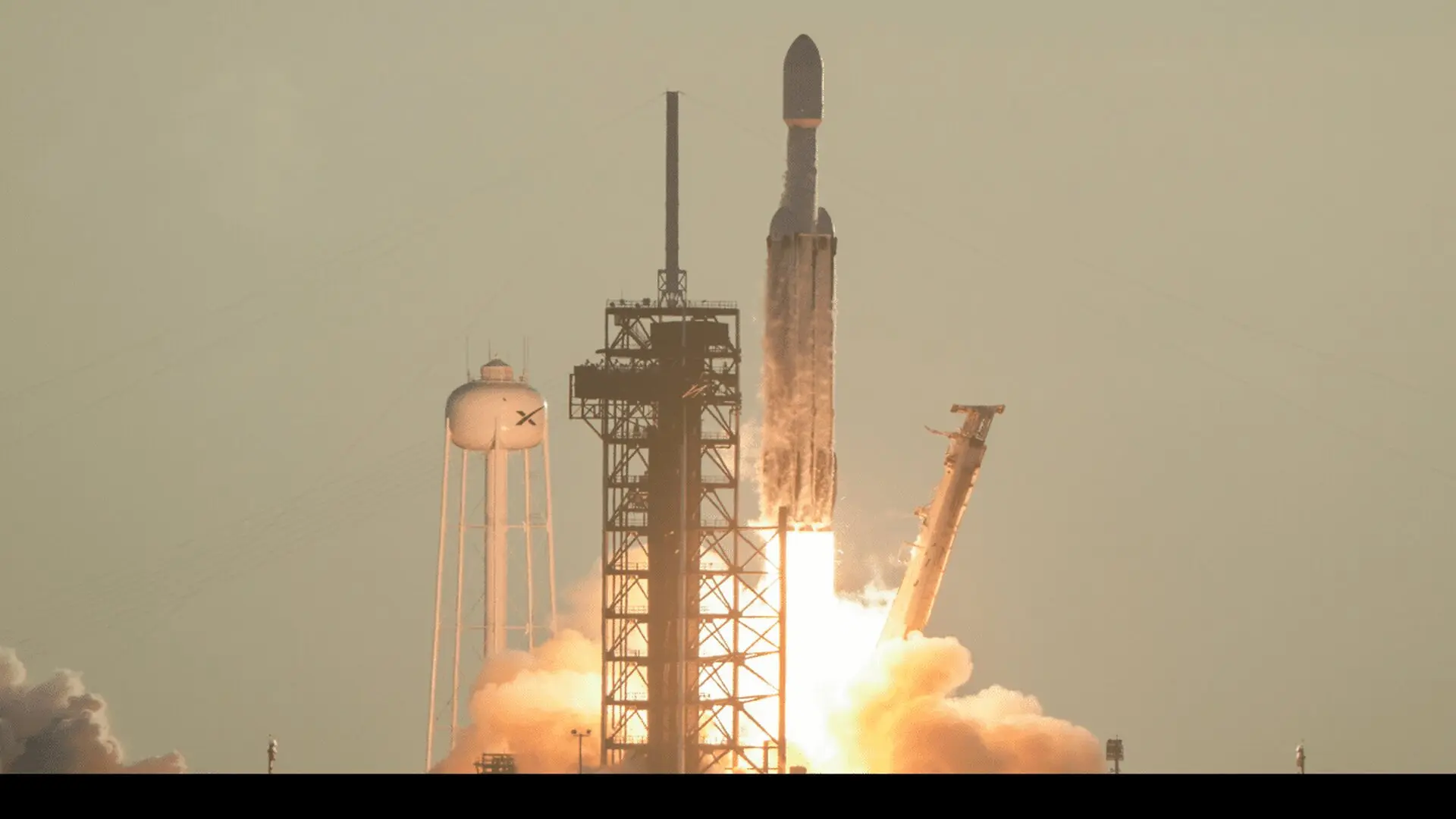
A powerful new eye on the cosmos has successfully begun its journey into the deep reaches of space. The Nancy Grace Roman Space Telescope lifted off from the Kennedy Space Center aboard a SpaceX Falcon Heavy rocket, marking the start of a multi-billion-dollar mission to probe the mysteries of dark energy, distant exoplanets, and the formation of the early universe.
Following a successful launch, the $4.3 billion observatory is now navigating toward its final destination, a vantage point located roughly 1 million miles (1.6 million kilometers) from Earth. It will spend the next three months in transit before beginning its high-stakes scientific survey.
Falcon Heavy launches @NASA’s Nancy Grace Roman Space Telescope from pad 39A in Florida, beginning its more than three-month journey to its destination where it will generate never-before-seen photos of the universe pic.twitter.com/L3gHrBiQ08
— SpaceX (@SpaceX) August 30, 2026
Unmatched Panoramic Capabilities
Named in honor of NASA’s inaugural chief astronomer, Nancy Grace Roman—a visionary who laid the groundwork for space-based observation—the telescope is designed to complement existing tools like the James Webb Space Telescope, Hubble, and the European Space Agency’s Euclid. While other observatories are optimized for deep, narrow-field study, Roman acts as a wide-angle surveyor.
Its primary advantage is speed and breadth. The telescope’s field of view is more than 100 times larger than Hubble’s, enabling it to scan massive swaths of the sky with incredible efficiency. NASA science mission director Nicky Fox noted that the telescope will catalog tens of thousands of planets, billions of galaxies, and tens of billions of stars, performing tasks that were previously impossible at this scale.
“Roman’s vast reach will allow us to find the weird, the rare and the unusual,” said senior project scientist Julie McEnery. “We’ll redefine what it means to find a needle in a haystack.”
Probing Dark Energy and Alien Worlds
A primary objective of the mission is to peel back the layers of dark energy and dark matter. By creating detailed maps of galaxy distribution across vast cosmic distances, researchers hope to calculate the rate of the universe’s expansion with unprecedented precision. Furthermore, the observatory features an experimental coronagraph, a specialized instrument that masks the blinding glare of distant stars to capture direct imagery of orbiting exoplanets.
The telescope’s hardware carries an intriguing backstory. Its primary mirror, measuring nearly 8 feet (2.4 meters) in diameter, was originally manufactured for a National Reconnaissance Office satellite program. The agency later donated two of these mirrors to NASA, allowing the team to repurpose the high-grade optics for deep-space science at a significant reduction in development time.
A Legacy of Scientific Leadership
The mission stands as a milestone in NASA’s astrophysics program, arriving ahead of its projected schedule and within its planned budget. For many in the scientific community, the name of the telescope serves as a poignant reminder of the woman who fought to establish space-based astronomy decades ago.
Retired NASA scientist Ed Weiler, a long-time colleague of Roman, emphasized the appropriateness of the tribute. “This is very, very fitting,” Weiler said. “I think Nancy would be very proud” to see her namesake tackling the most profound questions remaining in modern physics.
Following the successful deployment, the mission received attention from the highest levels of government, with President Donald Trump praising the feat during a visit to Houston’s Johnson Space Center. As the observatory continues its trek toward its distant orbit, it is poised to provide a foundation for future astronomical discoveries for generations to come.
This article has been fact checked for accuracy, with information verified against reputable sources. Learn more about us and our editorial process.
Last reviewed on .
Article history
- Latest version
Reference(s)
- “https://twitter.com/SpaceX/status/2094081879150403768/video/1.” <https://t.co/L3gHrBiQ08>.
Cite this page:
- Posted by Aisha Ahmed