Neanderthals Repeatedly Carried Animal Skulls Into a Spanish Cave, And the Pattern Was Not Random
A new spatial study of Des-Cubierta Cave in Spain shows that Neanderthals deliberately brought large horned animal skulls deep into a narrow gallery, placing them in the same area again and again.
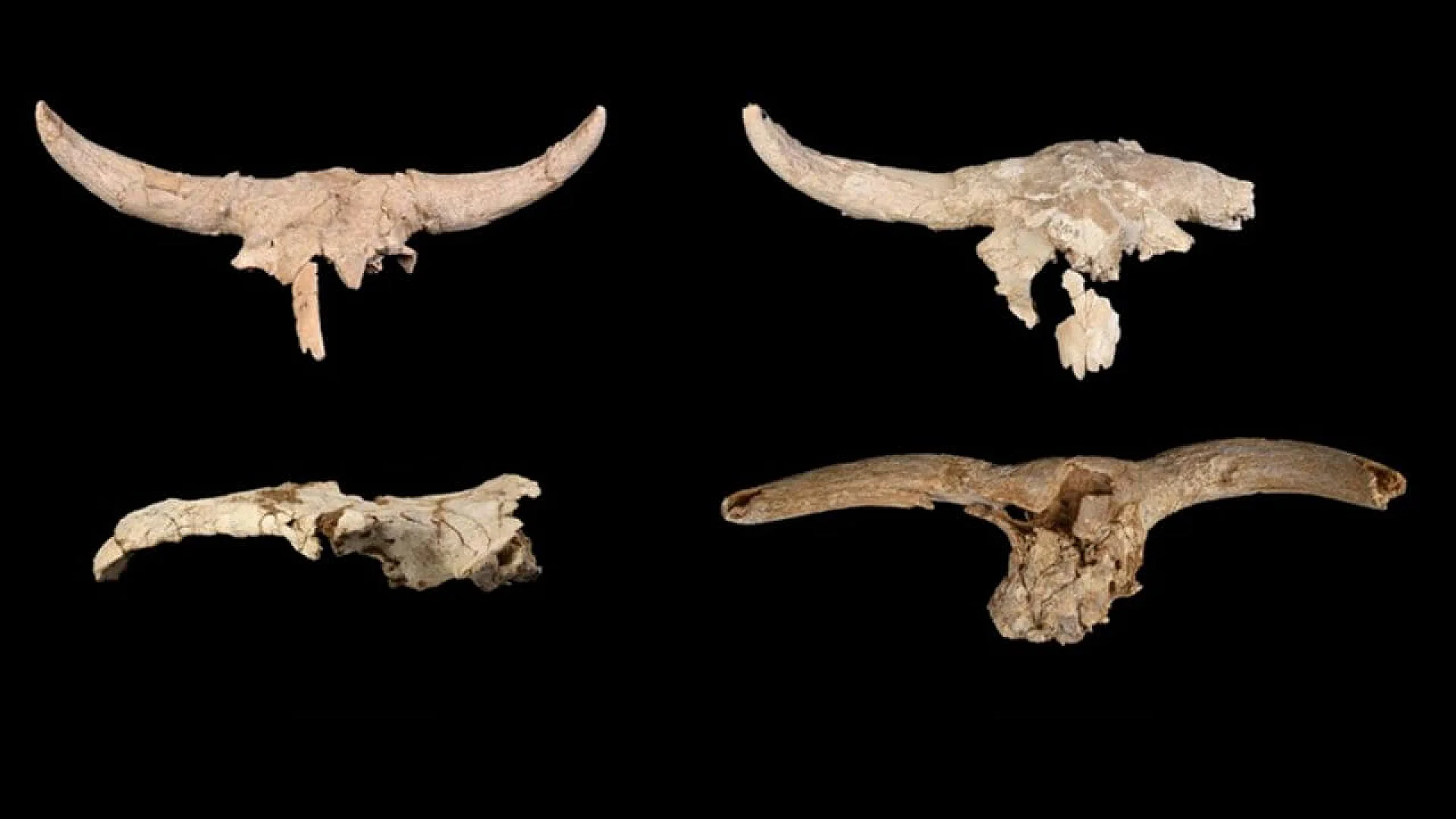
In the mountains north of Madrid, near Pinilla del Valle, several caves preserve traces of Neanderthal life. One of them, Des-Cubierta Cave, has puzzled archaeologists for years.
Inside this narrow, zigzag-shaped cave, researchers found something unexpected. There is a dense concentration of large animal skulls, mostly from horned herbivores such as bovines, deer, and even rhinoceroses.
What makes it unusual is not just the number. It is the pattern.
In Level 3 of the cave, at least 35 individuals are represented by their crania, which means skulls. These species all had defensive cranial appendages, in simple words, horns or antlers. But the rest of their skeletons are mostly missing.
That imbalance immediately raises questions.
Were these skulls dragged in by carnivores. Did water carry them inside. Or did Neanderthals deliberately bring them into the cave.
A new study published in Archaeological and Anthropological Sciences tries to answer that question, not with guesswork, but with careful mapping and statistics.
Looking at the Cave Like a Data Map
The team focused on Level 3, a roughly 2 meter thick layer formed mainly by rockfalls. Over time, large angular boulders fell from the cave roof and built a cone-shaped deposit in the widest part of the gallery.
Mixed within these rocks are thousands of archaeological materials. More than 6,000 mapped items were analyzed, including about 4,780 bones and 1,719 stone tools. In addition, 3,047 large dolomitic clasts, meaning rock fragments between 200 and 905 millimeters in size, were recorded.
Every piece was mapped in three dimensions during excavations between 2009 and 2022. Each object has exact x, y, and z coordinates.
That level of detail matters. Because once everything is plotted on a digital map, patterns begin to appear.
The researchers used geostatistical methods, including nearest-neighbor analysis and kernel density estimation. These techniques test whether objects are randomly scattered, clustered, or evenly spaced.
If something is random, it follows what scientists call complete spatial randomness. If not, there is likely a specific process behind it.
Rocks and Bones Tell Different Stories
When the team analyzed the geological clasts, they found patterns consistent with rockfall processes. The boulders form a cone-shaped structure, thickest in the Monumental sector, which is the widest part of the cave.
This makes sense. Over time, repeated roof collapses dropped rocks that piled up naturally, forming a sloping deposit.
But the archaeological materials behaved differently.
The bones and stone tools did not simply follow the same distribution as the rocks. In fact, geological and archaeological materials showed distinct spatial patterns.
That separation is important. It means the bones were not just passively trapped within falling debris. Something else was happening.
And when the team zoomed in specifically on the crania, the pattern became even clearer.
A Clear Cluster of Horned Skulls
The crania are not randomly scattered across Level 3. Instead, they are concentrated in specific zones.
Moreover, their preservation varies depending on location. Skulls near the central, apical part of the sedimentary cone tend to be more complete. Those in southern and higher areas are more fragmented, likely due to gravity, erosion, and soil processes.
Bone refitting analysis adds another layer of evidence. Refitting means reconnecting broken fragments of the same skull.
If bones had been widely transported by water or animals, fragments of the same skull would likely be found far apart. But the study shows limited movement of medium and large fragments.
In simple terms, once the skulls were placed there, they mostly stayed there.
Could Carnivores Have Done This?
Caves often contain bones accumulated by hyenas or other carnivores. So that possibility had to be tested carefully.
However, typical carnivore dens show certain signatures. They usually contain many different skeletal parts, including limbs. They also show heavy gnawing marks and coprolites, which are fossilized feces.
At Des-Cubierta Cave, the record is different.
There is a strong over-representation of crania. About 88 percent of the identified specimens are cranial elements. The postcranial skeleton, meaning the rest of the body, is largely absent.
This selective pattern is difficult to explain by natural predators.
What About Water or Gravity?
Water transport can sort bones by size and weight. Light bones may move farther, while heavy ones stay behind.
But these are not small fragments. Bison and other large herbivore skulls are heavy and awkward to move. The cave’s narrow geometry also reduces the likelihood of strong water flows carrying such objects deep inside.
Geostatistical tests further reject a random distribution.
The Clark–Evans and Hopkins–Skellam indices, supported by Monte Carlo simulations, show that the pattern does not match complete spatial randomness.
In addition, archaeological materials are largely absent from the most clast-rich zones formed by early rockfalls. This suggests that rockfall built the debris cone first, and Neanderthal activity happened afterward.
The sequence matters.
Dating a Complex Deposit
Dating Level 3 has not been simple. Radiocarbon attempts on bone were unsuccessful.
However, uranium-thorium dating of speleothems provides important boundaries. A speleothem known as S2 gives a maximum age of about 135 thousand years. Another underlying speleothem, S1, has been dated to around 185 thousand years.
Charcoal from an upper level suggests a minimum age in the range of roughly 43 to 53 thousand calibrated years.
Taken together, Level 3 likely formed during MIS 4 or early MIS 3, a cold and dry period in the Late Pleistocene.
That places the accumulation firmly within the time of Neanderthals.
Repeated Behavior, Not a Single Event
The deposit was not formed in one moment.
Sedimentary hiatuses within the cone structure suggest multiple episodes of growth. The accumulation of at least 35 individuals also points to repeated events over time.
This is crucial.
If Neanderthals were bringing skulls into the cave only once, it could be interpreted as a practical event linked to a specific hunt. But repeated introductions across different depositional phases suggest a pattern of behavior.
And that pattern appears structured.
The study notes that species selection was not random either. The crania belong to large ungulates with defensive appendages, animals with horns or antlers.
That detail has been emphasized in previous interpretations of the site.
A Symbolic Dimension?
The researchers are careful in their wording. They do not claim direct evidence of ritual.
But they do argue that the repeated, deliberate accumulation of modified horned crania indicates culturally motivated behavior.
Across Europe, Middle Paleolithic sites show diverse behaviors. These include specialized hunting, pigment use, bird claw collection, and even possible ritual structures.
Within that broader picture, deliberate treatment or accumulation of animal skulls is rare.
At Des-Cubierta Cave, the evidence points to intentional selection, transport, and placement of crania inside a specific cave zone.
That suggests something beyond ordinary subsistence.
Perhaps the skulls had social, symbolic, or group meaning. The data cannot fully answer that yet. But the structured spatial pattern makes it difficult to dismiss the possibility.
Why Spatial Statistics Matter
One of the strongest contributions of this study is methodological.
Instead of relying only on visual impressions, the team used geostatistics to test hypotheses about formation processes. They corrected for edge effects, modeled pattern intensity, and compared geological and archaeological distributions quantitatively.
This approach helps separate natural sedimentary dynamics from human behavior.
In a cave shaped by rockfalls, erosion, and karst processes, post-depositional movement can easily blur the picture. Without spatial analysis, behavioral patterns might remain hidden.
Here, they become visible.
A Cave That Challenges Simple Assumptions
Many archaeological layers are imagined as flat surfaces where people dropped tools and bones.
Level 3 is different.
The cone-shaped sedimentary structure means that materials may have accumulated along sloping, concave surfaces rather than horizontal planes. That complicates interpretation.
Yet even within that complex geometry, the crania show clustering that stands apart from natural rock distribution.
It is a subtle but powerful finding.
What Comes Next
Des-Cubierta Cave remains an active research site. Future studies will likely refine the chronology and examine microscopic traces in more detail.
For now, the evidence supports a clear conclusion.
Neanderthals repeatedly brought large horned animal skulls into this narrow cave in central Spain. They placed them within a defined area shaped by earlier rockfalls. The skulls remained largely in place, and their accumulation cannot be explained by water or carnivores alone.
It was deliberate.
And it adds one more piece to the growing picture of Neanderthal behavioral complexity.
The research was published in Archaeological and Anthropological Sciences on January 03, 2026.
This content has been reviewed by subject-matter experts to ensure scientific accuracy. Learn more about us and our editorial process.
Last reviewed on .
Article history
- Latest version
Reference(s)
- Villaescusa, Lucía., et al. “Towards a formation model of the Neanderthal symbolic accumulation of herbivore crania: Spatial patterns shaped by rockfall dynamics in Level 3 of Des-Cubierta Cave (Lozoya valley, Madrid, Spain).” Archaeological and Anthropological Sciences, vol. 18, no. 1, 03 January 2026, doi: 10.1007/s12520-025-02382-5. <https://doi.org/10.1007/s12520-025-02382-5>.
Cite this page:
- Posted by Hassan Raza