Scientists Reveal Horns and Armor on England’s First Complete Dinosaur Skeleton After 160 Years
New study finally reveals details of the first complete dinosaur skeleton, discovered 160 years ago, uncovering what scientists previously missed.
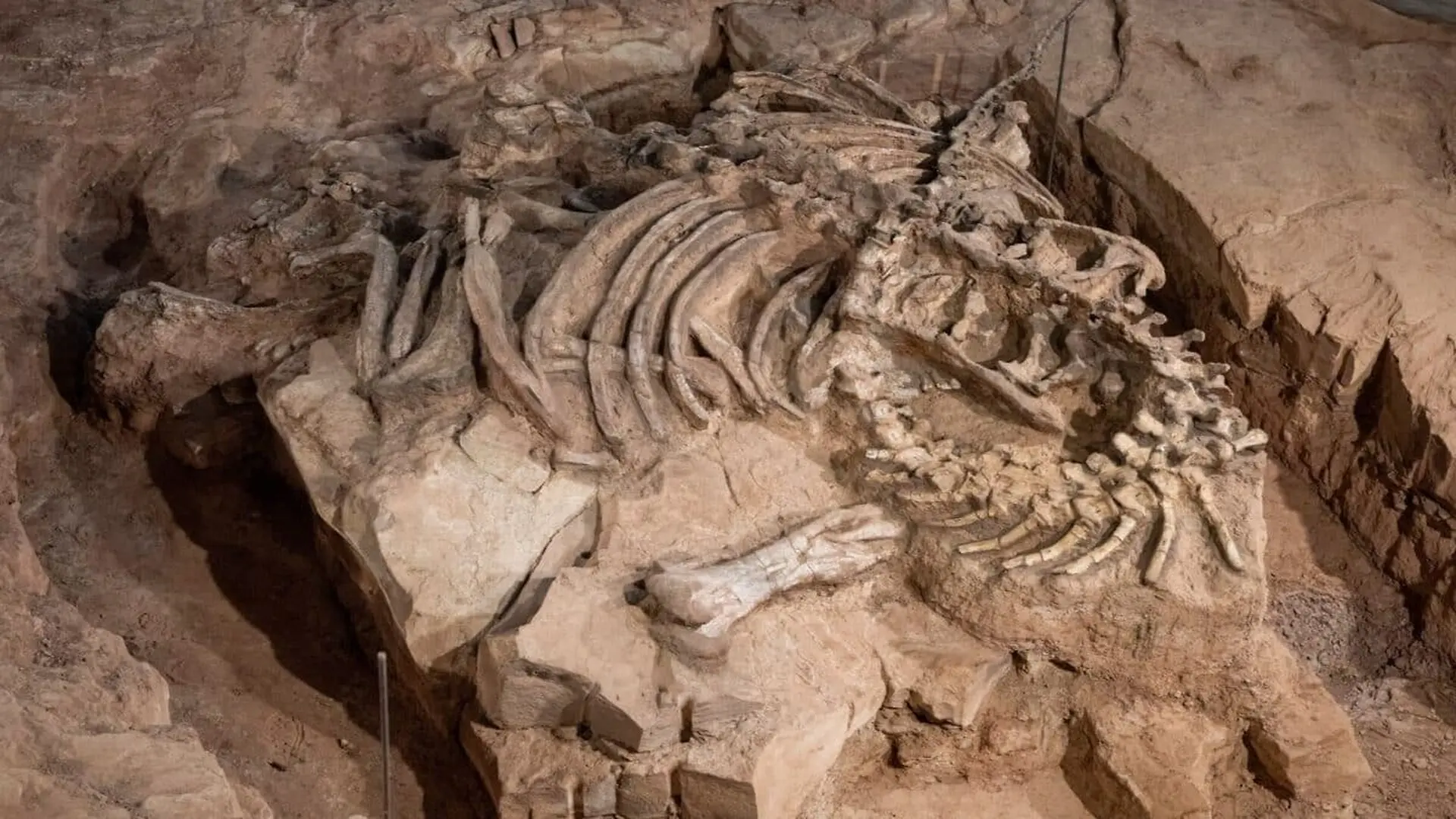
More than a century and a half after its initial discovery on England’s Jurassic Coast, the first fully articulated dinosaur skeleton ever uncovered has finally been examined in depth. The new analysis sheds light on previously unknown aspects of Scelidosaurus and refines its position within the early dinosaur lineage.
Scelidosaurus holds a unique place in paleontological lore. Extracted from strata dating to roughly 193 million years ago, the specimen was collected during the formative years of dinosaur research and quickly attracted attention for its exceptional preservation.
The fossil eventually came under the care of Richard Owen, the naturalist who introduced the term “dinosaur.” Despite the specimen’s significance, Owen never produced a comprehensive monograph; his contribution consisted of only two brief papers, leaving many anatomical details unresolved and allowing the specimen to fade into relative obscurity for more than a century.
Three Decades of Study Finally Yield a Complete Portrait
A breakthrough arrived thanks to Dr David Norman of the University of Cambridge. Over a three‑year period he reassessed every known fragment attributed to Scelidosaurus, including the original material housed at London’s Natural History Museum.
Norman’s results appeared across four papers in the Zoological Journal of the Linnean Society, offering the most detailed reconstruction to date of a dinosaur that lived at the dawn of the Jurassic.
Reflecting on the project, Norman remarked, “When you consider the historical context, the amount of information we actually possessed about Scelidosaurus was astonishingly scant.”
It is an ironic twist that the first completely articulated dinosaur skeleton ever found remained one of the least thoroughly investigated major fossils.
“This discovery carries great weight,” said Dr Mike Simms, curator of Natural Sciences at National Museums Northern Ireland. “Ireland’s geology is largely unsuitable for dinosaur preservation, making such finds exceptionally rare.”
New Anatomical Insights Rewrite the Dinosaur’s Profile
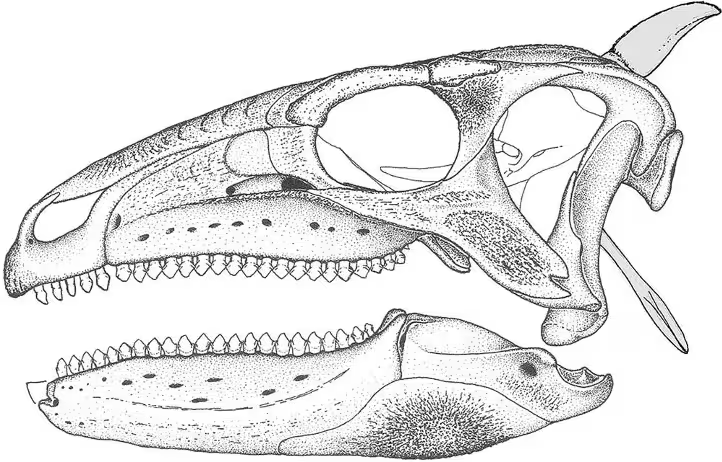
The reassessment unveiled several previously unnoticed skeletal traits. Most striking is the identification of horn‑like projections along the posterior margin of the skull. Norman also highlighted a suite of bones that had not been recognized in any other dinosaur taxa.
“Nobody realized the skull bore horns on its rear edge,” Norman explained. “It also possessed a collection of bones that are unique among dinosaurs.”
Examination of the skull surface suggests it was overlaid by a tough, keratinous armor comparable to the scutes seen on modern turtles. The remainder of the body appears to have been similarly fortified.
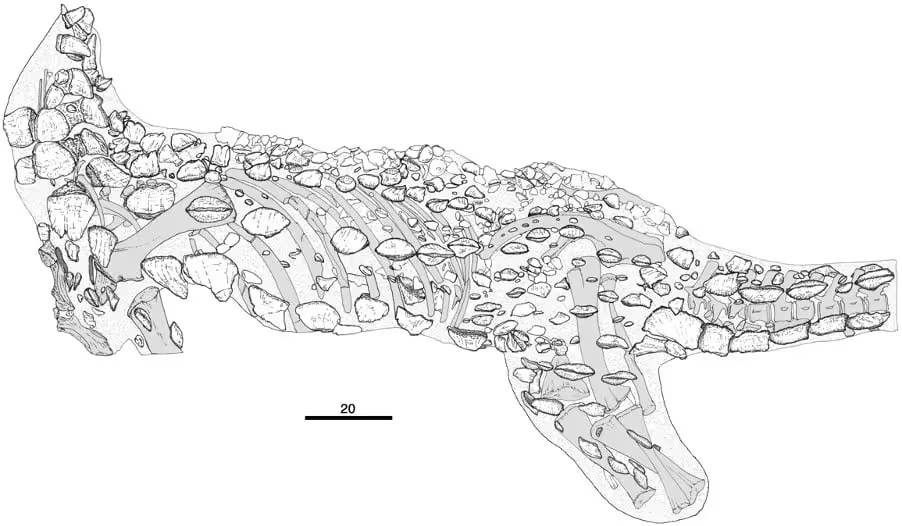
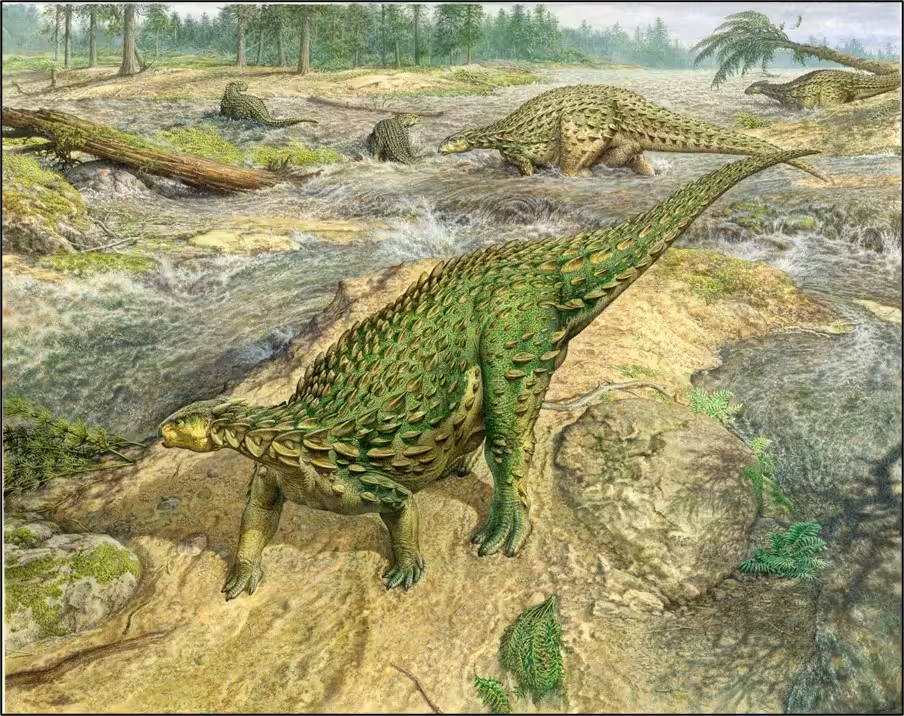
The team documented a complex armor system composed of numerous bony plates and spine‑like projections, confirming that the animal’s integument was heavily armored. Nearly 200 million years after it roamed the Earth, researchers now possess the clearest view yet of Scelidosaurus.
Repositioning an Early Ornithischian Within the Dinosaur Tree
The findings, also featured in the Proceedings of the Geologists’ Association, address a long‑standing debate over the dinosaur’s phylogenetic placement. Historically, scientists classified Scelidosaurus as a basal relative of both stegosaurs and ankylosaurs, a view driven by incomplete anatomical data.
Norman’s comprehensive analysis suggests instead that Scelidosaurus occupies a position as an early offshoot leading to ankylosaurs, the heavily armored clade that flourished later in the Cretaceous. Its age places it at, or very near, the evolutionary emergence of Ornithischia, one of the two primary dinosaur divisions.
“It is regrettable that such a pivotal specimen, uncovered at a formative moment in dinosaur science, was not fully described earlier,” Norman noted. “Now, finally, it offers a wealth of unexpected information about early dinosaur biology and their evolutionary relationships. As the saying goes, better late than never.”
This article has been fact checked for accuracy, with information verified against reputable sources. Learn more about us and our editorial process.
Last reviewed on .
Article history
- Latest version
Reference(s)
- “David Norman | Department of Earth Sciences.” <https://www.esc.cam.ac.uk/people/david-norman>.
- <https://www.researchgate.net/profile/Michael-Simms-2>.
- Simms, Michael J.., et al. “First dinosaur remains from Ireland.” Proceedings of the Geologists' Association, vol. 132, no. 6, December 1, 2021, pp. 771-779. Elsevier BV, doi: 10.1016/j.pgeola.2020.06.005. <https://www.sciencedirect.com/science/article/abs/pii/S0016787820300638>.
Cite this page:
- Posted by Hassan Raza