Why Falling Cats Almost Always Land on Their Feet, Scientists Finally Explain
A new study reveals the hidden mechanics behind cats’ famous midair twist. By analyzing feline spines and filming real falls, scientists discovered that different sections of a cat’s back play distinct roles in the remarkable “air-righting” maneuver.
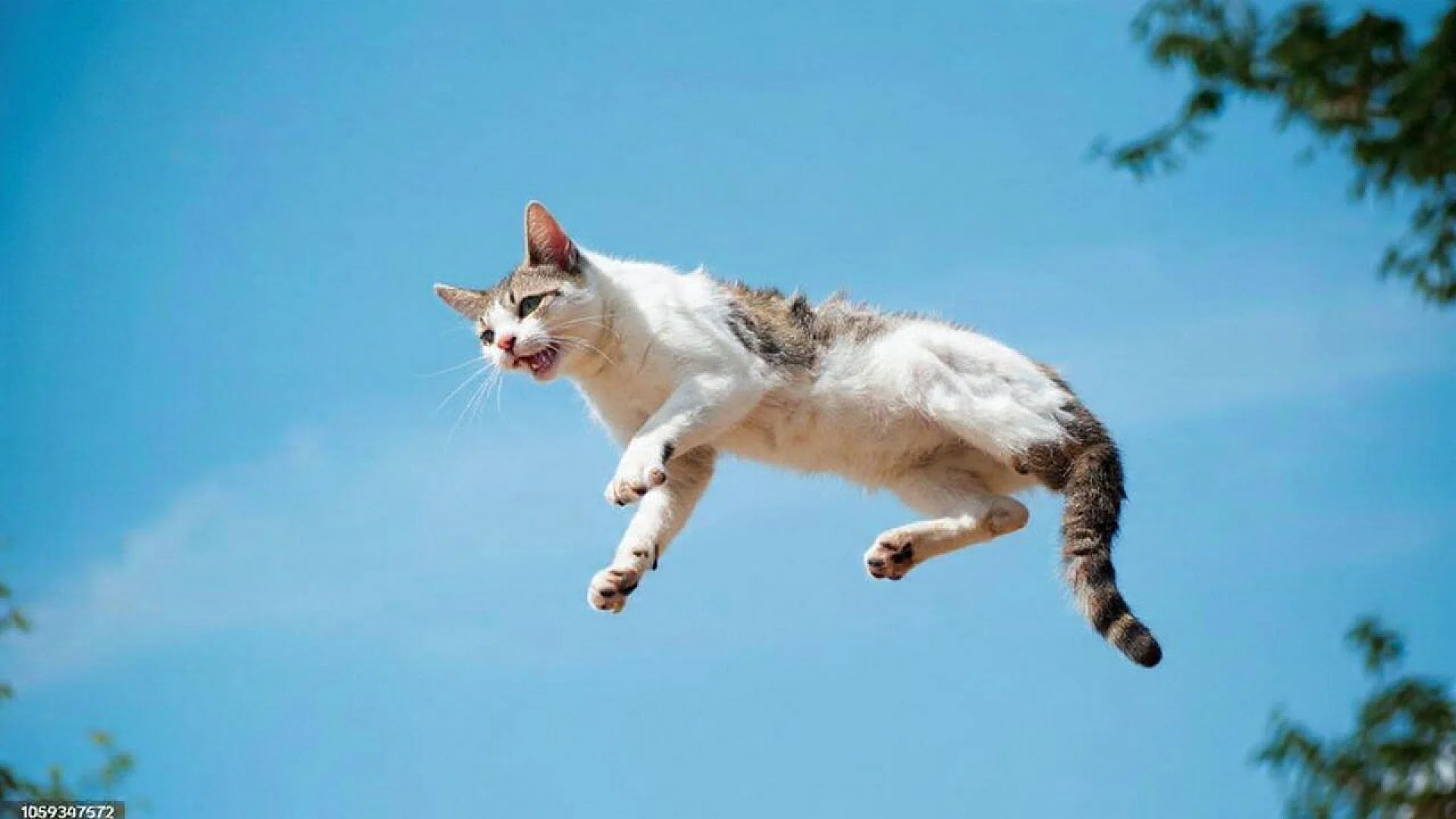
Anyone who has watched a cat slip from a ledge has likely witnessed the same astonishing moment. Within a fraction of a second, the animal twists its body and lands neatly on its feet.
This graceful recovery happens so quickly that it almost feels like magic. Yet behind the seemingly effortless movement lies a highly coordinated mechanical process that scientists have tried to understand for more than a century.
A team of researchers from Yamaguchi University in Japan now believes it has identified a key piece of the puzzle. Their work shows that the feline spine is not simply flexible. Instead, different sections of the spine have specialized mechanical roles that allow the animal to rotate its body in midair with extraordinary control.
The study sheds new light on a phenomenon known as the “air-righting reflex,” one of the most recognizable behaviors in the animal kingdom.
A Long-Standing Scientific Puzzle
At first glance, the ability of cats to land on their feet appears to contradict basic physics.
In free fall, an object cannot easily change its orientation unless it pushes against something. For animals suspended in the air, there is nothing obvious to push against. Yet cats routinely manage to rotate their bodies while falling.
Scientists have long known that cats accomplish this through a sequence of twists along the spine. By moving different parts of the body in opposite directions, they can change orientation without violating the laws of physics.
Still, exactly how the spine enables this precise maneuver has remained unclear.
The new research focuses on an overlooked detail of feline anatomy. Rather than acting as a single flexible column, the spine behaves more like a coordinated system of segments with different mechanical properties.
Understanding those differences turned out to be crucial.
Looking Inside the Feline Spine
To investigate how the air-righting reflex works, the researchers first examined the structure of the feline spine itself.
They studied the spines of five cat cadavers, separating two major regions of the back. The thoracic spine occupies the upper and middle portion of the back, while the lumbar spine forms the lower section closer to the hips.
The scientists then subjected these spinal sections to controlled twisting forces. This allowed them to measure several mechanical properties, including flexibility, resistance to rotation, and structural strength.
The tests revealed a striking contrast.
The thoracic spine turned out to be remarkably flexible. It contains what researchers call a “neutral zone,” a range of movement where the spine can twist with very little resistance.
In cats, that neutral zone allows almost 50 degrees of rotation before significant resistance appears.
The lumbar spine behaved very differently.
Rather than twisting freely, it remained relatively stiff and resistant to rotation. This stiffness helps stabilize the rear portion of the animal’s body.
Together, these two regions create a built-in mechanical strategy for rotating in midair.
Capturing Cats in Midair
To see how these spinal differences translate into real movement, the research team conducted another experiment.
They filmed two healthy cats using high speed cameras while the animals were gently dropped onto a soft cushion. Reflective markers were placed on the cats’ shoulders and hips so that their movements could be tracked with precision.
The recordings revealed a carefully timed sequence.
As soon as the fall begins, the cat turns its head and front legs toward the ground. Because the thoracic spine is extremely flexible, the front half of the body can rotate quickly.
The rear half does not follow immediately.
Instead, the lumbar spine keeps the hips relatively stable at first. This allows the front half of the body to swing around without causing the entire animal to spin uncontrollably.
Once the front section is oriented downward, the rear half of the body begins its own rotation.
Within a fraction of a second, both halves of the body align, and the cat prepares to absorb the landing with its legs.
A Sequential Rotation Strategy
The researchers describe the process as a sequential rotation.
The front portion of the body rotates first, followed by the rear portion. This sequence depends heavily on the contrast between the flexible thoracic region and the rigid lumbar region of the spine.
The authors summarized the behavior in their analysis, explaining that trunk rotation during the air-righting maneuver occurs in stages, beginning with the front section and continuing with the back section.
The thoracic spine provides the flexibility needed for rapid twisting, while the lumbar spine functions as a stable anchor.
Together, these features create a highly effective system for controlling body orientation during a fall.
Evolution’s Engineering
From an evolutionary perspective, the feline spine appears to be finely tuned for agility.
Cats rely heavily on quick reflexes and precise body control in many aspects of their lives. Whether chasing prey, climbing trees, or leaping between surfaces, they must constantly adjust their posture and balance.
The air-righting reflex may represent one extreme example of that broader ability.
The division between flexible and rigid spinal regions allows cats to manipulate different parts of their bodies independently. This kind of mechanical specialization is common in animals that depend on rapid movement and balance.
It also highlights how anatomy and physics interact in living organisms.
Rather than breaking physical laws, cats exploit them by redistributing their body mass and rotation along different segments of the spine.
Why This Discovery Matters
Understanding the mechanics of feline movement has implications that extend far beyond curious pet behavior.
The researchers suggest that their findings could improve mathematical models used to simulate animal motion. Accurate models are important for fields ranging from biomechanics to animation and robotics.
Robotics engineers, for example, often look to animal movement for inspiration when designing agile machines.
A robot capable of adjusting its orientation in midair could be useful in environments where stability is difficult to maintain, such as search-and-rescue missions or planetary exploration.
The study also has potential value in veterinary medicine.
A better understanding of how different spinal regions function during movement could help veterinarians diagnose and treat spinal injuries in animals.
The Air-Righting Reflex in Context
Although cats are famous for landing on their feet, the ability has limits.
The air-righting reflex requires a small amount of time and space to operate. If a fall occurs from a very short height, the cat may not have enough time to complete the rotation.
Conversely, extremely high falls can pose other risks, even if the animal successfully rights itself.
Still, the reflex remains one of the most reliable protective behaviors observed in mammals.
Research on feline falls has even led to surprising observations in urban environments. Studies have reported that cats falling from moderate heights often suffer fewer injuries than those falling from intermediate heights, possibly because they have more time to fully deploy their righting reflex and relax their bodies before impact.
The new research adds another layer of understanding to this complex behavior.
What Scientists Still Want to Learn
While the new findings explain how different spinal regions contribute to midair rotation, several questions remain.
For instance, researchers still want to understand how muscles coordinate with the spine during the maneuver. The bones and joints provide the mechanical framework, but muscles control the timing and force of each movement.
Another open question involves how kittens develop the reflex.
Young cats gradually learn to coordinate their movements as their nervous systems mature. Studying that developmental process could reveal more about how the brain controls complex motor behavior.
Future studies may also explore how other animals perform similar aerial adjustments.
Many species, including squirrels and some reptiles, demonstrate remarkable control during falls or leaps. Comparing these behaviors may reveal common mechanical principles across the animal kingdom.
A Small Mystery Finally Explained
The image of a cat twisting midair has long been part of everyday life. It appears in cartoons, viral videos, and countless household observations.
Yet behind that familiar sight lies a sophisticated biological design.
By showing how different regions of the feline spine work together during the air-righting reflex, the new study provides one of the clearest explanations yet for this remarkable behavior.
The discovery highlights a simple but powerful idea. Sometimes the secrets of nature are hidden not in exotic features, but in the subtle coordination of familiar ones.
In the case of falling cats, the answer was written along the length of the spine all along.
Why This Matters
Understanding how animals control their bodies in motion helps scientists uncover broader principles of biomechanics.
Insights from feline movement may influence robotic design, improve veterinary care, and refine scientific models of locomotion.
Even everyday phenomena can reveal sophisticated engineering when studied closely.
The research was published in The Anatomical Record on February 24, 2026.
This content has been reviewed by subject-matter experts to ensure scientific accuracy. Learn more about us and our editorial process.
Last reviewed on .
Article history
- Latest version
Reference(s)
- Higurashi, Yasuo., et al. “Torsional flexibility of the thoracic spine is superior to that of the lumbar spine in cats: Implications for the falling cat problem.” The Anatomical Record, 24 February 2026, doi: 10.1002/ar.70165. <https://dx.doi.org/10.1002/ar.70165>.
Cite this page:
- Posted by Hassan Raza